
Pennsylvania Attorney General Dave Sunday sues TikTok over youth addictiveness and exposure to mature content
Pennsylvania joins more than a dozen other states suing the social media company.
Listen 1:12
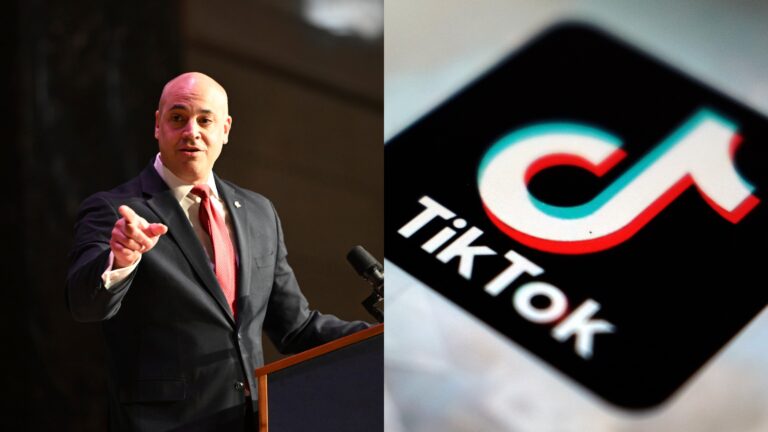
FILE - Dave Sunday gestures while speaking to an audience after taking the oath of office to become Pennsylvania's attorney general, Jan. 21, 2025, in Harrisburg, Pa.; a view of the TikTok app logo, Sept. 28, 2020. (AP Photo/Marc Levy/Kiichiro Sato)
From Philly and the Pa. suburbs to South Jersey and Delaware, what would you like WHYY News to cover? Let us know!
Pennsylvania Attorney General Dave Sunday is suing TikTok, accusing the social media company of misleading parents about the prevalence of mature content on the platform while deliberately designing the mobile app to keep children and teenagers scrolling.
Sunday said the suit “seeks to put into place effective barriers and safeguards.”
“It’s an action rooted very simply in protecting children, as are our previous actions demanding accountability from big tech companies and AI producers,” Sunday said at a press conference Tuesday.
The 65-page complaint, filed in Allegheny County Common Pleas Court, alleges TikTok violated Pennsylvania’s consumer protection law by presenting its app as appropriate for users as young as 13, and failing to disclose the risks posed by features that encourage compulsive use.
Pennsylvania’s lawsuit joins a broader wave of legal challenges against social media companies over their treatment of young users. A bipartisan group of 14 attorneys general sued TikTok in 2024, raising similar allegations about endless scrolling, push notifications and the effect of the platform on youth mental health.
Related Content
New Jersey lawmakers move bills to address online safety for children
Legislation is being fast-tracked to better protect children’s online privacy and force black box social media warnings to be posted on platforms.
7 months ago
Listen 1:03Mature content
A central claim in the lawsuit concerns how TikTok describes its content in app stores. TikTok previously carried a 12+ user rating in Apple’s App Store and now has a 13+ rating under Apple’s revised system. According to the complaint, the company characterizes sexual content, nudity, profanity, suggestive themes and references to drugs and alcohol as “infrequent” or “mild.”
The attorney general’s office alleges those descriptions are false and that such material appears frequently on the app — including in videos recommended by TikTok’s algorithm to accounts belonging to 13-year-old users.
At the press conference, Sunday said TikTok “deliberately misrepresents their platform to achieve an age rating of 13+.”
Apple privately urged TikTok in 2022 to revise its App Store age rating after concluding the platform contained “frequent or intense mature or suggestive content,” according to internal communications described by The Washington Post.
Sunday said the lower rating expands the potential audience for the platform, allowing TikTok to show advertisements to more users.
“The more users that are on their app, the more eyeballs for advertising, which is their main revenue stream,” he said. “So having an age 13+ rating is very important for their bottom line.”
The state argues that TikTok should have received a 17+ rating under Apple’s previous system, or a 16+ or 18+ rating under the current one. Those higher ratings would allow parental controls on some devices to prevent children from downloading the app.
Sunday said the ratings are important because parents rely on them to decide what their children can access.
The lawsuit also alleges TikTok has made misleading claims about the effectiveness of tools such as Restricted Mode and Family Pairing, which are intended to give parents more control over what young users see and how long they spend on the platform.
“The age restrictions that TikTok purports to maintain are essentially worthless,” Sunday said. “Safety features such as restricted mode and family pairing often fail and are easily circumvented.”
Related Content

Inside the legislative effort to expel cellphones from Pennsylvania’s K-12 schools
A bill that would ban cellphone use from "bell to bell" was advanced out of committee Tuesday to a full vote before the state Senate.
10 months ago
Listen 5:57‘Addictive-by-design’ features
The second part of the complaint targets TikTok’s underlying design, including its personalized “For You” feed, endless scrolling, push notifications and other features intended to keep users engaged.
Sunday said teenagers described the effects of those features during a series of “teenTALK” events his office held last school year. Students told him they knew spending hours on the app was unhealthy but felt unable to stop.
Many also introduced him to the term “bedrot,” Sunday said, a term that means spending hours in bed scrolling through a phone after waking up or before going to sleep.
“They lose hours at a stretch in the morning when they wake up or in the evening, just scrolling on their phones for hours,” Sunday said. “TikTok’s infinite scroll feature promotes that. And if you haven’t been on the app in a while, they will send you a very enticing push notification to try and lure you back.”
The state alleges TikTok’s features are “addictive-by-design,” using information about individual users to continually refine the videos placed in front of them, removing natural stopping points and encouraging children to remain on the app longer.
More than two-thirds of American teenagers use TikTok, and about 1 in 5 say they use it “almost constantly,” according to Pew Research Center data. Internal documents obtained by the Kentucky attorney general as part of that state’s lawsuit suggest the company knew their safety measures were mostly ineffective in reducing youth consumption of the content, including adult content.
In an email to WHYY News, a TikTok spokesperson said the lawsuit is misleading and ignores safety measures the platform has in place.
“Teen accounts have 50 preset safety, privacy and security settings built-in, and TikTok’s Family Pairing tools give parents direct control over screen time and content filters,” the spokesperson said. “We will vigorously defend against these claims.”
The lawsuit contends that the “Family Pairing” feature is “deficient” and “ineffective.”
Related Content
The Big Fix: getting kids off screens
Can we make technology safer and healthier for kids and teens? Do social media and phone bans actually work? And who should be responsible for setting the boundaries?
Air Date: May 27, 2026 12:00 pm
Listen 51:27State seeks changes
The AG’s office is asking the court to declare TikTok’s practices unlawful, order the company to change them and impose civil penalties. The complaint also seeks restitution and legal costs.
Sunday emphasized that forcing changes to the platform is the state’s primary objective.
“Our goal as we are driving this lawsuit is to argue for and advocate for and demand injunctive relief,” Sunday said. “What we are seeking is not to grab as much money as humanly possible; it’s to ensure there’s an environment that’s as safe as humanly possible for children.”
Sunday said Pennsylvania has communicated with TikTok and expects to collaborate with other state attorneys general as the litigation proceeds. Sunday is co-chair of the National Association of Attorneys General’s bipartisan Consumer Protection Committee.

Get daily updates from WHYY News!
WHYY is your source for fact-based, in-depth journalism and information. As a nonprofit organization, we rely on financial support from readers like you. Please give today.

Pa. attorney general sues Snapchat for its addictiveness and disappearing messages
The lawsuit alleges Snapchat misleads parents about mature content and uses addictive features that encourage compulsive use among children.
1 month ago
Listen 1:07
Montgomery County sues social media companies over youth mental health harm
Research shows using social media for three or more hours a day doubles the risk of certain mental health problems for teens.
2 months ago

A report detailing the “troubling connections” between the music behemoth and concert venues was released the same day the trial resumed. Here's what to know.
6 months ago