
70% of Pa. students are taking at least 1 arts course, but there are disparities in smaller, poorer districts
While state law mandates districts to make arts classes available, public education funding disparities have meant that some schools are still catching up.
Listen 1:12
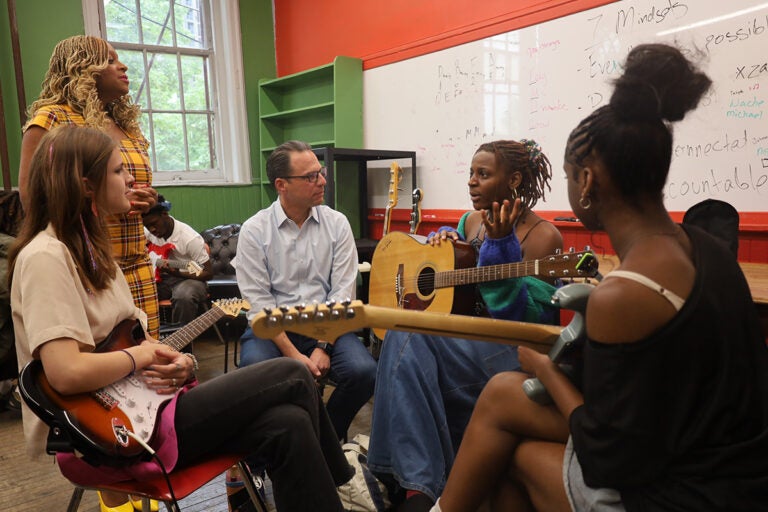
Gov. Josh Shapiro talks to Zarahamla Nielsen, a high school student and participant at the Beyond the Bars music program in West Philly as Layla Days, Shilynn Black and City Councilmember Jamie Gauthier listen. (Carmen Russell-Sluchansky/WHYY)
From Philly and the Pa. suburbs to South Jersey and Delaware, what would you like WHYY News to cover? Let us know!
More than seven in 10 public school students in Pennsylvania are enrolled in at least one arts course, according to state data compiled by the Arts Education Data Project that offers one of the clearest pictures yet of how dance, music, theater and visual art are taught across the commonwealth.
The commonwealth’s K-12 education system serves more than 1.7 million students. According to the data project, more than 1 million participate in visual arts with nearly 1 million more taking music classes. Fewer take theater and dance classes, which are also coded as arts education.
In Philadelphia, more than 80% of public school students are enrolled in at least one creative arts class, which Bob Morrison, founder of the Arts Education Data Project, said puts the district in a respectable position.
“If you’re looking at a state’s overall participation rate K-12, if that state’s participation rate is in the mid-70s, you’re on solid ground,” he said. “If you’re 80 and above, you’re doing really well.”
Any given district is unlikely to boast a 100% participation rate because students in higher levels have some choice in their course selections.
“At the elementary level, it’s not unusual to see close to 100% participation because those courses are compulsory,” Morrison said. “Once students reach high school, participation becomes a function of choice, access and opportunity.”
Disparities in smaller and lower-wealth districts
While large urban districts such as Philadelphia show relatively high overall arts participation, the dashboard reveals lower participation rates in many smaller and lower-wealth districts — even when arts courses are technically offered. For example, less than 7.5% of the roughly 2,000 students at Somerset Area School District in Somerset County, Pennsylvania, are enrolled in arts courses. Only around 11% of the roughly 1,200 students in the Shamokin Area School District, a small, rural public school district located in Coal Township, participate.
State law mandates “active learning experiences in art, music, dance and theatre” for “every student every year in the primary program,” which includes elementary and middle schools, but school budgets vary wildly across the commonwealth, the result of a property tax-based funding system the Pennsylvania Supreme Court found unconstitutional in a 2023 ruling.
As a result, some rural schools have faced disadvantages. WHYY News asked the superintendents of the Somerset and Shamokin school districts if their low participation rates are the result of funding issues, but neither has yet responded.
Related Content
‘A safe and healthy outlet’: 9-year-old helps students through art classes
A Philly elementary schooler makes a space for her peers to express their feelings through art and writing.
2 months ago
The gaps often reflect how districts allocate limited resources, said Benjamin Hoffman, a visual arts teacher in the Kutztown Area School District and former president of the Pennsylvania Art Education Association.
“Very few standards dictate … how the funding is distributed amongst departments K-12,” he said. “When the budgets are typed, the arts and humanities do face a little bit more disparity than some other disciplines.”
In districts under pressure to raise standardized test scores, arts programs can be especially vulnerable, said CJ Matz, an art educator in the Catasauqua School District and current president of the association.
“If a district isn’t performing as well as it wants on tested subjects like math or English language arts, money is often funneled away from the arts,” Matz said. “That directly affects what students have access to.”
‘A skill they need no matter what’
Even then, arts educators say participation numbers alone do not capture the reality of an area of study that is currently evolving. For example, many students across the state take more technical courses that are not necessarily coded as arts education.
Pennsylvania is currently revising its arts and humanities standards, a process that involves Hoffman and Matz. The update aims to reflect contemporary practices, including media arts, design and technology-driven creative fields.
Hoffman said that art and technology go “hand in hand.”
“You pick up your smartphone, you take for granted that someone designed the shape of the app and how that app navigates,” he said. “There’s an inherent user experience in everything that we do, such as color choices. A lot of psychology went into that. We’re already teaching these skills. The standards are catching up to what’s happening in classrooms.”
Matz said the revised standards may also help districts better understand the role arts education plays beyond traditional studio classes.
“The arts teach students that there are multiple solutions to a problem,” he said. “In our contemporary society, that’s something that every student needs to know how to do.”
Matz, quoting academic studies, added that arts education encourages social and emotional development, helping students become well-rounded individuals.
“When we think about career readiness and we think about post-secondary education, kids who do better in the arts have a better understanding and grasp of the world around them,” he said.

Never miss a moment with the WHYY Listen App!


WHYY is your source for fact-based, in-depth journalism and information. As a nonprofit organization, we rely on financial support from readers like you. Please give today.
Part of the series
Creativity Sparks Success
WHYY News explores the impact that creativity and arts programming has on the development on school-aged children.
Nearly 1 million New Jersey students take arts classes by law. Advocates say sustaining those gains amid budget pressures is the next fight.
4 weeks ago
Listen 1:11
How nature is fostering kids’ creativity in Philadelphia
Studies suggest nature can help lower stress and boost attention. Researchers and educators say it can also help kids express creativity.
2 months ago
Listen 4:42
At this South Jersey farm, a classroom rooted in the garden helps students grow skills for life
A culinary program uses adaptive tools and small classes to help students with a range of abilities and needs build confidence, connection and independence.
2 months ago
Listen 0:42