

A Philly lawmaker’s bill would rein in utility profits: ‘The entire system is out of whack’
The bill’s supporters say it would align investor-owned utility profits with typical Wall Street earnings. Utilities say it would threaten infrastructure investment.
Listen 1:04
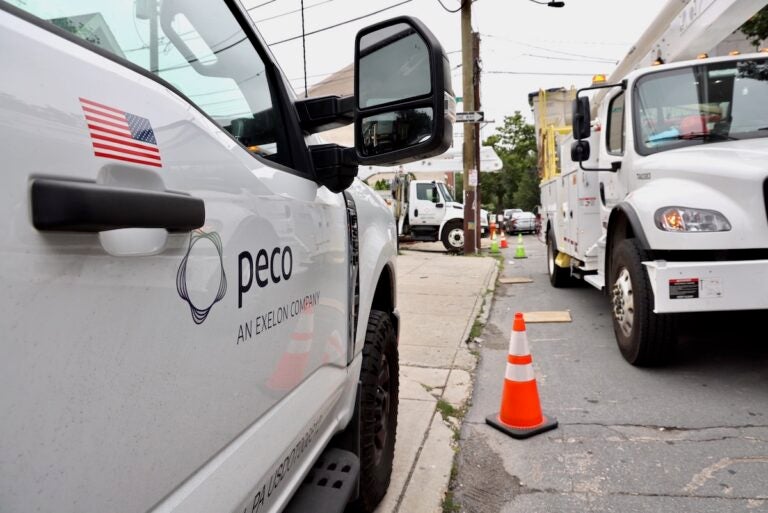
An electrical repair crew work on West Thompson Street in Fishtown. (Emma Lee/WHYY)
This story is part of the WHYY News Climate Desk, bringing you news and solutions for our changing region.
From the Poconos to the Jersey Shore to the mouth of the Delaware Bay, what do you want to know about climate change? What would you like us to cover? Get in touch.
A new bill aimed at limiting utility profits by transforming the state’s current rate-making procedures will be introduced this week as lawmakers struggle to rein in rising rates.
“Currently, the entire system is out of whack,” said state Rep. Elizabeth Fiedler, D-Philadelphia.
“We should not be having energy consumers, neighbors, ratepayers, regular people subsidize some of these excessive profits.”
Fiedler, who chairs the House Energy Committee, is introducing House Bill 2224, along with state Rep. Danilo Burgos, D-Philadelphia. The legislation would amend the state’s Public Utility Code by establishing a cap on investor-owned utilities’ return on equity. In the past seven years, utilities’ returns have reached double digit figures of 10% to 15%, according to the Pennsylvania Public Utility Commission.
The proposal would peg any authorized return on equity to the government bond market, capping it to the current 10-year Treasury yield plus 2% for investor-owned utilities, including water, sewer, gas and electric providers.
The additional 2% is meant to recognize the risk for investing in a utility, which are typically considered low risk given they operate as monopolies that provide vital services for all residents and businesses within the providers’ geographic area.
Although the Treasury rate fluctuates, if the formula were in place today, it would result in returns on equity of between 6.5% to 7%.
“This legislation limits excessive profits for utility corporations, not all profits, but excessive profits,” Fiedler said.
Should the utilities determine that the formula results in a return on equity too low to attract investors, the legislation outlines a process where the companies would then be able to seek capital through a transparent auction, thereby allowing the free market to determine the rate of return necessary to secure investment.
“I think it’s really important to emphasize that this legislation would create a default formula-based return on equity for investor-owned utilities that reflects the true market-based cost of equity,” Fiedler said.
Why some say it’s a ‘broken’ system
Investor-owned utilities that provide water, sewer, gas and electricity services make their profits on infrastructure upgrades, not the supply of gas and electricity. So the more they build, the more profit they can make. Because utilities enjoy a monopoly for practical reasons, a system is in place to help mimic competition to prevent price gouging. That system in Pennsylvania is laid out by the Public Utility Code and overseen by the state Public Utility Commission.
But public advocates, and Pennsylvania Gov. Josh Shapiro, have said this system established back in the late 1930s is broken. In April, Shapiro sent a letter to 24 electric, gas and water utilities, telling the companies’ CEOs that “the 20th century utility model is broken – we can no longer simply prioritize corporate profitability to drive infrastructure development.”
The bill seeks to codify one proposal outlined in Shapiro’s letter, ending so-called “black-box” settlements, which prevent the public from knowing the agreed upon return on equity or how it was determined.
Related Content
Some customers in the Philly area pay as much as 20% of their monthly electric bill to company profits, according to a report. An industry group calls the report misleading.
6 months ago
Listen 1:40Utility infrastructure, including poles, wires and pipes, is financed through a combination of debt and equity, or funds contributed by their shareholders. The shareholders expect a return on that investment and the companies have a duty to provide it. But Fiedler, along with consumer advocates, say those returns have become too high and are the source of a growing affordability crisis for the average customer.
For example, PECO made record profits in 2025 after a rate increase that led to a second quarter rate of return of 10.59% for electricity and 10.19% for gas, according to a report issued by the Public Utility Commission. PECO’s third quarter 2025 return on equity was 13.1%. When the utility filed a rate case in March seeking a 12.5% rate hike for electricity and an 11.4% rise for gas, the requested return on equity was 10.95%. The request prompted a backlash, and the company withdrew it after pressure from Shapiro.
“Regular people may have a little bit of money in a savings account or in some sort of an account through their employer, but they certainly are not earning this sort of rate of return on those accounts that they are counting on for their retirement,” Fiedler said.
Defending the status quo as a ‘rigorous process’
Across the U.S., electric and gas utilities requested $31 billion in rate hikes in 2025, doubling the amount requested the year prior, according to a report by PowerLines. In Pennsylvania, the state is also seeing record-breaking requests, with 31 rate cases filed in 2024.
Spending by investor-owned utilities nationwide has grown 6% each year since 2014 in real terms, which is four times faster than in the previous two decades, according to a recent report by the Lawrence Berkeley National Laboratory.
But the proposal to cap profits is likely to get strong pushback from industry leaders who say it would limit the capital needed to provide safe and reliable services.
“Water systems are capital-intensive and depend on continuous long-term investment to replace aging infrastructure and meet increasingly stringent health and environmental requirements including recent mandates on PFAS, which will cost tens of billions of dollars to remediate,” Jenn Kocher, vice president of communications for the National Association of Water Companies, wrote in an email.
“The return available to investors is what allows regulated, private water utilities to attract the money needed to make the necessary improvements to protect safety and reliability,” Kocher said.
The utilities defend the current rate-making system as a fair way to balance the needs of utilities to build new infrastructure, make a profit and maintain affordability.
They say it has been operating for almost 100 years and does not need major reform.
“It’s a rigorous nine-month, fully public process,” said Andy Tubbs, president of the Energy Association of Pennsylvania, a trade group that represents electric and gas utilities in the state. “It’s not just the commission and the utilities that are part of the conversation.”
Rate-making cases have dozens of participants, including those who advocate specifically for consumers like the Office of Consumer Advocate and the Office of Small Business Advocate.
“And the commission staff that’s called the Bureau of Investigation Enforcement, they’re separate from the commissioners,” Tubbs said. “And then you also have other low-income advocates and industrial customers. So you have a breadth of stakeholders in those cases that look at how utility costs are being incurred, whether or not they’re prudent, and you get a full accounting of the utilities operations and whether or not any request for increase is justified.”
Tubbs said the process takes into account the current market conditions along with analysis of what other similarly situated utilities are earning.
Utilities have “a reasonable opportunity to earn a fair rate of return,” and utility rates must be “just and reasonable,” according to decades-old U.S. Supreme Court rulings.
“When the commission says that a utility has an opportunity to earn a rate of return on its investment, it’s not guaranteed,” Tubbs said. “It is set in that proceeding. It’s probably one of the most heavily litigated aspects of a rate case with experts … challenging one another.”
Tubbs said there are other ways to bring down utility bills, including reforming the regional grid operator PJM Interconnection’s capacity market and tackling supply costs that the utilities do not control. Tubbs, who once worked at the Public Utility Commission, said he disagrees with Shapiro, and praised the current rate-making process as free from political interference. He said that implementing a cap would mean that investors would flee to other states to invest in utilities and raise the price of capital for the providers in Pennsylvania, which would then increase costs for consumers in the state.
Related Content

Pa. data centers: How lawmakers are responding, from electricity and water use to tax breaks
Dozens of data centers are planned for the Philly region. Some lawmakers want to put up guardrails, while others want to speed their development.
5 months ago
Listen 1:02Advocates say utilities can ‘game the system’
Consumer advocates say the current system favors the utilities and is in need of radical reform, otherwise ratepayers will continue to face rising rates.
“The idea that somehow [the utilities would be] deprived of the ability to attract equity is just patently untrue,” said Patrick Cicero, an attorney at the Pennsylvania Utility Law Project, who served as Pennsylvania’s Public Advocate between 2021 and 2025 and supports the proposed legislation. “What [the utilities] are going to have is less profit.”
If the utilities reject the authorized return on equity based on the 10-year treasury yield plus 2%, then the bill establishes in detail how an auction for equity would work.
“If the auction is fair, then the return generated from the auction would be a fair rate of return that’s actually demanded by investors,” Cicero said.
Cicero said the fact that utilities have earned rates of return in excess of 10% in recent years is evidence the system is broken. He said the reason for the pushback is because the bill, if approved, would mean they would no longer be allowed to manipulate the rate-making process to their benefit.
“The problem is that utilities have all the incentive, all the time, and all the resources to ensure that their return on equity is as high as possible, using the Public Utility Commission process to establish that,” he said. “The general principle of return on equity is that it should be no higher than the actual cost of equity.”
Cicero said the most important aspect of the bill is that it defines cost of equity as “the minimum rate of return necessary to attract capital,” and that return on equity would be based on a formula rather than a complicated rate-making process, which he said the utilities use to game the system.
“If the utilities think that 6% or 6.5% or 7% is too low, fine, go out and prove it and have an equity auction,” Cicero said.

Get daily updates from WHYY News!
WHYY is your source for fact-based, in-depth journalism and information. As a nonprofit organization, we rely on financial support from readers like you. Please give today.
Part of the series

Delaware governor signs legislation that aims to make data centers ‘pay their fair share’
The legislation would prevent data centers from passing the costs of running data centers onto ratepayers.
1 week ago
Listen 1:03
New Jersey Gov. Sherrill signs data center legislation that aims to protect ratepayers
Sherrill signed a package of legislation this week that aims to prevent data centers and utility companies from passing costs onto ratepayers.
2 months ago
Pennsylvania lawmakers push federal bill to boost clean energy
The Energy Bills Relief Act would reinstate tax incentives and speed the development of new clean energy projects.
3 months ago
Listen 1:12