

Your PECO bill could increase by $20 each month starting in 2027
The utility wants to raise its rates for electricity customers and suburban natural gas users. The CEO of PECO's parent company, Exelon, made more than $15.6 million in 2025.
Listen 1:15
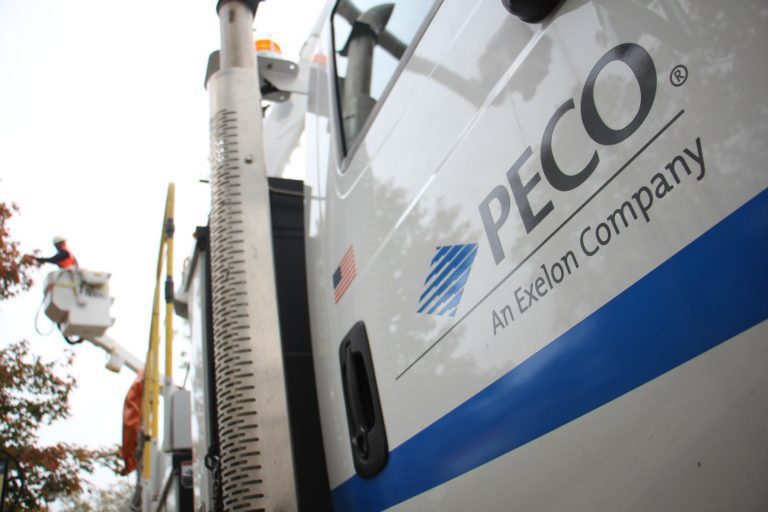
A PECO truck is seen in a file photo. (Emma Lee/WHYY)
This story is part of the WHYY News Climate Desk, bringing you news and solutions for our changing region.
From the Poconos to the Jersey Shore to the mouth of the Delaware Bay, what do you want to know about climate change? What would you like us to cover? Get in touch.
PECO electricity customers in Philadelphia and its suburbs are facing potential rate hikes of 12.5% beginning in 2027, while the company’s suburban natural gas customers could also pay an increase of 11.4%.
The company filed two requests to raise rates with the Pennsylvania Public Utility Commission on Monday. The current proposal would increase a typical electricity customer’s bill by $20.08 a month and a typical gas user by $14.52 a month, according to PECO.
“Affordability is top of mind for everybody … but so too is infrastructure broadly and whether or not it’s ready for the challenges of today,” said Doug Oliver, PECO senior vice president of government, regulatory and external affairs.
Oliver said given affordability issues, the company considered waiting another year before seeking a rate increase, but said the short-term gains for customers would not be worth it since the longer the wait, the higher the costs would be for needed infrastructure upgrades to ensure safety and reliability.
The company is seeking an additional $429 million to pay for electricity infrastructure investments and $81 million for natural gas upgrades. PECO serves 1.7 million electricity users in southeastern Pennsylvania along with more than 553,000 gas customers in suburban Philadelphia.
PECO said it plans to invest $10 billion in infrastructure over the next five years to shore up the electrical grid and replace existing leaky natural gas pipelines. The company said replacing the lines would reduce the release of the greenhouse gas methane, while upgrading electrical power infrastructure with state-of-the-art technology would ensure that the lights remain on during increasingly severe storms.
“We understand that any increase in costs is difficult for families and businesses, and
we don’t take this request lightly,” PECO president and CEO David Vahos said in a statement. “Our customers deserve a system they can count on – especially as severe weather grows more frequent. These investments will strengthen the grid, reduce outages, and ensure we’re delivering the safe, reliable service our customers expect every day.”
As part of the rate case, the company has proposed spreading out some increases over six years, a longer time period than is typical, which it said would reduce costs to ratepayers by $88 million in 2027.
“[This] demonstrates to our customers that we totally understand the challenges they are facing but we think we have struck the right balance that we are making the investments that we know are needed but also make sure there are sufficient protections in place for our customers,” Oliver said.
PECO’s previous rate hike, which kicked in at the beginning of 2025, resulted in record profits. Net income shot up 47.7% to $814 million in 2025 over the previous year, according to earning reports by its parent company Exelon.
Exelon President and CEO Calvin Butler earned more than $15.6 million in 2025.
Related Content
Philadelphia utility bills surged in 2025, and more increases are coming in 2026. Here’s why
Philadelphians’ electric, gas and water bills all increased in 2025. Together, the typical household is paying around $30 more per month.
9 months ago
Utilities like PECO make their profits off of infrastructure
Investor-owned utilities that provide gas and electricity make their profits on infrastructure upgrades, not the supply of gas and electricity, so the more they build, the more profit they can make. The supply costs, which are also rising, are determined by power generators and passed on to customers in their PECO bills.
Because utilities enjoy a monopoly when it comes to the distribution of gas and electricity, any increase in distribution rates must be approved by regulators, which in Pennsylvania is the Public Utility Commission.
These rate-making cases are legal procedures that involve abundant and complex financial documents. In order to attract investment in infrastructure, investors do need to earn a return, but critics say those returns have soared, while ordinary ratepayers struggle to pay their bills.
The key number that regulators and consumer advocates scrutinize is the return on equity, or ROE.
Oliver said PECO is seeking a return on equity in this rate case of 10.95%, which would have to be approved as part of the rate case before the commission. He said it will likely not be the resulting figure over time.
“In any year after rates are affected you will see a sharp decline in ROE, a sharp decrease in earnings,” Oliver said.
Much goes into determining the returns, including weather, which influences usage, he said.
Oliver said the reason PECO is seeking this rate hike is that by 2027, the company estimates its return on equity at 5.7%.
“The ROEs would dip to a level that’s unhealthy,” said Brendon Taylor, vice president of regulatory policy for PECO.
Pennsylvania’s Consumer Advocate Darryl Lawrence has said the ROE should be between about 8.5% and 9.5%.
But other critics say it should be lower.
“The academic literature and financial markets indicate that the return that they’re currently getting authorized by state regulators is well in excess of what is required in order to attract capital,” said Marissa Gillett, senior fellow at the American Economic Liberties Project.
Gillett served as chair of Connecticut’s Public Utilities Regulatory Authority between 2019 and 2025. She said the ROE should be 6% to 7%.
“Long-term asset projections from Wall Street say that 6% to 7% is more what the equity market demands,” Gillett said.
The increases resulting from the previous 2024 rate case began in January 2025 included a 10% increase for electricity ratepayers and a 12.5% increase as part of the same rate case for suburban natural gas customers.
Another PECO distribution rate increase occurred in January of this year, as the second phase of the utility’s 2024 commission-approved rate hike. As a result, the typical monthly residential bill rose an additional 2.8%, from $156.01 in December 2025 to $160.37 in January 2026.
PECO said the upgrades are also needed to expand access for electric vehicles, growing AI data centers, solar installations and battery storage.
The company listed a number of recent projects including $66 million for infrastructure in Upper Darby, $56 million for a new substation in the Overbrook section of Philadelphia, $52 million for Center City substations and new natural gas infrastructure in Marple Township, Delaware County.
PECO spokeswoman Candice Womer said in an email that, “following our 2024 rate case, 2025 marked one of the lowest power outage rates in company history, with 73% of PECO customers experiencing zero or one outage. These outcomes demonstrate why we believe the case for continued investment is strong.”
Disclosure: PECO is among WHYY’s financial supporters. WHYY News produces independent, fact-based news content for audiences in Greater Philadelphia, Delaware and South Jersey.

Get daily updates from WHYY News!
WHYY is your source for fact-based, in-depth journalism and information. As a nonprofit organization, we rely on financial support from readers like you. Please give today.
Part of the series

Hydropower parts manufacturer in Northeast Philadelphia lands federal research partnership
Kingsbury plans to test new materials for hydroelectric power equipment that can support the needs of modern-day grids.
18 hours ago
Pennsylvania Gov. Josh Shapiro calls PECO rate hike request ‘pure greed’
PECO seeks to raise rates again by 12.5% for Philly and suburban electric customers. The governor's office says Shapiro believes the rate case should be withdrawn immediately.
6 months ago
Listen 1:33
PECO’s profits skyrocket almost 50% after 2025 rate hikes
Critics say investor-owned utilities, which enjoy a monopoly, earn too much at the expense of ratepayers. PECO says the increased rates fund needed infrastructure upgrades.
7 months ago
Listen 1:15