

Inside the legislative effort to expel cellphones from Pennsylvania’s K-12 schools
A bill that would ban cellphone use from "bell to bell" was advanced out of committee Tuesday to a full vote before the state Senate.
Listen 5:57

Central Bucks West High School, which implemented a cellphone ban during instructional time during the 2025-2026 academic year. (Kimberly Paynter/WHYY)
From Delco to Chesco and Montco to Bucks, what about life in Philly’s suburbs do you want WHYY News to cover? Let us know!
A bill aiming to impose a ban on cellphones in Pennsylvania’s K-12 schools is gaining momentum in Harrisburg as educators struggle to compete with mobile devices for their students’ attention.
The state Senate Education Committee unanimously voted Dec. 9 to advance the legislation to the chamber floor for consideration.
If enacted, Senate Bill 1014 would amend the Public School Code of 1949 to enact a statewide “bell-to-bell phone-free policy,” meaning students’ devices would be unavailable to them throughout the entire school day, including lunch and recess. There would be exceptions for certain students with specific needs.
The policy would then go into effect during the 2027-2028 academic year. Implementation of the proposed ban — including how schools would store the phones, for example — would be up to individual districts.
The bill still must survive a full Senate vote and similar scrutiny in the state House before it could possibly reach Gov. Josh Shapiro’s desk. But the bipartisan bloc of Pennsylvania legislators behind the bill are cautiously optimistic it could become law.
A spokesperson for the governor declined to say in an email Wednesday whether he would support or oppose the legislation.
“The Shapiro Administration is still reviewing this legislation and will follow it through the legislative process,” the spokesperson wrote.
Interest in muzzling student cellphone usage comes as research emerges about its potentially harmful effects on learning and social development. Social media, in particular, has drawn much of the growing ire in the United States — and abroad. Australia recently enacted the world’s first social media ban for children under the age of 16.
Related Content
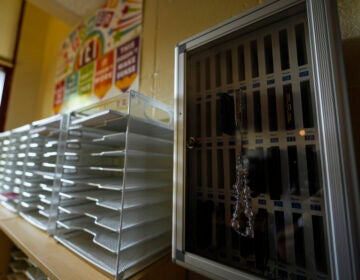
New Jersey students could soon face a ‘bell-to-bell’ cellphone ban in schools
A commission tasked with studying social media's effect on adolescents wants sweeping cellphone limits, citing links to anxiety, depression and shorter attention spans.
6 months ago
Listen 1:04Why now?
From the dawn of the affordable flip phone to the age of the smart phone, students have brought their mobile devices to class to text a friend or scroll on social media. As long as teachers have had a knack for spotting the glow of a screen below desk level, schools have mostly managed to keep phone usage in check.
What changed?
“The obviousness of it has become more glaring,” state Sen. Vincent Hughes, D-Philadelphia, told WHYY News. “Cellphones have proliferated throughout all parts of society, all times of day, all opportunities to get on a phone and be distracted and not focus on what is necessary at a given time.”
He said teachers tell him they face two major problems. The first is low wages.
“The No. 2 issue that I’ve heard from school teachers is the distractions that occur during the day in their classroom because students have their heads down buried in their cellphones,” Hughes said.
Back in 2024, middle schoolers in Chester County made national headlines amid an online bullying scandal, where some students made TikTok accounts impersonating teachers. Educators called for the adoption of a digital citizenship curriculum as frustrated community members demanded accountability from the Great Valley School District.
Pennsylvania’s proposed cellphone-free school policy is the brainchild of Hughes and state Sens. Devlin Robinson, R-Allegheny, and Steve Santarsiero, D-Bucks. The trio worked together to mirror similar bans enacted across the country. Robinson wasn’t immediately available for comment.
Thirty-five states have enacted some form of restriction on cellphone usage in schools as of 2025. Eighteen states, plus Washington, D.C. and the U.S. Virgin Islands, have completely banned the devices for students in classrooms.
“The states that have enacted some kind of a ban have had very positive results,” Santarsiero said. “New York state is the most recent of those. A lot of this is anecdotal, of course. We have not had the time yet to get studies of how it’s impacted students, but what we do know is that every day it seems that there’s more information coming out about how the constant use of this technology is really impacting kids in a negative way.”
Related Content

Is social media to blame? Chester County teachers become target of viral attacks
Middle schoolers in Chester County made national headlines for creating TikTok accounts impersonating their teachers. We ask: Are teens getting meaner in the digital age?
Air Date: July 9, 2024 12:00 pm
Listen 49:56Research on potential harm to youth
A new study published Dec. 1 in the journal Pediatrics found that adolescent smartphone ownership is associated with higher rates of depression, obesity and sleeping problems.
Santarsiero held a webinar Dec. 9 with a number of panelists, including Dr. Mitch Prinstein, chief of psychology at the American Psychological Association and co-director of the Winston Center on Technology and Brain Development at the University of North Carolina.
“The research is emerging, I should say, but there are some things we’ve already learned,” Prinstein said. “The first, of course, is that we already knew that kids who are scrolling through their devices in school are getting lower grades than those who are not. We also knew that the same is true for the kids sitting behind them.”
Prinstein called it a “secondhand screen effect.”
The influx of such technology, he said, is leading to some children reporting symptoms of clinical dependency on their mobile device.
“This is concerning, of course, because that means the kids are showing symptoms of excessive uncontrolled overuse of their devices: tolerance, withdrawal symptoms and interference with their daily roles and routines, including paying attention during instructional time,” he said.
The compounding effect of so much screentime is fundamentally changing the way some children are developing and learning for the worse, he said.
“On every single measure of cognitive development — and by that I mean their memory, their vocabulary, their reading ability, their comprehension — the kids using social media the most are scoring meaningfully lower on all of those metrics,” Prinstein said.
Related Content

Can teachers spot AI writing? Penn researchers weigh in
The widespread use of AI has sparked a dilemma for teachers and professors. How do you tell the difference between assignments written by students, and those written by a bot?
4 months ago
Listen 1:11Bucks County teachers, parents say early results show promise
Christie Besack is a teacher at Central Bucks West High School, which implemented its own cellphone ban during instructional time during the 2025-2026 academic year.
During the webinar, Besack said the difference between last year and this year has been like night and day. The policy brings “consistency,” she said. Before it was enacted, individual teachers had to enforce their own rules for cellphone use.
“It’s been pretty incredible,” Besack said. “And it just really sets the tone for this as a place for learning. Let’s set aside the digital distractions.”
She asserted test scores are higher in her class compared to last year.
“There’s an emotional connection in the school building again, and it feels really so necessary, especially post-COVID,” Besack said. “And I can absolutely say that teachers are loving this — loving creating those relationships with kids again, with each other.”
Parent Kristin McGowan, a co-lead of PA Unplugged and an organizer with the Bucks County chapter of Wait Until 8th, said her interest in getting devices out of the hands of young students goes beyond potential changes in academic performance.
“School is not just a place for learning reading and math,” she said during the virtual panel. “It is a place to culturally build your social emotional awareness and have a safe place to build new and different types of relationships, try new things. And I think that the research and schools that have made the shift are seeing their lunch rooms are lively again. The conversation in the hallways and the richness of the dialogue in the classroom has changed.”
Santarsiero, a former teacher at Bensalem High School, remembers when flip phones first began to make appearances in his classroom. He recalled students trying to hide the glow of the screen under the desk. Even then, he said, he asked that students put their phones in a box when they entered his class.
Santarsiero says calling today’s mobile devices “phones” is a misnomer.
“It’s essentially a handheld computer, and the apps that are on there are designed not only to be distracting — but they’re designed to be addictive,” he said.
He credited his attention to the matter in the General Assembly to former state Sen. Ryan Aument, R-Lancaster, who gave his colleagues in the legislature copies of Jonathan Haidt’s “The Anxious Generation.”
“I’ll be honest, for the first two or three months, it sat on my desk without my opening it,” Santarsiero said. “And then I read it, and it was eye-opening in many ways.”
He said it ultimately compelled him to join the effort to restrict cellphone use.
Related Content

Philadelphia schools celebrate Computer Science Education Week with an hour of coding
The district has been dedicated to increasing digital literacy, upgrading and installing new computer labs and curricula.
4 months ago
The case against a complete ban
There’s limited research available to date regarding the efficacy of school cellphone bans. Some studies, like one from 2024 at Auburn University, suggest such a policy could improve student engagement and social interactions with some limitations.
However, researchers at the University of Birmingham could not find much of a difference in academic and social outcomes between students who attended schools with cellphone bans and those who attended schools that did not.
School District of Philadelphia Superintendent Dr. Tony Watlington said in an interview with Philadelphia Magazine in August that he believes the decision is best made by each school.
“There are parents who feel very strongly that they need to be able to reach their children at all times, and there are others who feel the complete opposite,” Watlington told the magazine. “Cellphones can certainly be a distraction, but they can also be a walking library in the classroom.”
Some parents critical of legislative-level cellphone bans also highlight the need to reach their children in an era of school shootings and mass violence.
Santarsiero argued that cellphones, in those instances, may do more harm than good. Some school safety experts might agree.
Santarsiero recalled a time when he was a teacher where an armed robbery several blocks away prompted a lockdown at the school. Unaware of the robbery, he locked the classroom door, gathered his students to the corner of the room, away from the windows, and waited for instructions.
“We did that, and for the next hour and a half, before the incident was resolved, the kids started going on their phones, and they were texting home and really spreading a lot of rumors that turned out not to be true: that there was an armed shooter roaming the halls, that we were in imminent danger. And this was now filtering out to parents,” he said. “It was filtering out to other students, and it was creating a level of anxiety that was not helpful to trying to manage the situation.”
Pennsylvania School Boards Association, or PSBA, opposes Senate Bill 1014.
“While PSBA supports the goal of fostering learning-focused environments, the proposed legislation imposes a statewide, mandatory bell-to-bell ban on student cell phone use—stripping locally elected school boards of the ability to make decisions that best serve their communities,” the association wrote in a statement. “PSBA believes that locally elected school directors are in the best position to make decisions for their school communities concerning the use and possession of cell phones and other electronic devices in schools.”
According to PSBA, the bill “usurps local control.”
“PSBA also has some concerns with the wording of SB 1014, specifically the language regarding restriction of device possession and with the language regarding public comment,” PSBA wrote. “The bill would require schools to establish the manner in which a student’s possession of a device is to be restricted. It is unclear whether this language would require schools to take some sort of action to separate a student from their phone at the start of each school day (such as by purchasing and using lockable cell phone bags).”
Hughes said that officials must acknowledge the “good” that comes with the advancements in communication technology. However, he said the harm cannot be ignored.
“We need to have thoughtful conversations to come up with thoughtful policies that advantages the best of this technology, and minimizes the pain and the hurt that the technology can have on people — especially our children,” Hughes said.
The Senate is scheduled to return to session in January.

Get daily updates from WHYY News!
WHYY is your source for fact-based, in-depth journalism and information. As a nonprofit organization, we rely on financial support from readers like you. Please give today.
Part of the series

Students and advocates call for expansion, not elimination, of 5 West Philly schools
A West Philadelphia rally called for the consolidation of five schools set to be closed under the school district's plan.
2 weeks ago

Students are calling for Lutnick Library to be renamed after documents revealed the U.S. commerce secretary maintained contact with Jeffrey Epstein years after his conviction.
3 weeks ago

Philadelphia School District proposes $225 million in budget cuts. Here’s what it means
The cuts, proposed to go into effect 2026-27 school year, begin the process of eliminating a $300 million deficit.
3 weeks ago