
New Jersey’s business outlook for 2026: What you need to know
With rising unemployment and higher energy costs, Garden State businesses are expressing concern about what the new year has in store for them.


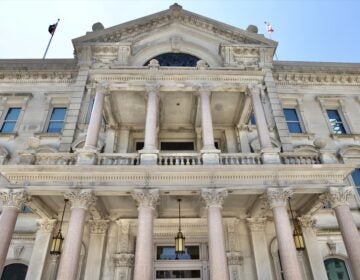
The New Jersey state capitol building in Trenton, N.J. (Evelyn Tu for WHYY)
From Camden and Cherry Hill to Trenton and the Jersey Shore, what about life in New Jersey do you want WHYY News to cover? Let us know.
Kyle Staffa, who owns Staffa Stone, a landscaping supply store in Berkeley Township, New Jersey, is hoping for a bright 2026, but he’s concerned. He said energy cost increases unfortunately must be passed on to customers, and there are other challenges as well.
“Tariffs affect us pretty tremendously, as some of our veneer stones and stones for patios are imported from overseas,” Staffa said.
As a result, he said, his company is using more stones from Pennsylvania, New York and Connecticut.
An array of issues
Rutgers University economist James Hughes, dean emeritus of the Edward J. Bloustein School of Planning and Public Policy, said a rise in unemployment nationally, mixed messaging from Washington, D.C., the increasing cost of electricity and long-standing issues with bureaucratic red tape are adding to the uncertainty business owners feel.
“New Jersey has a tough road ahead of it,” Hughes said. “It took a long time for us to move into that negative business position, so I think the road out is going to be long as well.”
He said New Jersey’s energy infrastructure is old and will be costly to upgrade. Hughes also noted the state used to be known for suburban office buildings, but that’s no longer the case, with office hiring now stagnant.
New Jersey Business and Industry Association President and CEO Michele Siekerka said economic uncertainty is a major problem for companies large and small.
“In order to make investments in our workforce, in our companies, in our facilities to create new jobs, we need to be able to plan as businesses,” she said.
The association’s 67th annual Business Outlook Survey found uncertainty around tariffs and rampant energy cost increases are considered a strong and largely unexpected constraint on profits for many companies.
“Think about, as a resident, your energy bill going up 10, 20, 30%,” she said, “Now times that by a hundred. For the facilities that businesses operate in, it’s devastating.”
Siekerka said fluctuating tariffs have led to supply-chain price increases for almost 90% of businesses, and one-third of them reported seeking out products from different suppliers.
“Think about that. It’s a time issue. You’ve got to take time to find a new supplier. Also it changes, potentially, the quality and the relationships that you have in your supply chains,” she said. “It makes things slow down.”
There may be a silver lining. On the flip side, Siekerka said, increased tariffs may benefit manufacturing companies, as businesses seek out more domestically made goods.
“But for that to happen, we have to get efficiency and permitting and licensing to allow these manufacturers to expand,” she said.
Related Content
New laws will take effect in New Jersey in January 2026. Here’s what you need to know
Starting Jan. 1, the minimum wage will increase, and Garden State drivers will pay more on toll roads and bridges.
3 months ago
Listen 1:01Waiting and watching
Eileen Kean, the New Jersey state director of the National Federation of Independent Business, said the outlook for many smaller businesses in 2026 remains unclear.
“Tariff changes have had a great impact on the cost of consumer goods, but we haven’t seen the [final] results of the holiday season,” she said. “What’s so important for small businesses is how well they do during the holiday season, so when those numbers come in we’ll have a better handle on where we stand.”
Kean said the NFIB’s Optimism Index is at a standstill.
“Difficulty finding qualified workers continues to be a drag on the small business economy,” Kean said. “Small business owners are cautiously optimistic, but there’s still a lot of uncertainty when it comes to staffing, rising costs and tough decisions about future investments.”
The outlook for 2026 is “a bit tepid,” Siekerka said. “The good news is there will be an increase in wages, there will be bonuses and an increase in hiring, but at very low levels. We’re going to be slow and steady.”
Meanwhile, Staffa said he is optimistic about what the new year will bring for his landscaping supply business.
“I hope that consumer confidence stays strong, and that the economy continues to grow,” he said.

Never miss a moment with the WHYY Listen App!


WHYY is your source for fact-based, in-depth journalism and information. As a nonprofit organization, we rely on financial support from readers like you. Please give today.

Gen Z college graduates in Philadelphia are facing tough odds in the job market
With a historically bad job market, phantom job listings and a loss of entry-level positions due to AI, young Philadelphians are sounding the alarm.
2 months ago
How can I prevent a utility shutoff during the winter months?
As more Americans struggle to pay their utility bills, here’s how Pennsylvania, New Jersey and Delaware are protecting ratepayers during the winter months.
3 months ago
Listen 1:12
Report: Atlantic City casino smoking ban may cost 2,500 jobs
The Casino Association of New Jersey commissioned the report, which determined that smokers, who account for 21% of Atlantic City gamblers, are worth more to casinos.
4 years ago