
New mobile mammography unit aims to address barriers to receiving care in Sussex County, Delaware
TidalHealth Mobile Mammography launched this month. Its goal is to bring screenings to neighborhoods in Sussex County with limited preventive care.
Listen 0:58
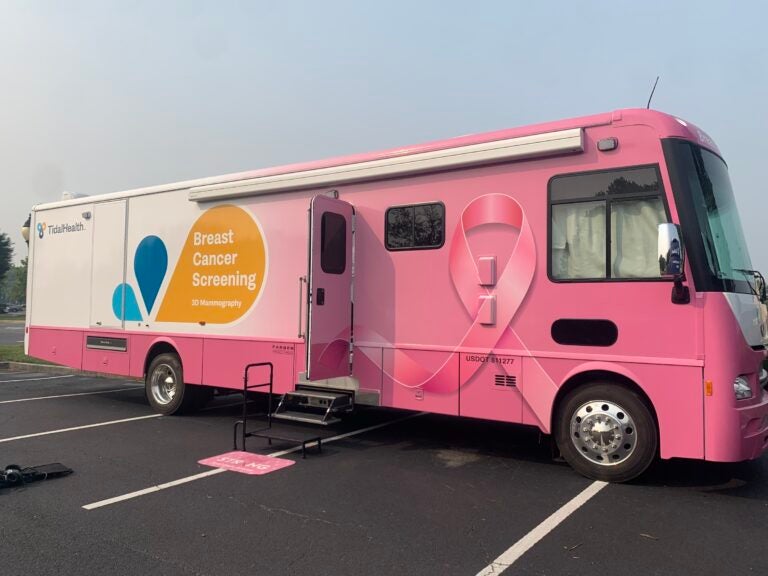
TidalHealth Mobile Mammography unit parked outside of La Red Health Center in Georgetown, Del. (Sarina Grossi/WHYY)
What are journalists missing from the state of Delaware? What would you most like WHYY News to cover? Let us know.
It’s hard to miss a bright pink, 38-foot-long bus taking up multiple spaces in a parking lot. It might look out of place, but inside it hosts cancer screening technology that can detect a tumor within the span of a 15-minute appointment.
TidalHealth Mobile Mammography, a bus that provides mammograms, launched earlier this month. The unit uses the same 3D mammogram imaging technology available at TidalHealth Breast Centers. The health care provider will offer mobile mammograms throughout the Delmarva region, including Sussex County and parts of Maryland’s Eastern Shore.
“It is not different than much of the services at many of our breast centers throughout Sussex County,” said Kathryn Fiddler, the vice president of Population Health at TidalHealth. “It provides all that same wraparound support. It’s just able to bring it into neighborhoods so people don’t have to do so much to travel to get that testing.”
The $1 million project was funded partially through donations raised by TidalHealth last fall. Donations include $100,000 from the Franklin P. and Arthur W. Perdue Foundation and $125,000 from Joseph Zimmer LLC, which established the Sheila Zimmer Breast Screening Fund. The fund will provide about $250,000 annually if matched over the next five years.
The mobile unit parks at a variety of community spots, like workplaces, health fairs and TidalHealth locations, among others. That includes areas that have limited access to preventive care.
“We understand that the Route 13 and Route 113, everything more westerly — is often more impoverished and has a lot more challenges accessing lots of things — food, safe housing and health care,” said Fiddler, who is also a doctor of nursing practice. “That is definitely an area of focus, but not the only focus because there’s pockets of people who desperately need support through access to healthcare throughout Sussex County.”
In its Community Health Needs Assessment, TidalHealth identified breast cancer as one of the most serious health issues in Sussex County. It noted that community feedback emphasized that the county might not receive the same health programs as New Castle and Kent counties. According to Fiddler, there are no other active mobile mammography units available in Sussex County.
“We’ve heard it from women, how hard it was and how difficult it was to get the screening and some of the barriers that they had,” Fiddler said.
Related Content
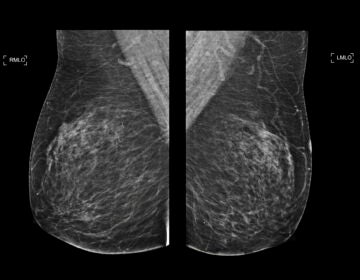
Pennsylvania doctors say mammograms could be used to detect early heart disease in women
Mammograms can detect the presence of breast arterial calcification, which is associated with a higher risk of future heart attacks and stroke.
7 months ago
Listen 1:11Barriers to receiving mammograms
A key player in access to care is transportation. Erika Narducci is the program director for Cancer Support Community Delaware, a nonprofit that provides support groups, health classes and educational sessions to cancer survivors statewide. She said that there is great cancer care available throughout the state and in nearby metropolitan areas. However, they are not always accessible to residents living in rural areas.
“Just because the cancer centers are there, doesn’t mean that you are able to get there,” Narducci said. “You may have, for example, Beebe Hospital in the Rehoboth Beach, Lewes area, but you could live an hour away in the county and so, it’s not necessarily easily accessible.”
Narducci said disabilities could be a physical barrier to possibly receiving care. She noted there is also a lack of trust in medical providers among Hispanic, Latino and Haitian-Creole populations in Sussex County.
“Sussex County has quite a few seasonal and migrant agricultural workers. So they may be low income, uninsured or under-insured, [and] also have limited English proficiency,” Narducci said. “All those things can be barriers to accessing care, just even making an appointment, let alone getting to the care.”
The mobile unit does not have in-person interpreters on site, but according to TidalHealth, the team does utilize its available interpretation services.
Women working a typical 9-to-5 schedule will likely have to take time off for a mammogram appointment. Narducci said that even if transportation is possible, offices might not be open when they are available to take time off work.
Mothers also might need to find child care during an appointment window. Paying for child care, transportation and insurance coverage, while possibly foregoing pay to take the time off for the appointment, can cause financial strain.
According to Fiddler, this could make a person choose between receiving an annual mammogram or paying for groceries, depending on their economic status.
“So this van being closer to many different neighborhoods at many different times, providing hours that might be outside of some people’s working hours is really providing that access in different ways,” Fiddler said.
Fiddler said that the mobile unit also offers a team of people on staff, including community health workers, registered nurses and mammography technicians to walk them through the process so patrons feel more comfortable getting screened.
Related Content
Delaware program aims to expand maternal care access in rural communities
A new initiative in southern Delaware aims to reduce maternal health disparities by bringing prenatal and postpartum support directly to women.
2 months ago
Listen 1:23How the mobile unit works
Mobile mammography events will be posted ahead of time so people can make appointments. Fiddler said that the units require appointments to ensure patients get appropriate services done based on their background information. The mobile unit team also needs some personal information, like an address and phone number to send results of the mammogram.
“Just as you would for anything else, hopefully you have a primary care physician or nurse practitioner or provider that has provided an order. If not, we can work through that process with you to make sure that you have an order for the mammogram,” Fiddler said.
When patients arrive for their appointments, they are asked to bring their insurance information. TidalHealth Mobile Mammography does not collect cash on site. Insurance is not required for the service, and the team will work with patients on finding financial resources to cover service costs.
Once in the van, Fiddler said patients will put on a gown, wait until a technician brings them into the room and complete the mammogram. She said it normally only takes about 15 minutes for the appointment to be finished.
If a test comes back and additional screenings are required, a navigator on the team will walk the patient through their next steps.
“This is not just about a woman going on to a van for a mammogram. It’s really making sure that she has all the tools she needs to be successful and healthy for her, for [her] family, for the people that she cares about,” she said.
Related Content
Using data from 3,492 patients, a ChristianaCare study found breast cancer hotspots in Wilmington and Middletown.
1 year ago
Listen 1:28Breast cancer in Delaware
Breast cancer is the most commonly diagnosed type of cancer in the First State. According to data released by the Delaware Division of Public Health in April, female breast cancer accounted for 17% of all new cancer cases between 2018 and 2022. Delaware also has the second-highest incident rate for breast cancer in the U.S., with about 145 cases reported per 100,000 residents.
New Castle County in particular hosts a number of hotspots where women are more likely to be diagnosed with advanced breast cancer. That’s according to research conducted by ChristianaCare’s Cawley Center for Translational Cancer Research. The study found that the elevated cases were connected to low annual screening rates and the prevalence of triple-negative breast cancer, a more aggressive form of the disease that does not respond to typical hormonal treatments.
However, Kent and Sussex counties still have high incident rates, with both counties higher than the national average.
Connie Holdridge is the director of survivorship for the Delaware Breast Cancer Coalition, a nonprofit focusing on breast cancer awareness and providing support to survivors. She said the high incident rates could be attributed to statewide efforts to increase screenings.
“The more people you screen, obviously, the more people you will have that are diagnosed,” Holdridge said.
Overall, cancer mortality rates have fallen about 1.5% per year between 2008 and 2022, in the state. Holdridge said that the drop in death rates could be attributed to early screenings and diagnoses.
However, Delaware’s breast cancer mortality rates are higher than the national average. Between 2019 and 2023, Delaware had the fourth-highest mortality rate in the country, according to the National Cancer Institute.
Non-Hispanic Black populations also have a higher mortality rate for breast cancer in Delaware compared with the national average. Sussex County has the highest death rate in the state for the group, with about 35 deaths per 100,000 people.
For women 40 and older, it is recommended they receive an annual mammogram. Holdridge said that getting screened at 40 creates a baseline for doctors so they can note any changes in breast tissue in future screenings.
Narducci said getting screened often can detect early stages of breast cancer, which is more treatable and has better outcomes overall.
“Less treatment is involved with earlier stages. So it’s a cost savings, not only for the patient but for the medical centers,” she said.
If a person waits too long, later stages of breast cancer can metastasize to other parts of the body.
Holdridge, a breast cancer survivor of 25 years, said it’s important to avoid this at all costs.
“I live without my breasts. I can’t live without my liver. I can’t live without my heart,” she said.
Related Content
Women in the study who were obese and taking GLP-1 weight loss medications were 30% less likely to develop breast cancer than other women.
3 months ago
Listen 1:23Not the first mobile unit
Prior to TidalHealth offering mobile mammograms, the Delaware Breast Cancer Coalition offered a similar service with the Women’s Mobile Health Screening Van. The state’s health department funded the effort until 2018.
“The state of Delaware decided that there were enough stand-alone mammogram facilities that the van was not necessary,” Holdridge said.
She noted that the van also had outdated technology that was not in line with the current 3D mammogram model used today.
After the van went out of commission, the coalition started running the Women’s Health Screening Program. It focuses on helping women receive screenings by walking them through the process of scheduling screening appointments, taking into account economic and cultural barriers. They also help with language interpreters and will transport participants to screenings.
According to the coalition’s Annual Impact Report, it coordinated more than 1,100 cancer screenings between 2024 and 2025.
Holdridge said the coalition was excited to hear that TidalHealth started their own mobile mammography unit. She said their screening program will transport women to mobile mammography events in the future.
“What we want is to get people screened. We want people to be healthy. And we have a number of different programs that we are focused on, but the van is such a huge, huge help,” she said.
The next mobile unit screening in Sussex County will take place Thursday, July 23, from 10 a.m. to 3 p.m. in Seaford. Locations and times for August can be found on TidalHealth’s website.
WHYY is your source for fact-based, in-depth journalism and information. As a nonprofit organization, we rely on financial support from readers like you. Please give today.
Part of the series


A report from the State Employee Benefits Committee said market realities prevent more strident moves to address rising drug costs.
2 weeks ago
Listen 1:03
The governor’s friend and advisor Neil Hockstein says he was hired for the position without having to apply.
3 weeks ago
Listen 1:06
The CDC and Delaware public health officials urge unvaccinated residents exposed to the measles virus to get the shots within three days.
4 weeks ago
Listen 0:54