

Southern Delaware hospitals say proposed ChristianaCare campuses will negatively impact region
Leaders from Bayhealth, Beebe Healthcare and TidalHealth argued to the state’s regulators that the campuses slated for Camden and Georgetown should be denied.
Listen 1:06
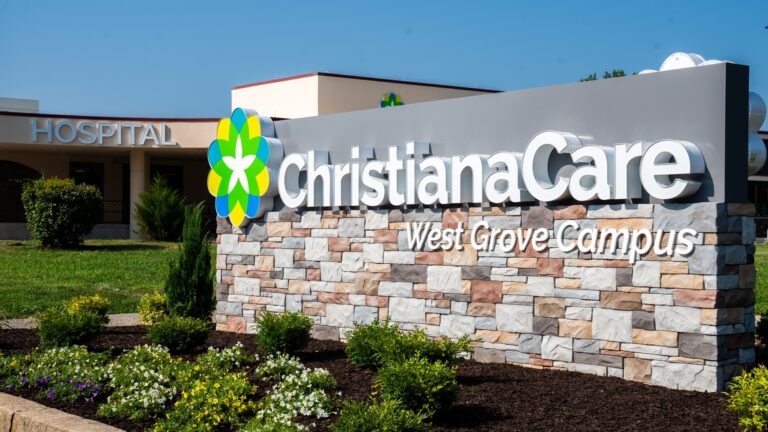
File - A ChristianaCare sign at its hospital in West Grove, Pennsylvania (Courtesy of ChristianaCare)
What are journalists missing from the state of Delaware? What would you most like WHYY News to cover? Let us know.
Leaders from three southern Delaware hospital systems spoke out against two proposed ChristianaCare campuses at a public hearing this week. It comes after they submitted letters to the Delaware Health Resources Board, the state’s regulatory body and requested the meeting.
Representatives from Bayhealth, Beebe Healthcare and TidalHealth spent more than two hours arguing that the two proposed campuses — planned for Camden in Kent County and Georgetown in Sussex County — should either be denied or an alternative project should be accepted in its place. About 100 attendees joined the meeting virtually.
ChristianaCare submitted applications for the two campuses to the regulatory board in June. The Georgetown location overlaps with all three of the opposing hospital systems’ coverage range. The Camden location also encroaches on Bayhealth’s Kent County services.
The health resources board is expected to make further deliberations on the applications for both campuses at a later meeting.
Related Content

If approved, the two “neighborhood hospitals” proposed for Camden and Georgetown would open in 2028. Other hospital systems question if they actually comply with state law.
2 months ago
Listen 0:45ChristianaCare’s proposed expansion
The proposed campuses are part of a larger effort to expand ChristianaCare’s reach in Delaware. In 2025, representatives for the hospital system announced it would invest $865 million to expand over the course of three years.
ChristianaCare’s hospital service range in Delaware is currently contained to New Castle County. The health care provider does not operate a hospital downstate, though it does have a presence in Kent and Sussex counties through primary care and specialty services.
“Patients and community members have told us directly they want more care close to where they live with less travel and more time with the people who depend on them,” said Pauline Corso, president of ChristianaCare’s Ambulatory Network Continuity and Growth, at the hearing.
According to Corso, Kent County is expected to see a more than 5% growth in its population by 2030, while Sussex County is anticipated to see an almost 10% growth. Those numbers are even higher for populations over the age of 65 that require more care, with Kent County anticipated to see a 16% increase and Sussex County anticipating a 22% increase.
Corso said this will lead to a greater demand for care in both counties, which already have existing gaps in access to care and doctor shortages. In Kent County, there’s a shortage of at least 24 primary care providers, and in Sussex County, there’s a shortage of nearly 40 physicians.
Both campuses will have ambulatory health centers that provide primary care, specialty care, behavioral health and other services.
Corso said that challenges in finding primary care can lead to people not getting help early, further leading to more emergency department visits.
“Delaware currently ranks fourth worst in [emergency department] visit [times] in the country,” Corso said. “And waiting for care is hard, especially when you’re worried about yourself or someone you love. Long emergency visits can add to that worry.”
Emergency department visit times for available hospitals in Kent and Sussex counties range from about 170 minutes to 280 minutes, which is higher than the national average of less than 160 minutes, according to ChristianaCare. Visit time is not the same as wait time, as it encompasses an entire visit.
Though there are emergency departments available in both counties, Corso said that the communities still need to accommodate for population growth.
Both proposed campuses will also house what ChristianaCare calls a “neighborhood hospital,” also referred to as “microhospitals.” They would feature 24/7 care with eight emergency beds and eight inpatient beds. It would also offer imaging services like X-rays and CT scanners, according to Dr. Vinay Maheshwari, the physician executive for growth and strategic partnerships with ChristianaCare.
Maheshwari said the campuses are designed to serve small communities and work alongside other regional facilities and the already existing local health care infrastructure in both counties.
ChristianaCare’s internal projections expect the new neighborhood hospitals will have a 90-minute visit time based on other existing models. The health care provider already opened two neighborhood hospitals in Pennsylvania with their Aston Campus and West Grove Campus. The proposed Delaware campuses would be the first of their kind in the state.
“We recognize the neighborhood hospital concept is new to Delaware, but it represents an innovative, right-size approach to support communities more locally. ChristianaCare is committed to working with state regulators and policy makers to support the model’s implementation and meet all the applicable requirements,” Maheshwari said.
According to Maheshwari, the combined health centers and neighborhood hospitals would also bring down care costs for patients by giving an option for earlier treatment, reducing avoidable hospitalizations and relieving emergency departments capacities.
ChristianaCare projects that about 70,000 Delawareans could lose health coverage due to Medicaid cuts. More than a fifth of Kent and Sussex counties’ populations were covered by Medicaid in 2023, according to Georgetown University’s McCourt School of Public Policy. Maheshwari said that ChristianaCare’s charity care policy, which provides financial aid for patients, would apply to both campuses.
Additionally, Maheshwari said the campuses could help expand the state’s medical workforce. If approved by the health resources board, he said the campuses will hopefully open in early 2029.
As a part of the state’s regulatory process, projects that cost more than $5.8 million are required to receive a Certificate of Public Review from the board. That review process decides whether or not a hospital is approved based on its impact to a region’s health care systems or public health. Combined, the ChristianaCare projects cost about $117 million, Maheshwari said.
Related Content
Delaware invests more than $1.3 million to build health care workforce in Kent, Sussex counties
The funding comes from the Rural Health Transformation Program, and aims to address the two medically underserved counties.
4 weeks ago
Listen 1:08Would neighborhood hospitals negatively impact emergency care?
All three of the opposing hospital systems acknowledged the need to create a healthy medical ecosystem in Delaware. Kyle Benoit, Bayhealth’s executive vice president and chief operating officer, said that families deserve more accessible care close to their community, particularly through primary, specialty, behavioral health and urgent care services.
“But we are tasked, us at Bayhealth and all health care providers, as well as this board, with protecting patients from the rising health care costs,” Benoit said. “We must ask ourselves: Do these proposals solve these challenges or do they further lock in the high cost infrastructure into our health care system here in Delaware?”
Benoit argued that the neighborhood hospital is more akin to a freestanding emergency room, which creates “exceptionally high cost for a low-volume benefit for the community.” He said that there are challenges facing local emergency departments, but increasing the number of emergency departments is not the correct solution to the problem.
“The reality is the ER and the inpatient [services] are some of the most expensive parts of a health care organization,” Benoit said. “The most difficult to staff, the most high cost to run, and as we continue to focus on lowering costs in the state, it makes no sense to introduce a more high-cost setting into an area already being served by Bayhealth.”
In his rebuttal, Maheshwari said ChristianaCare chose the smaller neighborhood hospital model specifically because free standing emergency departments “require significant investment in resources and adds overall cost to the environment.”
David Tam, Beebe Healthcare’s president and CEO, also said eight emergency beds for the neighborhood hospitals would not be enough to accommodate the growing senior population.
“The fact of the matter is, the majority of our patients come in, they’re over 65, and we have to identify whether they have a stroke or whether they have a heart attack, and many times they are sent to go to the cath lab to get further studies, and this is not something that can be done at the currently proposed facility,” Tam said at the hearing.
Tam added that it is unclear how transfers and collaborative care will work with the proposed campuses and surrounding hospitals. He said that if a patient is transferred to the nearest ChristianaCare facility in Northern Delaware, it could lead to higher costs for patients. If they are transferred to other hospitals nearby, it can still create stress on emergency capabilities.
“If an emergency ambulance in Millville or Millsboro or Georgetown is trying to figure out where to go and get the care that a patient needs and drop them off, but then they have to go back and then transport that patient from that facility to another facility in order to get a higher level of care, it actually creates increased ED capacity pressures instead of relieving it,” Tam said.
Tam also pointed to long visit times not necessarily being due to a lack of emergency beds, and that those visits often deal with patients who do not need emergency care.
“It’s because we don’t have enough behavioral health care beds,” Tam said. “We don’t have enough skilled nursing facility beds. We don’t have other disposition opportunities that other places have and that is why patients stay longer in the ED.”
However, Maheshwari said that the neighborhood hospitals will be targeting the moderate-acuity population, or people who need immediate care but are not facing life-threatening issues. Eight beds were selected based on other neighborhood hospitals.
He also said that it is not ChristianaCare’s goal to keep patients within their systems, and that patients, if needed, will be transferred to “the most appropriate acute care facility.” ChristianaCare expects a transfer rate of about 6%.
“We have the capability to rapidly assess and and hopefully work with and collaborate with our regional institutions to ensure that patients can be treated rapidly and effectively,” Maheshwari said. “We’re doing it today. We anticipate that we can do that tomorrow. It will take partnership.”
According to Benoit, the board also previously set a precedent in 2019 when it expressed concerns about a Bayhealth proposal to build a freestanding emergency department, stating it was too costly. Beebe Healthcare also proposed a freestanding emergency department in Georgetown that same year and was denied. Benoit said the ChristianaCare campuses should be held to the same standard.
“We are not being protectionist, we are not suggesting that there aren’t gaps in care in Delaware. We know there are,” Benoit said. “And while we’re committed to address those gaps, we also know that other partners can come in and help do that in a cost effective and responsible way.”
Bayhealth announced expansions to its Kent County and Sussex County locations this month. Part of that expansion is adding more beds to the Kent campus and the Milton Total Care facility.
“We recognize that our current performance and metrics in our ERs are not acceptable, which is why we are executing on plans that we started underway in the July time frame,” Benoit said. “We’re seeing improved metrics overall in the care we’re delivering while waiting for this additional space.”
Benoit said the ChristianaCare Camden campus would only be about 4 miles away from their Kent County campus, and that Bayhealth is already addressing the need in the region. Additionally, the Georgetown campus would also only be about 10 miles from Bayhealth’s Milton site, 13 miles from TidalHealth Nanticoke in Seaford and about 16 miles from Beebe Healthcare’s Lewes hospital, all of which offer emergency beds.
TidalHealth Nanticoke President Penny Short said that the application for the Georgetown campus has not properly demonstrated the need for another hospital, and it leaves a question as to why an outpatient health center can’t move forward without the neighborhood hospitals.
“Georgetown may need more physicians, behavioral health care, specialty access,” Short said. “The application has not shown why those needs require inpatient beds and another hospital emergency department.”
Short also questioned ChristianaCare’s claims that the model will provide lower costs, and said that the application provides little state-specific evidence.
Maheshwari said that though there are other capacity challenges in the state, there is still a need for short-stay inpatient capacity.
“Adding short-stay inpatient beds creates another avenue for appropriate patient placement. It helps relieve some of the pressure on the existing facilities and provides a much needed release valve within the broader health care system,” Maheshwari said.
Related Content

Delaware bans private equity hospital purchases, expands health care access
Senate Majority Leader Bryan Townsend says his legislation phases in price caps on hospitals and strengthens primary care access.
4 months ago
Listen 0:57Regulatory concerns for neighborhood hospitals
Another concern raised previously in the three hospital systems’ opposing letters dealt with the ownership and operation of the hospital.
For the proposed campuses, ChristianaCare would partner with the for-profit entity Emerus Holdings, a developer of neighborhood hospitals.
Maheshwari said ChristianaCare owns both properties, and would be the sole owner and operator of the health center. But for the neighborhood hospitals, they “would maintain majority ownership and governance oversight.”
“Our name, ChristianaCare, carries a responsibility to the people we serve. We take that responsibility seriously, and our commitment to our neighbors belongs at the center of this partnership. The same commitment that we have made to Delawareans for over 140 years,” Maheshwari said.
Gov. Matt Meyer signed Senate Bill 313 into law earlier this summer, establishing a two-year moratorium that keeps the state’s nonprofit hospitals from being purchased by private equity firms.
TidalHealth CEO Steve Leonard questioned how the neighborhood hospitals would be defined by Delaware law since it is new to the state. He said that the board should understand what license applies to the model before approving the projects.
“This is a policy question for Delaware, not something that should be resolved through a single [Certificate of Public Review] application. Eight beds does not make the regulatory questions smaller,” Leonard said. “Clarity is even more important. Define the hospital, define the license, demonstrate compliance, then consider approval.”
Benoit also said it remains to be seen how the partnership would play out in operating the neighborhood hospitals. He claimed that it’s not clear how feasible the model is, pointing to two prior Emerus partnerships that have since closed in Wisconsin and Indiana.
However, Maheshwari said ChristianaCare’s current neighborhood hospitals have been successful so far, and that they chose to work with Emerus because of its expertise in the model.
“We chose Emerus because they are the national leader in operating and putting together neighborhood hospitals. They have a 20-year track record over 50 hospitals and over 5 million patients served,” Maheshwari said.
He further emphasized that ChristianaCare is a nonprofit entity, and will ensure they have majority ownership in the projects.

Get daily updates from WHYY News!
WHYY is your source for fact-based, in-depth journalism and information. As a nonprofit organization, we rely on financial support from readers like you. Please give today.
Part of the series

Bayhealth’s ‘Next Wave’ aims to further expand care in Sussex and Kent counties
Officials with the hospital system say that they are planning for “responsible growth” to prepare for a growing population in central and southern Delaware.
4 weeks ago
Listen 1:02
A report from the State Employee Benefits Committee said market realities prevent more strident moves to address rising drug costs.
3 months ago
Listen 1:03
The governor’s friend and advisor Neil Hockstein says he was hired for the position without having to apply.
3 months ago
Listen 1:06