

Jersey Shore beaches face uncertainty as federal funding delays threaten tourism, storm protections
Severe erosion is threatening the Jersey Shore's 2026 tourism season. Local leaders are looking to federal aid to restore coastlines before Memorial Day.
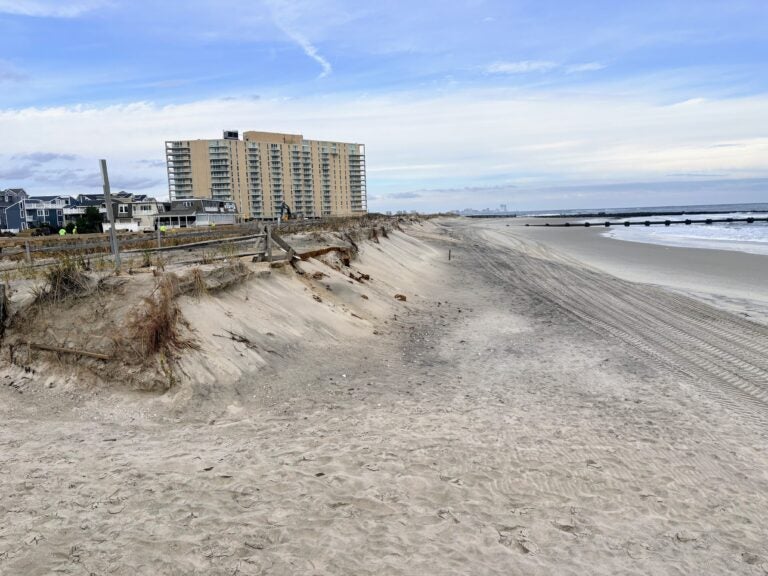
Ocean City's north-end beaches are short at high tide after several storms. The city has asked for federal funding to replenish them. (Rebecca Acevedo/WHYY)
From Camden and Cherry Hill to Trenton and the Jersey Shore, what about life in New Jersey do you want WHYY News to cover? Let us know.
For decades, the U.S. Army Corps of Engineers has overseen beach replenishment projects along the Jersey Shore authorized by Congress, pumping sand onto eroded beaches and reinforcing dunes as part of long-term coastal protection plans. In communities such as Ocean City and Strathmere, local officials say these beach replenishment projects are critical for their tourism-heavy economy and also for storm protection, shielding homes, roads and infrastructure from coastal flooding.
But federal replenishment funding was largely absent from the fiscal year 2025 budget, leaving these shore towns waiting for emergency allocations and federal approvals as the summer season approaches. Local officials say funding timelines remain uncertain, raising concerns about whether replenishment will be completed before peak tourism and hurricane season.
“In terms of short-term measures ahead of the 2026 summer season, there are no meaningful interim actions that would materially restore the beach. In Strathmere, the erosion is substantial enough that only a full-scale nourishment project would make a noticeable difference. Smaller efforts would not significantly change current conditions,” said James W. Van Zlike, township administrator for Upper Township.
Federal officials and coastal advocates say inconsistent appropriations have delayed projects nationwide, including along the Jersey Shore.
“These projects are authorized by Congress for 50-year federal participation. The problem is that each nourishment episode is subject to appropriations by Congress,” said Dan Ginolfi, executive director of the American Coastal Coalition.
Related Content
Federal funding freeze stalls New Jersey beach replenishment projects
The stalled beach nourishment projects come after a new study found that coastal flooding could become the norm in the near future.
4 months ago
Proposed legislation aims to stabilize coastal funding
In response to ongoing funding gaps, U.S. Reps. Jeff Van Drew, R-Atlantic County, and Laura Gillen, D-N.Y., have introduced bipartisan legislation that would create a permanent funding stream for coastal storm protection projects, including beach nourishment.
The legislation, if approved, would establish a dedicated revenue source funded by offshore energy lease revenues and invest $1 billion annually into coastal storm risk management projects led by the Army Corps, according to a statement released by Van Drew’s office.
In a statement, Van Drew described the bill as an effort to address longstanding funding uncertainty.
“The American coastal economy contributes to 46 percent of national GDP, but too often the government does not deliver coastal protection until after a disaster strikes,” he said.
Ginolfi said the proposed legislation is exactly what coastal communities need to remain resilient.
“This bill establishes a reliable and dedicated revenue stream in an amount that would satisfy the needs of coastal communities nationwide,” he said.
Ginolfi said details about future funding timelines have not yet been released, and current federal funding remains below typical levels.
“Funding right now is far below usual levels, and the best way to support funding for beaches is by contacting legislators and letting them know that the nation’s beaches are in dire need of attention,” Ginolfi said.
Still, local towns are running out of time to replenish sand as they are gearing up for summer, their peak season for tourism.
Related Content

Businesses in Cape May County shore towns said they had to work harder to keep tourism and profits strong.
6 months ago
Coastal protection relies on federal, state and local coordination
Beach replenishment projects are typically funded through partnerships among federal, state and local governments. The Army Corps oversees engineering and construction, while the state and municipalities contribute funding, permitting and maintenance.
The New Jersey Department of Environmental Protection oversees coastal permits and administers the Shore Protection Fund, which provides about $25 million annually to support coastal protection projects and leverage federal funding.
A department spokesperson did not return a request for comment.
Recently, federal officials met with state and local leaders to assess erosion damage and evaluate replenishment needs, underscoring the urgency of restoring storm protection along vulnerable stretches of coastline.
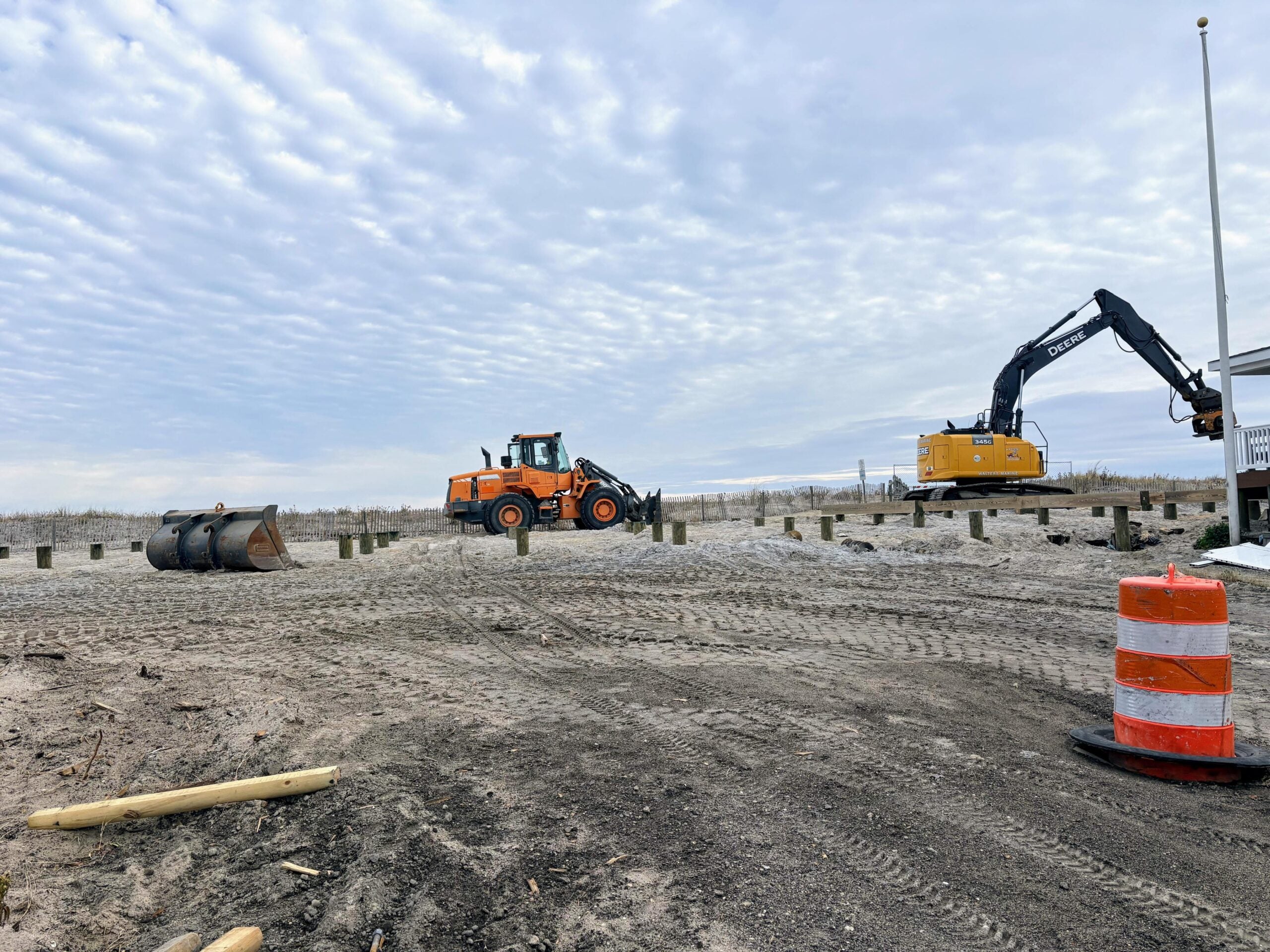
Speaking on Ocean City’s boardwalk recently, Van Drew said tens of millions of dollars in federal funding would be directed toward beach replenishment projects and identified Ocean City as a top priority for the investment. He didn’t know exactly when funding would come, but said he hoped it would arrive by the summer.
“We are working to secure federal funding for as many shore communities as possible, and Ocean City is simply the starting point because it was next on the U.S. Army Corps of Engineers’ existing construction schedule,” Van Drew said in a statement. “This is not a one-town solution. More communities are expected to move forward as funding is finalized, and the Army Corps has indicated they will be expediting the process so that as much work as possible can be completed ahead of the summer season.”
Related Content
New Jersey and Delaware report significant beach erosion following nor’easter
The nor'easter led to a state of emergency in New Jersey, and voluntary evacuations in parts of Delaware.
6 months ago
Listen 1:12How are shore towns responding to the funding crisis?
To help secure funding, late last year, Ocean City and Stratemere declared a state of emergency. Ocean City has also said publicly that it was stockpiling sand to protect its beaches.
As of Feb. 2, the Avalon borough website reported that the town is utilizing two newly acquired sand-moving trucks to combat severe northern beachfront erosion caused by Hurricane Erin and subsequent 2025 storms. While federal funding for a traditional hydraulic beach fill remains unavailable for the 2026 cycle, the borough is currently seeking bids for a sand operation to restore dunes and shorelines this spring.
“If no project occurs before summer 2026, impacts would include reduced beach width, diminished recreational space and continued exposure of public infrastructure and private property to storm risk,” Van Zlike said. “Doing nothing long-term is not a viable option, but timing is directly tied to the availability of federal funding.”
He said that Upper Township has identified its share of the available state funding.
“The primary uncertainty continues to be the federal portion, which traditionally represents the majority of project funding,” Van Zlike said.
The Federal Emergency Management Agency said it will finally distribute funds for the long-awaited $24.3 million seawall expansion project designed to strengthen coastal defenses along Beach Avenue in Cape May. According to the city’s website, the work includes extending the seawall and promenade from East of Madison Avenue to Wilmington Avenue.
The project was identified following Superstorm Sandy in 2012, which exposed vulnerabilities in the city’s coastal protection system. More recently, nor’easters and Hurricane Erin in 2025 caused additional erosion and damage along the shoreline.
Construction is not expected to begin until fall 2026.
However, the best ways to protect the shoreline remains an active debate, according to town officials.
“Some engineers advocate for hard structures such as seawalls or other armoring approaches, while others caution that these can worsen erosion in adjacent areas. These structures are also extremely expensive and are not guaranteed to stop regional erosion trends. Neighboring municipalities with hardened infrastructure continue to experience erosion challenges, which highlights the complexity of the issue,” Van Zlike said.
Ginolfi believes it is only “a vocal minority against beach nourishment.”
He shared that critics often frame beach replenishment as an unnecessary cost, but that argument rarely holds up under scrutiny. He added that, when engineered and maintained correctly, these projects deliver significant return on investment for coastal communities, serving as a protective buffer, absorbing the impact of storms and erosion to safeguard homes, businesses and public infrastructure.
WHYY News is partnering with independent journalists across New Jersey to spotlight the people, communities, cultures and distinctive places that shape the Garden State. This work is made possible with support from the Geraldine R. Dodge Foundation.

Get daily updates from WHYY News!
WHYY is your source for fact-based, in-depth journalism and information. As a nonprofit organization, we rely on financial support from readers like you. Please give today.
Part of the series

New Jersey diaries: From shore towns to small towns
WHYY News is partnering with independent journalists across New Jersey to spotlight the people, communities, cultures and distinctive places that shape the Garden State.
Federal funding freeze stalls New Jersey beach replenishment projects
The stalled beach nourishment projects come after a new study found that coastal flooding could become the norm in the near future.
4 months ago
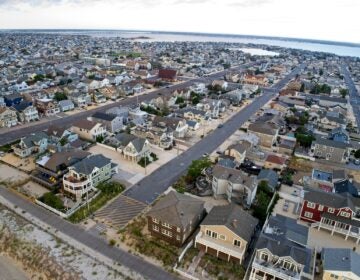
New Jersey modifies proposed building elevation rules along the shore by 1 foot due to new science
The state’s latest proposal would require new buildings in coastal flood zones be elevated an additional 4 feet, rather than 5 feet.
9 months ago
Listen 1:20
Thousands of bottle caps, plastic pieces littered New Jersey beaches last year, report finds
Though the number of plastic bags found on New Jersey beaches has declined, overall plastic waste persists.
12 months ago
Listen 1:17