

Georgetown’s planning commission votes against cottage housing repeal in Sussex County, diverging from town council
The town council voted in favor of starting a repeal process for the divisive ordinance last month. The planning commission says there’s not enough evidence to support it.
Listen 1:06
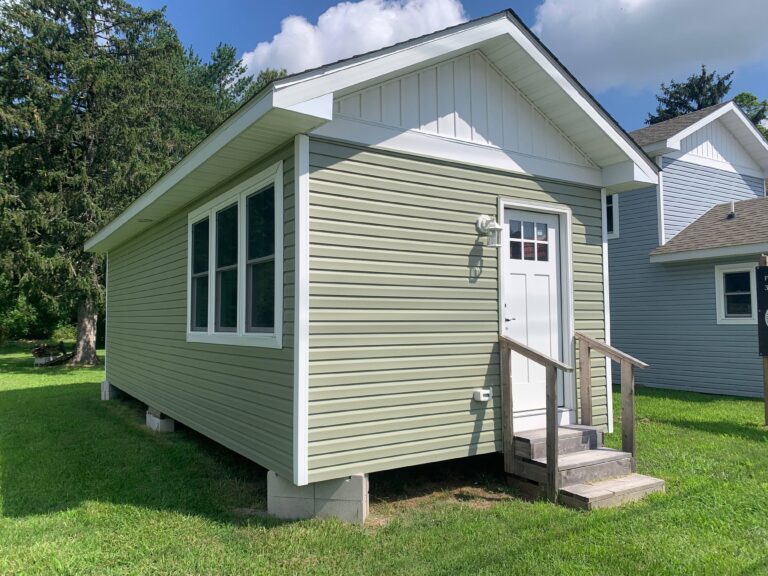
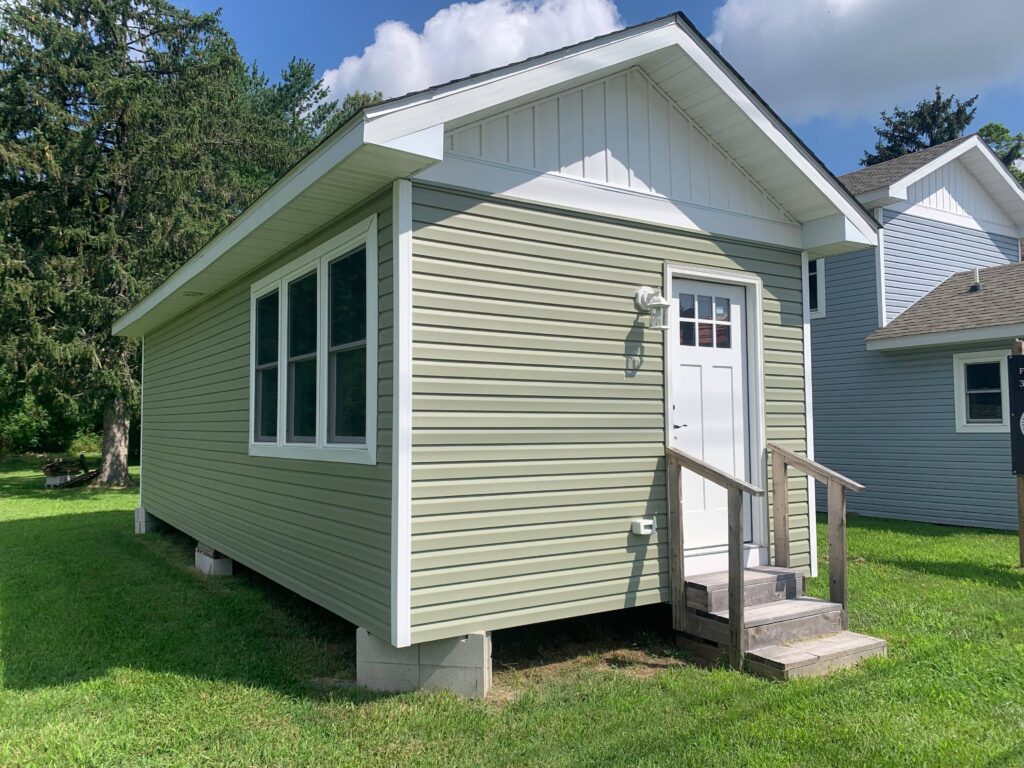
A model cottage home developed by Little Living, a nonprofit organization that will be building a cottage village in Georgetown, Del. The project would not be impacted by the Georgetown Town Council's decision to start the repeal process for the cottage housing ordinance. (Sarina Grossi/WHYY)
What are journalists missing from the state of Delaware? What would you most like WHYY News to cover? Let us know.
Georgetown’s planning commission struck down a proposed repeal of the town’s cottage housing law, despite support from some community members and elected officials. The commission voted 3 to 2 on recommending the town council to deny the repeal at a public hearing last week.
The current law allows developers to build 12 small cottages on an acre of land. It was adopted last December by the town council in a 4-to-1 vote after hours of public comment and debate.
Last month, however, the town council voted 3 to 1 to send the ordinance back to the planning commission as a way to start the repeal process.
The August decision was based on recommendations from an ad hoc committee the council formed earlier this summer. That was after Mayor Angela Townsend, who has opposed the cottage ordinance in the past, requested a discussion of amending or rescinding the measure be placed on the council’s agenda.
The council also moved to pause reviews of cottage development applications until further notice.
Why repeal?
In a letter to the commission, the ad hoc committee said that the original ordinance was adopted in an attempt “to be proactive in addressing housing needs and providing another housing option in Georgetown.” However, the state has since passed housing laws that change how developments are approved by local governments.
The letter names Senate Bill 23 in particular, which allows certain residential developments to be approved without a public hearing if they meet all zoning requirements.
“This process removes any oversight duties from planning and zoning,” wrote Eddie Wise, a member of the ad hoc committee. “With oversight duties no longer a safeguard, it is imperative that Georgetown take this opportunity to step back and develop a coordinated approach to housing and zoning considering ALL factors.”
At previous ad hoc committee meetings, members also pointed to House Bill 450 as another piece of legislation that impacts local jurisdictions. That law streamlines land use permitting and establishes requirements that increase housing density.
At the public hearing last week, commission Chair Larry Rohlfing said he was in favor of the repeal. He said that new laws require future housing plans to include a variety of different housing types. According to Rohlfing, if cottage housing is allowed before other housing types are considered, it could “throw out the balance of housing” in the town.
“The question isn’t about whether or not cottage housing is a good thing or a bad thing. It’s about what we need to do for the town of Georgetown today,” Rohlfing said.
Rohlfing also said that a significant amount of available properties in the town could meet cottage housing requirements, and that it should not be open to development until all housing types are considered.
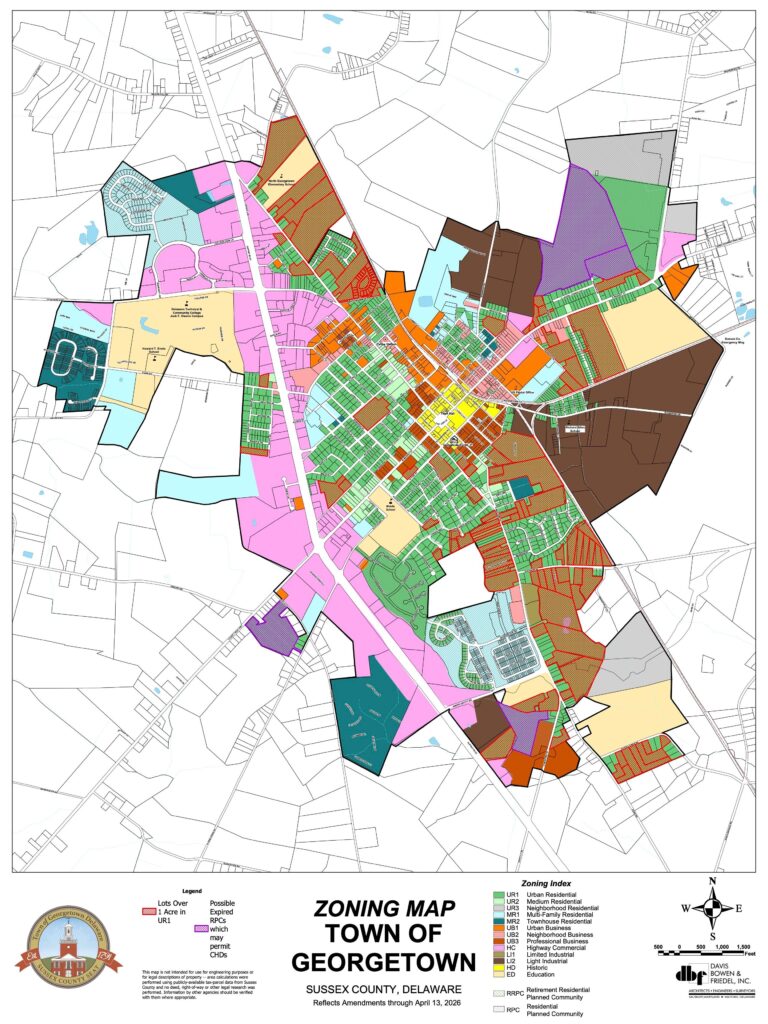
Linda Dennis, a Georgetown resident, also expressed concerns about the new housing law. She cited the city of Lewes as an example to follow, as the city is in talks to pause reviewing residential development applications in response to Senate Bill 23.
“Repealing this ordinance is required in order to ensure that the town has the ability to determine its land use and zoning needs without interference from the developers, the state and opportunists,” Dennis, who also is a part of Georgetown’s Supportive Housing Issues Committee, said at the hearing.
Some residents also shared concerns about how increasing cottage homes might impact the town’s quality of life.
“The homes this ordinance allows are not at all in the character of this town,” said Georgetown resident Adam Buczkowski, who’s also a member of the town’s Supportive Housing Issues Committee. “Georgetown is a historic town with limited room for future development. Let’s be smart about the future development and make sure it fits and compliments the town.”
Related Content
The zoning changes adopted back in December allowed for dense cottage communities to be built in town.
2 months ago
Listen 1:07‘Exchanging an existing housing opportunity for an uncertain future process’
Judson Malone, executive director and co-founder of Springboard Delaware, a nonprofit that is currently working on creating a cottage community in the town, posed a few queries to the planning commission.
Malone called into question claims about compliance with the new state laws at the public hearing, and said the ad hoc committee has not explained why the cottage ordinance needs to be repealed before housing in the town as a whole is reviewed.
“[The committee members] provide no commitment that cottage housing will return and no deadline for a replacement,” Malone said. “That leaves Georgetown exchanging an existing housing opportunity for an uncertain future process. The town is invoking laws intended to expand housing choices to justify taking one away.”
Currently, Georgetown only has one cottage housing project that has formally submitted a required preliminary site plan application. The Market Street Village project, spearheaded by nonprofit Little Living, is currently under review, and would not be impacted if the cottage housing code was repealed.
Malone previously told WHYY News that he believed Springboard Delaware’s project is far enough along to not be impacted by a possible repeal.
Jon Peterson, another Georgetown resident, also said during public comment that the town is in a housing crisis and needs to build more affordable homes.
“People who keep the town running — teachers, medical assistants, retail workers, young families, seniors on fixed incomes — are being priced out of their own community,” Peterson said. “Cottage housing is one of the few tools Georgetown has to create homes that ordinary residents can actually afford. If you repeal it, that tool disappears.”
In 2023, the Delaware State Housing Authority reported that the state needed about 20,000 more affordable homes to meet the demand of renters who make less than half the average median income, or about $33,200 per year.
The state’s Affordable Housing Production Task Force also supported high-density housing in its 2025 final report, recommending that local zoning codes should have minimum density requirements be at least 4 units per acre.
Peterson said that state laws are not forcing the town to repeal the cottage ordinance, and that a repeal wouldn’t be a pause as some leaders have suggested, but rather an elimination of cottage housing in Georgetown.
“The town can study housing anytime with the ordinance still in place. The commission is being asked to endorse a political decision without evidence,” Peterson said. “That is not planning and it will make our housing crisis worse at the very moment we need more attainable homes, not fewer.”
Commissioner Jennifer Weaver voted against the repeal, stating that she felt the ad hoc committee did not explain why the code isn’t supported by Senate Bill 23 and House Bill 450.
“I feel that they need to go back to the drawing board and figure out how our ordinance does not support this,” Weaver said.
The commission’s vote came with the condition that either the town council or ad hoc committee come back with recommendations for future discussion. The town council is not set to discuss the planning commission at their upcoming meeting, per the agenda.

Get daily updates from WHYY News!
WHYY is your source for fact-based, in-depth journalism and information. As a nonprofit organization, we rely on financial support from readers like you. Please give today.
Part of the series


Delaware recently implemented 2 land-use laws. Here’s what they mean for affordable housing
House Bill 450 and Senate Bill 23 both require Delaware counties and local governments to make changes in the way they approve developments.
6 hours ago

All of the bill sponsors said they worked with the governor’s office on the legislation and did not anticipate a veto.
4 days ago
Listen 0:53
A tax credit for film and other productions that spend $100,000 in Delaware is designed to draw Hollywood to the First State.
6 days ago
Listen 1:12