

‘Shocked’: Delaware legislators react to Gov. Meyer’s vetoes of four bills state lawmakers passed without opposition
All of the bill sponsors said they worked with the governor’s office on the legislation and did not anticipate a veto.
Listen 0:53
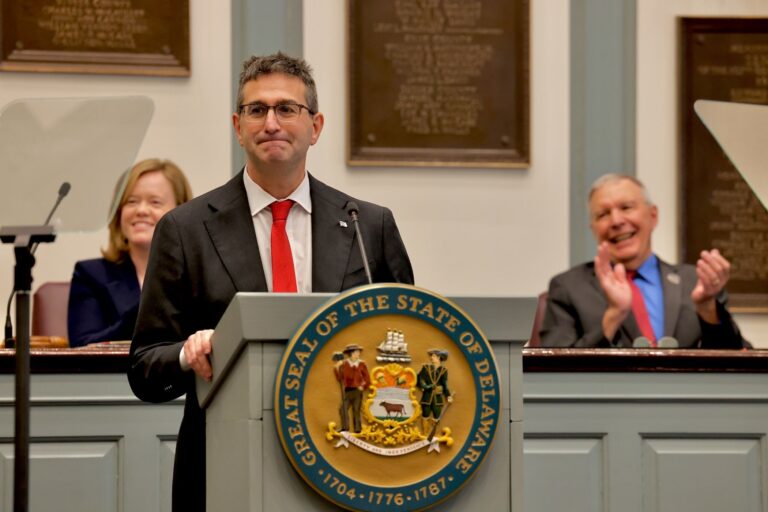
FILE - Delaware Gov. Matt Meyer pictured at his 2025 State of the State address. (Emma Lee/WHYY)
What are journalists missing from the state of Delaware? What would you most like WHYY News to cover? Let us know.
Delaware Gov. Matt Meyer vetoed four pieces of legislation this week, ranging from the governor’s emergency powers to salary increases for school social workers.
State lawmakers were notified of the vetoes on Wednesday. All four bills passed either unanimously or unopposed earlier this year.
The governor has until Oct. 1 to act on the hundreds of bills the General Assembly passes every year. Once the governor has received a bill, Meyer has 10 days to sign or veto the legislation. But bills often aren’t sent to his office by the Legislature until he requests them. The General Assembly’s deadline to send his office all outstanding bills was Sept. 18.
Meyer vetoed two Senate bills last year, one that loosened local zoning restrictions on recreational marijuana stores and the other that aimed to close wage theft loopholes that occur when a general contractor wrongly labels a subcontractor an independent contractor.
The General Assembly later overrode both of those vetoes.
The governor used his line item veto earlier this year to strike the legislative hall renovation from the capital improvements bill.
House Bill 393
HB 393 would have added additional consumer protections for third-party electric suppliers.
“I’m shocked,” said retiring state Rep. Debra Heffernan, D-Bellefonte. “They had always said that it had been a priority of theirs to protect consumers with legislation like this, and that’s why we had worked on it for over a year to craft it with the governor’s office.”
Heffernan’s legislation would have also mandated the Delaware Public Service Commission to develop and administer a training and certification program for suppliers and to consider penalizing suppliers who don’t comply with the rules.
Related Content
Legal scholars question who would be liable for an artificial intelligence agent’s bad behavior under the state’s proposal.
7 days ago
Listen 1:09Heffernan said these companies need more oversight because Delawareans have complained about being locked into contracts that auto-renew without notice, using variable rates that can spike without notice, and having charged customers more than they would have paid Delmarva Power for the same electricity.
Meyer’s veto message said third-party electric suppliers offer more flexibility to consumers and the legislation would mean less choice in the marketplace. Heffernan said if they’re taking advantage of customers, then they shouldn’t be in the marketplace.
“It’s almost like choice to pay to be ripped off,” she said.
House Bill 329
The legislation, sponsored by Rich Collins, R-Millsboro, would have allowed the General Assembly to void a governor’s power to continue a state of emergency after six months. It would have taken effect after Meyer left office.
Meyer’s veto message argues that the bill is unconstitutional because the process does not allow the governor veto power if state lawmakers decide to end the declared emergency.
“In an emergency, divided command means delayed action, confused responders, and blurred accountability,” he said in a statement. “When public safety is at stake, Delaware needs one clear chain of command and one official the public can hold accountable.”
Collins, who is not seeking reelection, said he disagrees with his legal reasoning and is concerned about the legislature’s ability to constrain a future overreach of executive authority.
What if we get a truly oppressive governor someday?” he asked. “Current law allows a governor to declare anything a state of emergency and keep the state of Delaware in it for as long as they say, even if that technically could be eight years, and there is no recourse.”
Senate Bills 231 and 279
SB 231, sponsored by state Sen. Marie Pinkney, D-Bear, would have raised the salary for licensed school social workers who passed the national clinical exam.
SB 279, sponsored by state Sen. Nicole Poore, D-South New Castle, would have adjusted the pay scale for eligible school-based occupational therapists.
Meyer said in a statement that he vetoed the two bills because of the cost and that his administration is waiting for the Delaware Department of Education to complete a survey of salaries.
“Concerned with the unfunded nature of these bills and for their potential to continue a piecemeal framework of salary adjustments across various education professionals, my administration agreed to conduct such a comprehensive review and is focused on completing that review,” the veto message said.
Poore said that 26 full-time occupational therapists teach students with disabilities skills, such as holding a pen or using a fork. She said that while she is disappointed with the veto, she was promised by the governor that the funding will be included in the next fiscal year state budget.
“I think ultimately we’re going to get to where we need to get to,” she said. “I’m just again surprised that it got vetoed, but as long as we’re able to level up the [occupational therapists], then I will be fine.”

Get daily updates from WHYY News!
WHYY is your source for fact-based, in-depth journalism and information. As a nonprofit organization, we rely on financial support from readers like you. Please give today.
Part of the series


The town council voted in favor of starting a repeal process for the divisive ordinance last month. The planning commission says there’s not enough evidence to support it.
2 weeks ago
Listen 1:06
Ted Lauzen defeats challengers in Delaware’s Democratic primary for state treasurer
Ted Lauzen will advance to the Nov. 3 general election and face Republican candidate Michael Ramone.
3 weeks ago

Katz defeats Shulli in Delaware’s Republican primary election for U.S. Senate
Dr. Mike Katz will face U.S. Sen. Chris Coons in the November general election. If elected, Katz would be the first Republican to hold the seat in 25 years.
3 weeks ago