
The future of flax is in a brick wall built along the Ben Franklin Parkway in Philadelphia
The Association for Public Art commissioned architect Jeff Richards to showcase the possibilities of flax as a building material.
Listen 2:45
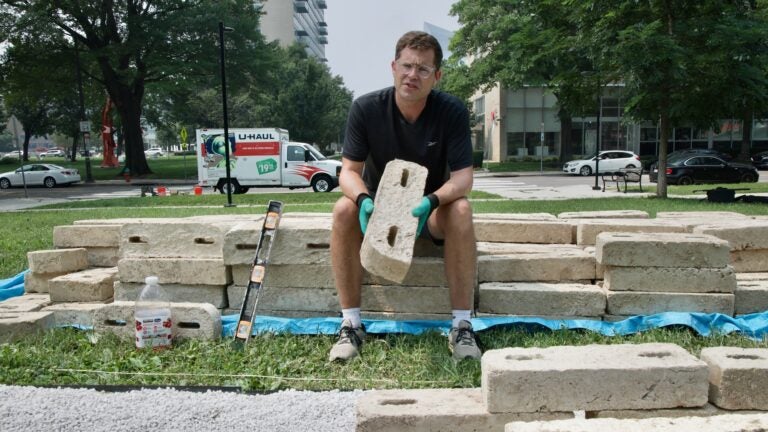
Architect Jeff Richards, an associate professor of architecture at Temple, fashioned 250 flaxcrete blocks for his project with the Association for Public Art, which touches on alternative building materials, human connections and the wisdom of Benjamin Franklin. (Emma Lee/WHYY)
From Philly and the Pa. suburbs to South Jersey and Delaware, what would you like WHYY News to cover? Let us know!
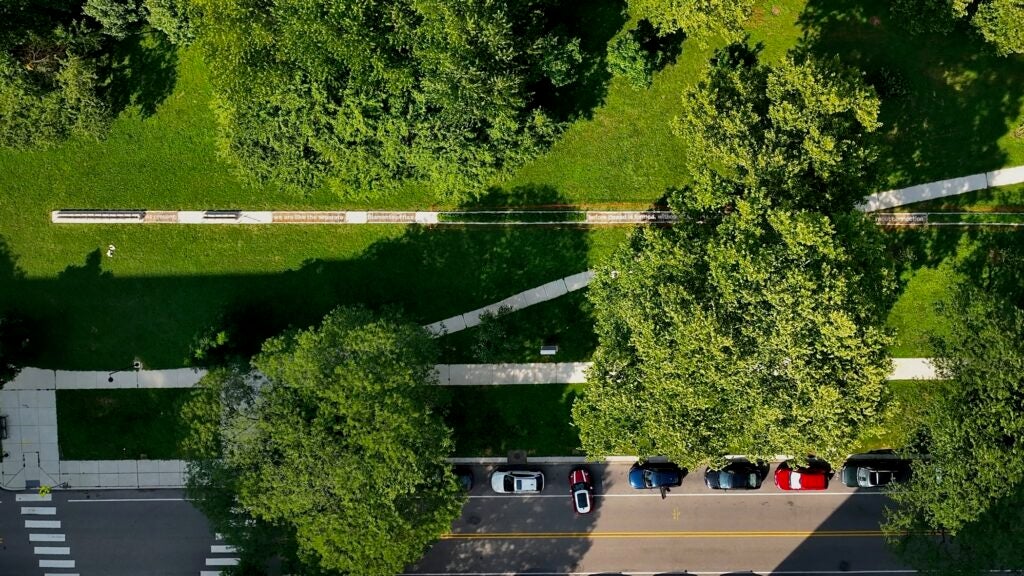
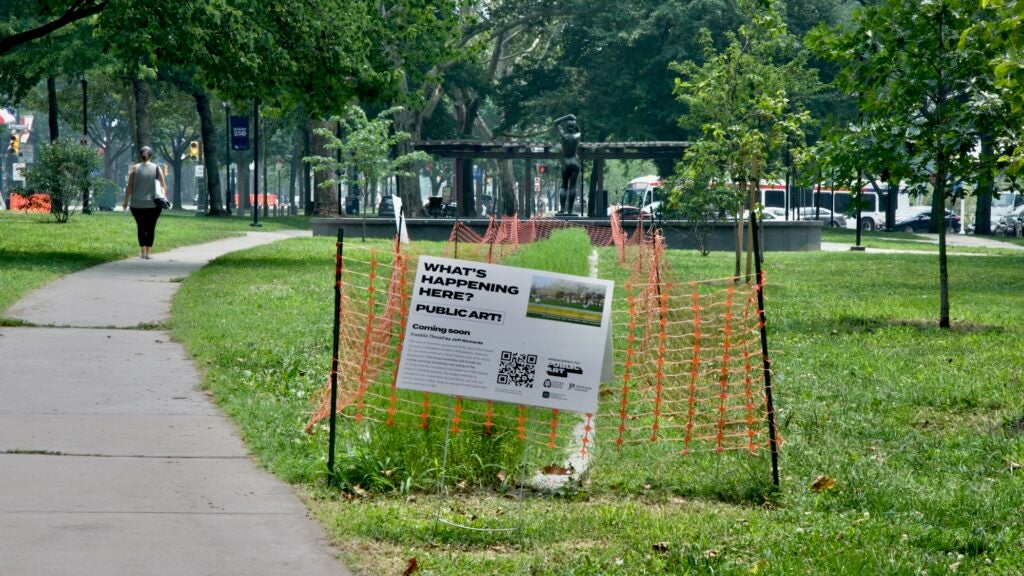
A 350-foot row of flax is growing in Maja Park along the Ben Franklin Parkway near Eakins Oval. The crop row is part of a temporary art installation commissioned by the Association for Public Art.
The plant, whose fibers have historically been used in linen textiles, has something to say. The row is accompanied by a quote that Ben Franklin wrote in 1747 as he was lamenting the lack of unity among American colonial militias.
“At present, we are like separate filaments of flax before thread is formed,” Franklin wrote in his pamphlet “Plain Truth.” “Without strength, because without connection.”
Called “Franklin Thread,” the installation was conceived and built by architect Jeff Richards to demonstrate the past and possible future of flax as a commodity crop, taking inspiration from Franklin’s quote.
“Obviously he was talking about strength against monarchy and independence from England. I find it resonant still,” Richards said. “It’s important for me in thinking about one way in which we can reestablish a way of operating that connects us. It connects us with the planet, with our city, with each other.”
Building a wall of flaxcrete
As the third iteration of the Association for Public Art’s “Art on the Parkway” program, executive director Charlotte Cohen said “Franklin Thread” was selected, in part, for its living growth and long, linear shape.
“Maja Park is not just a little patch of park. It’s a really big expanse that includes an allay of trees and an open lawn in brilliant sunlight in the middle of summer, and the seasons change,” Cohen said. “We are really open to different kinds of projects that will use it in different ways and engage the public in different ways.
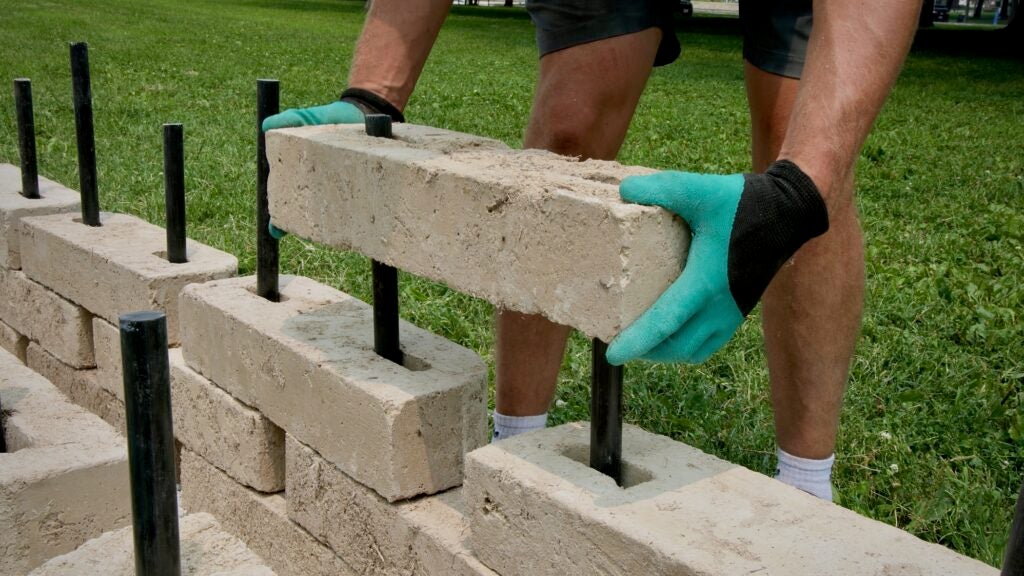
At the west end of the row is a wall Richards built out of concrete blocks made with parts of the flax plant. Called flaxcrete, the blocks are made with the flax shives, the woody part of the stem that is removed when flax is processed as textile fibers. The shives are then mixed with a lime binder.
Similar to hempcrete, which is made from woody parts of the hemp plant, flaxcrete is much lighter than traditional concrete. It is also less structural: Flaxcrete cannot be used to bear heavy weight loads as it has low compression strength.
But in Richards’ teaching and research at Temple University’s Tyler School of Art and Architecture, he has been experimenting with ways flaxcrete could be designed into buildings. He said he wants to go beyond environmental sustainability to think about environmentally beneficial design.
“I think, by and large, the environmental movement over the past 60 years has been a disaster,” Richards said. “To say one is to be sustainable is to presume that we can only do harm. It’s a matter of thinking that we as a human civilization are a cancer to the Earth and the best we can do is to limit that harm.
“But we can do better than that. We can be ecologically positive so that we’re actually improving our lot in the world.”
Related Content
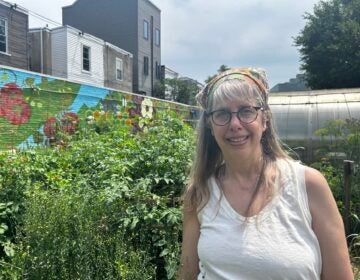
Pa. residents revive colonial-era practice by growing a ‘square yard’ of flax
The PA Flax Project promotes the revitalization of the industry as a climate-friendly crop that could be used to make the sustainable plant-based fiber linen.
2 months ago
Listen 1:01Sequestering carbon in building materials
The main binding element of traditional concrete is cement, made in a process that releases significant amounts of carbon dioxide into the atmosphere, contributing to climate warming. Cement production alone is responsible for about 8% of global carbon dioxide emissions, according to the U.S. Department of Energy.
Using plants in concrete could not just reduce its carbon footprint, but negate it. Plants absorb CO2, and binding plants into concrete would trap that CO2 into the building material where it would not burn, biodegrade or otherwise release it back into the atmosphere.
For many applications flaxcrete would not work. It is unlikely a highway overpass will be built out of flax. Even if there were ways to utilize flax, it is hard to get locally. Once plentiful in Pennsylvania, flax is no longer grown here as a commodity crop. Richards sourced shive for his flaxcrete blocks from Nova Scotia, Canada.
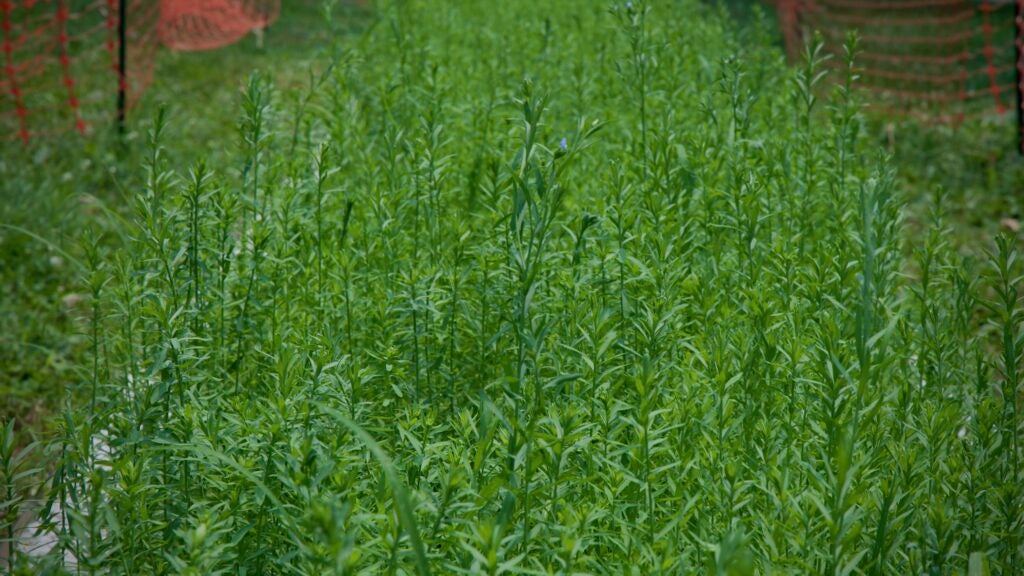
The PA Flax Project is trying to bring flax back into Pennsylvania agriculture, a little bit at a time. The cooperative’s square yard campaign is asking people to grow a square yard of flax, a challenge that has been taken up by the Betsy Ross House, among others. Flax Project founder Heidi Barr said there are 45 acres of flax being grown in Pennsylvania right now, and she expects to have 300 acres next year. She is shooting for 1,000.
It is a “Catch-22” game between farmers and processors, according to Barr. You need to grow large amounts of flax to justify building a mill, but you need a mill to justify growing large amounts of flax. Once growing and processing flax is established, she said it can be a zero-waste proposition.
“When we visited the mills in Europe, the thing that struck me the most is there are no dumpsters,” Barr said. “The products with commercial value are the long-line fiber, the short fiber, the shive and the dust. Those are all collected and sold.”
The PA Flax Project is primarily focused on growing flax for the textile industry. Could it also be used to launch production of viable building materials?
“That’s a million-dollar question right there. I would not be doing what I’m doing if I didn’t believe that all the products you could produce from flax are going to be viable in the near future,” Barr said. “In particular in the fiber market, there’s a global market that is growing. There’s a huge growing demand. The industrial building trades are a little bit behind the curve.”
Flax has taken a back seat to hemp
In the world of alternative building materials, hemp has been getting a lot of attention. The Healthy Materials Lab of Parsons School of Design in New York built a Hemp House in New Castle, Pennsylvania, to showcase the possibilities. Hemp has also entered the commercial building trades. Right Coast Hemp of New Jersey promotes hemp in construction and renovation, often as antimicrobial wall insulation.
Flax has not enjoyed the same popularity as hemp. Richards said he was attracted to flaxcrete’s potential because the plant is already part of the textile industry. Richards believes incorporating flax into design thinking could tie industrial processes to the Earth’s natural processes.
“It’s a part of a biological cycle that’s not disconnected from a human cycle,” he said. “Fifty years ago, a couple miles north of here, we used to make linen in this city. We no longer do. It’s now abroad in places like China. We can bring that back to our city and the way of thinking that builders can be connected to both natural and human processes.”
“Franklin’s Thread” will be on view through October. Public programs onsite are in the planning stages, which could include a harvesting demonstration and flaxcrete molding workshops.

Get daily updates from WHYY News!
WHYY is your source for fact-based, in-depth journalism and information. As a nonprofit organization, we rely on financial support from readers like you. Please give today.
Philadelphia readies first-ever New Year’s Eve concert on the Parkway
The event will feature LL Cool J, who boycotted his July 4 show because of a city workers strike.
8 months ago
A new Holocaust mural on the Parkway tells a story of displacement in 28 languages
“Lay-lah Lay-lah,” by artist Ella Ponizovsky Bergelson, uses ancient texts to connect the historic atrocity to a range of communities and underscore a shared humanity.
12 months ago
Listen 1:22
The Association for Public Art’s “Bar None” by Nicolo Gentile reflects on the history of the Parkway as a crucial site of public assembly.
1 year ago
Listen 1:16