

FBI Director Kash Patel joins Allentown roundtable on fentanyl hosted by Sen. McCormick
About 1,400 opioid overdose deaths were reported in Pennsylvania last year, a 60% drop from pandemic-era averages.
Listen 1:24
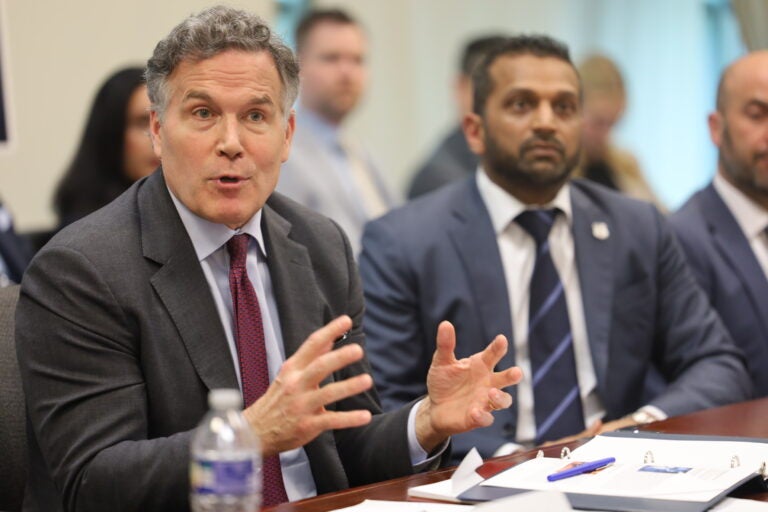
Sen. David McCormick (left) and FBI director Kash Patel lead a round table discussion on efforts to combat fentanyl addiction in Allentown Wednesday. (Carmen Russell-Sluchansky/WHYY)
From Philly and the Pa. suburbs to South Jersey and Delaware, what would you like WHYY News to cover? Let us know!
Federal, state and local leaders gathered Wednesday at the Edward N. Cahn Federal Building in Allentown, Pennsylvania, to confront what they described as one of the most urgent public health and public safety crises facing the country: fentanyl.
U.S. Sen. Dave McCormick, R-Pa., and FBI Director Kash Patel convened the roundtable, bringing together prosecutors, law enforcement officials and families who have lost loved ones to the drug. The discussion focused on recent progress, remaining gaps and the need for continued coordination across agencies.
McCormick opened by emphasizing the scale of the response and the stakes involved.
“This is such a poison that destroys families and destroys communities,” he said, pointing to the broad coalition in the room, including federal agencies, district attorneys and state officials. “We’re making progress. That’s the first message. The second message is there’s so much more to do.”
Overdose deaths in Pennsylvania averaged around 4,000 between 2020 and 2023, according to McCormick’s office, dropping over 30% in 2024 and again in 2025, bringing that number down to 1,400 last year. He highlighted federal efforts to disrupt supply chains, including targeting fentanyl precursors from China and cracking down on cartel distribution networks, while also stressing the importance of legislation aimed at making the drug harder to traffic and sell.
The human toll remained central throughout the discussion. McCormick noted several families in attendance who shared their stories, calling their losses “a disaster” and thanking them for speaking out “with the hope of making sure other families don’t have to go through this.”
Patel echoed that sentiment, describing the families’ experiences as a daily motivator for law enforcement.
“The enormity of your loss is something I can’t comprehend,” he said. “But I try to remind myself of it every day as a driving force to know that there’s still work to be done — and we’re going to do it.”
At the same time, Patel underscored the scale of the threat, citing major increases in fentanyl seizures and the volume of drugs intercepted in Pennsylvania alone.
“In 2025, the interagency effort seized enough fentanyl in Pennsylvania that would have killed half the population here,” Patel said. “That’s a constant reminder that we’ve done tremendous work, but we have a heck of a lot more work to do.”
A key theme of the discussion was coordination. Officials repeatedly described the fight against fentanyl as a “team effort,” requiring alignment across federal, state and local levels. Patel highlighted structural changes within the FBI, including shifting agents out of Washington, D.C., and into field offices around the country.
“Putting people on the problem set in the field — that’s how you break bureaucracy,” he said, noting that dozens of joint task forces now operate nationwide.
Related Content
Sen. McCormick, NIH director tour Penn medical sciences laboratory amid NIH funding crisis
The visit comes as questions swirl around the future of NIH funding. Sen. Dave McCormick said he would oppose any new cuts.
5 days ago
Listen 1:32McCormick made fighting the fentanyl epidemic a significant part of his 2024 campaign and has even advocated employing the military to attack drug cartels in Mexico. He co-sponsored the Halt Fentanyl Act, which permanently classifies fentanyl as a Schedule 1 drug, and was signed into law last year. Later, he introduced the Nitazene Control Act to similarly classify newer narcotics and, in March, introduced the Joint Task Force to Counter Illicit Synthetic Narcotics Act of 2025, to “improve federal coordination” to “go after trafficking organizations [and] address China’s central role in producing fentanyl precursors and laundering drug money.”
U.S. Attorney David Metcalf reinforced the importance of targeting higher levels of the drug supply chain.
“When you measure it by lives lost, the most significant criminal problem we face is still drugs,” he said. “We try to dismantle the problem at the highest level … with cartels and transnational organized crime.”
He noted that Pennsylvania removed more than 56 million doses of fentanyl in 2025 alone, calling it evidence of aggressive enforcement efforts while cautioning that progress must be sustained.
“Now’s the time where you triple down,” Sunday said.
Allentown Mayor Matt Tuerk, who was not present during the discussion, later told WHYY News that said the city is “happy when our federal partners come to Allentown in a collaborative spirit,” but warned that enforcement alone is not enough as federal dollars for social programs remain at risk.
“I hope that the administration is focused on not just the big headline gravity stuff, but on doing things that strengthen cities,” he said. “They can do that by making smart investments and working closely and collaboratively with cities.”
Tuerk said that includes funding social services that prevent addiction and help offset potential losses in access to fentanyl treatment for Medicaid recipients who may lose coverage under new work requirements and eligibility changes. Medicaid currently pays for about 90% of all treatment.
“As a mayor and as a city leader, my concern is that the good work that law enforcement does to deal with fentanyl or other violent crime gets undercut by decisions that the administration has made that weakens a social safety net and it just creates more problems at the local level,” Tuerk said.
McCormick acknowledged ongoing concerns about funding and long-term strategy, particularly around addiction treatment and mental health services.
“None of us feel like we have conquered all the dimensions of this problem,” he said, adding that Medicaid funding has actually been increased, though reforms may “slow the pace of growth in spending.”
“That pace of growth will slow to about 3%, which is still higher inflation, so it’s still growing,” he said. “How those additional funds will be allocated, I think, is something that remains to be seen.”
Pennsylvania Attorney General Dave Sunday emphasized that opioid settlement funds are being directed toward treatment and recovery programs, calling them “crucial” to reducing demand alongside supply-side crackdowns.
“We’re here talking about everything we’re doing today to address the supply, but at the same time, we have to just as vigorously go after the demand,” he said.
U.S. Rep. Ryan Mackenzie, R-Allentown, noted that the Lehigh Valley has been heavily impacted due to its location along major trafficking routes, with “hundreds of families” affected over the years.
Sunday added a personal perspective, describing the crisis not just as a law enforcement issue, but as a fear shared by parents across the state.
“When I was a kid, if you made a mistake, you might not feel well for a day,” Sunday said. “In today’s world, one mistake can equal death. That’s not hyperbole, that is very, very real.”

Get daily updates from WHYY News!
WHYY is your source for fact-based, in-depth journalism and information. As a nonprofit organization, we rely on financial support from readers like you. Please give today.
The FBI wants to interview six congressmembers who appeared in a social media video, including two from Pennsylvania — U.S. Reps. Chrissy Houlahan and Chris Deluzio.
4 months ago
Listen 0:45
Millionaire Sen. Dave McCormick favors Pa. ‘muni’ bonds as tax shelter
The bonds — issued by public agencies to fund infrastructure projects — are often favored by wealthy investors due to their low risk and the significant tax incentives.
6 months ago
Trump promotes energy and tech investments at a summit in Pennsylvania
Trump traveled to Pittsburgh at a summit helmed by Republican Sen. David McCormick that included dozens of top executives.
9 months ago