

Delaware civil rights advocates say proposed loitering and panhandling legislation criminalizes unhoused people
Current state laws against panhandling are not in effect because of First Amendment concerns by civil rights groups.
Listen 0:56
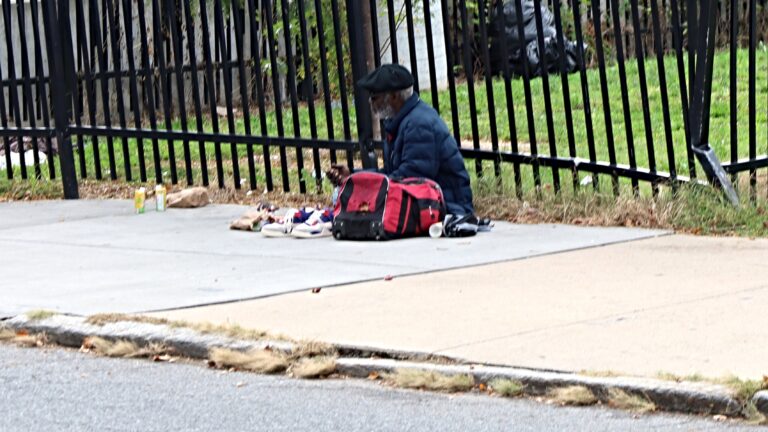
A man sits on a sidewalk in Wilmington, Delaware. Under proposed legislation, that could subject a person to a fine or arrest. (Sarah Mueller/WHYY)
What are journalists missing from the state of Delaware? What would you most like WHYY News to cover? Let us know.
Legislation cracking down on loitering and solicitation is expected to be introduced soon in the Delaware General Assembly after draft legislation languished for more than a year.
No one had been willing to publicly sign on to State Attorney General Kathy Jennings’ January 2025 draft Senate bill, until now. Updated legislation obtained by WHYY News, now a House bill dated Feb. 26, names state Rep. Stephanie Bolden and state Sen. Darius Brown, Wilmington Democrats, as sponsors. Brown and Bolden did not return a request for comment.
Some lawmakers have recently voiced frustration that law enforcement can’t do more to prevent vagrancy, also known as quality of life or status offenses, such as people standing on traffic medians panhandling, hanging out all day in front of businesses or sleeping on sidewalks or under overpasses.
Civil rights groups and housing advocates argue that high prices, a lack of affordable housing and persistent poverty are causing rising homelessness in Delaware, with people just trying to survive. They say officials are trying to criminalize having no place to live.
“I think what people are really saying with some of these statutes is, ‘I don’t want to see people who are unhoused,’” said Meryem Dede, executive director of the Tide Shift Justice Project. “‘I don’t want to see people with a certain skin color, and therefore I want this loitering statute … so that they can’t exist in public.’ And I think that’s what these really get to is trying to make it so that some people can’t exist in public.”
Related Content
The Friendship House is a Wilmington community organization that helps homeless residents find stability and resources.
10 months ago
Listen 0:54Current state law unenforceable due to free speech concerns
Jim Martin is the director of the Shepherd’s Office in Georgetown, which helps people experiencing homelessness. Once homeless himself, he’s spent 15 years serving people in need. He said town residents are unhappy with the group’s efforts to feed and care for those struggling.
“It just annoys people so much to see all the homeless out there,” he said. “They would rather the homeless be invisible. I think they don’t want to be reminded that there’s people that are desperately poor.”

Some state lawmakers say their constituents want additional legal restrictions to curb vagrancy in their districts. Joint Finance Committee Chair Trey Paradee, D-Dover, said there seems to be an uptick in petty crimes in Wilmington and Dover.
“It’s frustrating for the police officers who feel like they’re arresting some of the same people over and over and over again, and then those individuals aren’t being held accountable,” Paradee told Delaware Supreme Court Chief Justice Collins Seitz during a recent budget hearing. “But I think it’s also very frustrating for the public.”
Other state lawmakers are wary of taking a one-sided approach. Senate Majority Leader Bryan Townsend, D-Newark, said he requested his name be removed from the draft Senate bill in April after deciding against being the lead sponsor.
“I have concerns about any approach that does not properly provide for housing supports and other supports for the individuals we see panhandling on our roadways,” he said. “We cannot use simply a criminal approach to solve this problem.”
The state’s anti-loitering and anti-solicitation laws can’t be enforced after a 2024 legal settlement between the American Civil Liberties Union of Delaware and the state and city of Wilmington. The civil rights group sued, arguing it was unconstitutional.
Jennings’ proposed legislation tries to avoid potential free speech and due process infringement by talking about traffic safety rather than “pedestrians soliciting rides or business.”
Delaware Department of Justice spokesperson Mat Marshall said the measure preserves the most critical public safety and public order elements of the loitering and solicitation statutes as they previously existed, and puts the state on sound constitutional ground.
Mike Brickner, executive director of the ACLU of Delaware, said his organization has some concerns with Jennings’ bill as written.
“We believe there are several parts of that bill that, very likely, could still be found unconstitutional, that are vague, that run afoul of other legal cases that have come out of federal courts in terms of how you can and cannot regulate unhoused people and their speech and where they exist out in the community,” he said. “So we still have some pretty significant concerns about this proposed legislation.”
Marshall said the DOJ is confident the bill would pass constitutional muster.
Related Content
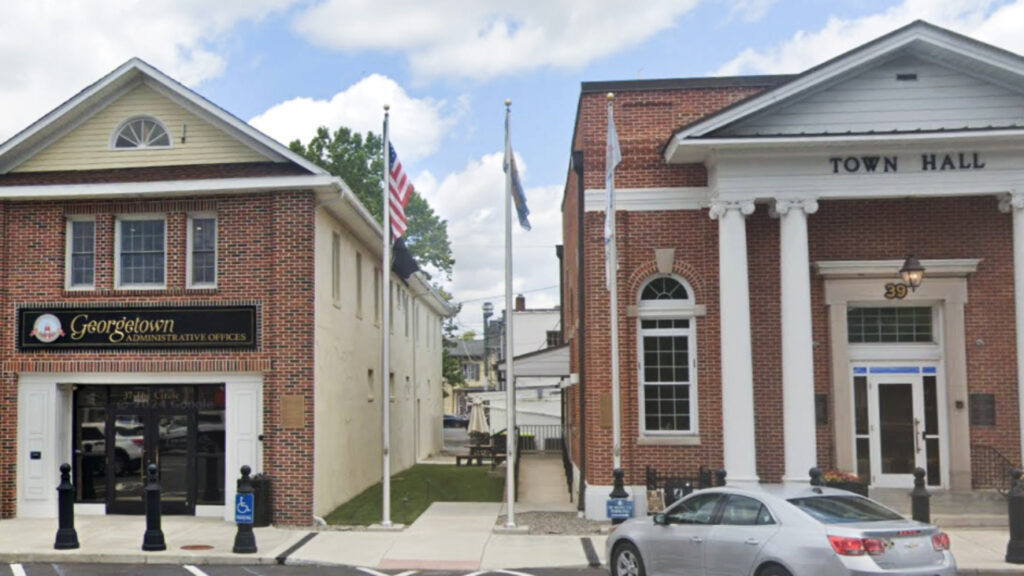
How services, housing gaps and policy made Georgetown, Delaware a focal point for homelessness
A new study sheds light on why homelessness is concentrated in Sussex County’s Georgetown and what leaders say is needed to address it.
9 months ago
Listen 1:40‘We will not incarcerate our way out of homelessness, substance use, addiction’
Chief Justice Seitz pushed back on lawmakers seeking a law enforcement solution, saying the state is unable to incarcerate its way out of the problem. He said fining people who don’t have any money is meaningless, and judges are unable to imprison them for years on end for minor offenses.
“Where we need to focus is on treatment and on poverty in the state,” he said. “You can cure a lot if you can lift people out of poverty and you get people jobs, you have job opportunities. There’s a lot of ways other than locking people up to solve this problem.”
Nearly 1,600 people were unhoused in Delaware in 2025, according to the Point in Time count by the nonprofit organization Housing Alliance Delaware. That’s a 16% increase over 2024. The state’s homeless population increased 9% in 2024, from 1,245 to 1,358, according to that year’s report.
To address a lack of affordable housing and homelessness, Gov. Matt Meyer is proposing spending $11 million in the operating budget and $37 million in capital projects for fiscal year 2027.
His recommended $6.9 billion budget devotes $1 million to combat homelessness, along with $19 million for the Housing Development Fund, which aims to provide affordable housing to very low-, low- and moderate-income households. He’s also proposing funding for downtown redevelopment, restoring vacant properties and workforce housing.
Related Content

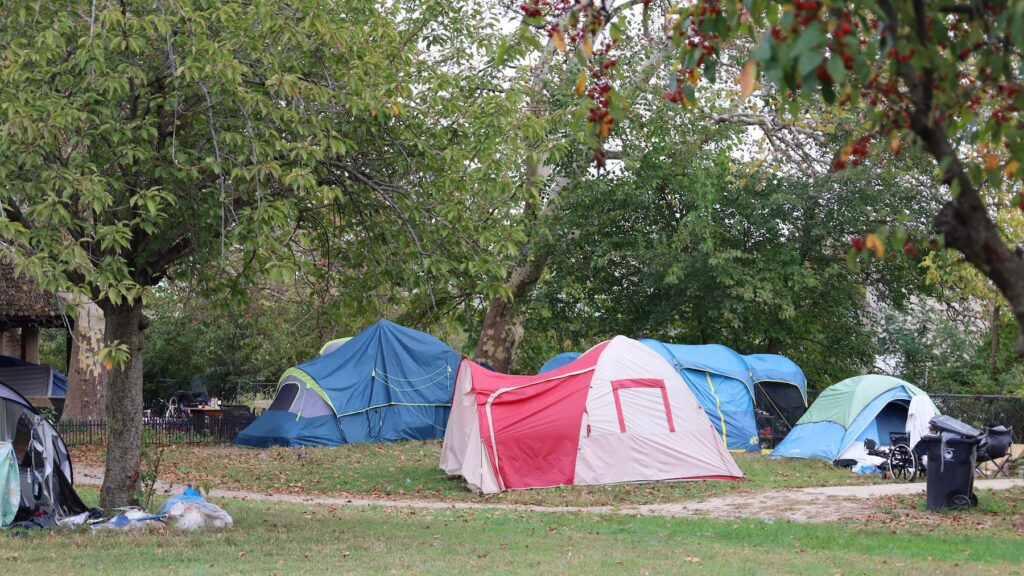
Wilmington officials will allow camping in one city park but ban sleeping outside in all other areas of the city.
12 months ago
Listen 0:49Municipalities considering anti-vagrancy laws earn mixed results
A traffic safety ordinance that would have penalized panhandling in the city of Dover failed 6-3 last month.
Wilmington City Councilman Chris Johnson is hoping he’ll get more support for his anti-loitering proposal, which he plans to reintroduce later this year. He previously pulled it to meet with stakeholders and the ACLU of Delaware. He said his measure was aimed at the liquor and smoke stores, not the unhoused.
“The city has a long-standing issue with the liquor stores, corner stores, so that is really the target,” he said. “We have people hanging outside. We want people to frequent stores, but people need to go to the stores, be a customer and then keep it moving.”
Wilmington has allowed unhoused people to sleep in Christina Park, but has banned sleeping outside in other parts of the city.
Georgetown has also prohibited sleeping outside and in their cars. Martin said he opposes the town’s sleeping ban, which can result in people being incarcerated for up to 20 days and fined up to $100.
“The government needs to give people a place to sit, stand or sleep without that being against the law,” he said.
State lawmakers return to session next week.

Get daily updates from WHYY News!
WHYY is your source for fact-based, in-depth journalism and information. As a nonprofit organization, we rely on financial support from readers like you. Please give today.
Part of the series

Part of the series


Sens. Coons, Blunt Rochester questioned the time the judge devoted to her late husband’s now-defunct ad firm and its political direction.
6 days ago
Listen 1:58
Justin Dynlacht thought his employer and health insurer didn’t provide adequate coverage for Crohn’s disease, but took his complaints way too far.
1 week ago
Listen 1:52
A man working for the contractor Greggo & Ferrara alleged he was called the N-word and “boy” by a white co-worker.
3 weeks ago
Listen 1:11