
U.S. Supreme Court Justice Gorsuch brings his vision of Revolutionary heroism to Philadelphia ahead of America’s 250th
Gorsuch and co-author Janie Nitze discussed their new children's book, “Heroes of 1776,” and the lessons the country’s founding era still offers today.
Listen 1:13
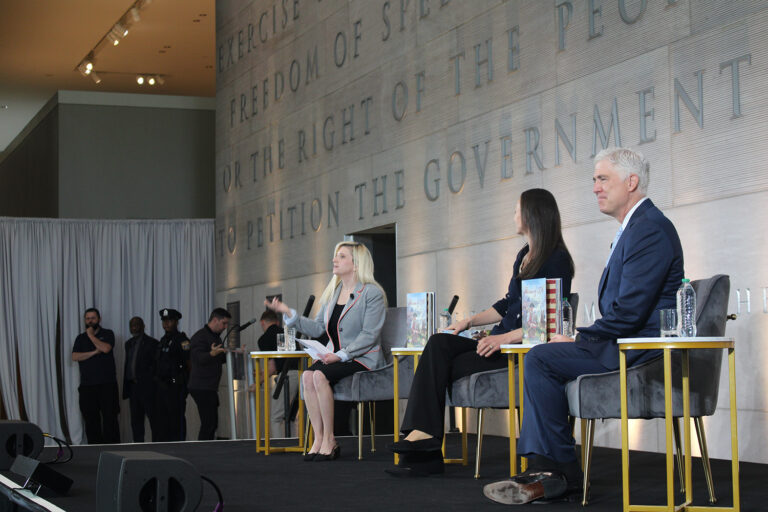
From left, Julie Silverbook of the National Constitution Center moderated a discussion with Janie Nitze and U.S. Supreme Court Justice Neil Gorsuch about their children's book, "Heroes of 1776: The Story of the Declaration of Independence," at the National Constitution Center in Philadelphia on May 30, 2026. (Emily Neil/WHYY)
From Philly and the Pa. suburbs to South Jersey and Delaware, what would you like WHYY News to cover? Let us know!
As Philadelphia prepares to mark the 250th anniversary of the nation’s founding, U.S. Supreme Court Justice Neil Gorsuch is entering the public discussion about how Americans should understand the generation that declared independence.
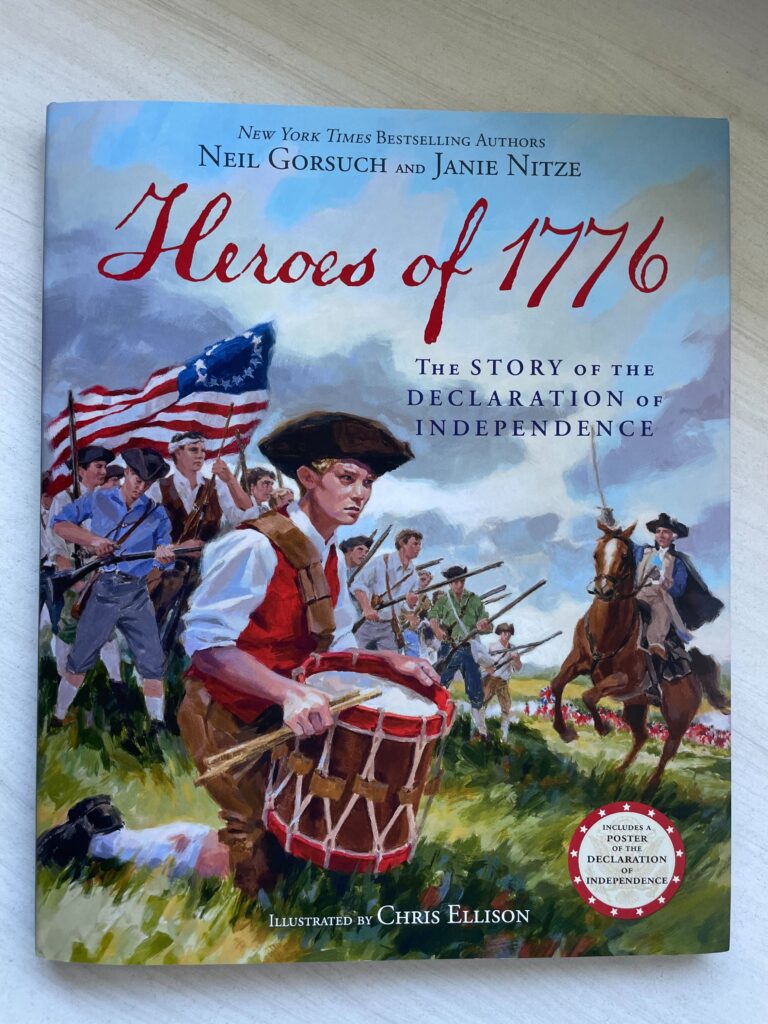
Speaking Saturday at the National Constitution Center, Gorsuch and coauthor Janie Nitze discussed their new children’s book, “Heroes of 1776: The Story of the Declaration of Independence,” released earlier this month. The pair said the book is intended to introduce young readers to the sacrifices, suffering and ideals that shaped the American Revolution.
More than 150 people attended the “Civic Story Hour” event, where Gorsuch and Nitze read excerpts from the book, discussed its origins with National Constitution Center Chief Content and Learning Officer Julie Silverbrook, and answered prescreened questions submitted by children in the audience.
Although there will be parades, fireworks and celebrations on the Fourth of July, the semiquincentennial is also “a time for reflection,” said Gorsuch, who’s also an honorary co-chair of the Center. He said that goal inspired him to write the book with Nitze.
“I think we forget the Revolution wasn’t an automatic thing, it was an eight-year-long bloody war, incredibly difficult, a lot of suffering, and there were people who were willing to give everything they had for those ideas,” he said. “And now soon enough they’re going to be in your hands, those ideas, and are you going to fight for them? What are you going to do with them? And that was kind of the inspiration behind the book to challenge children and adults to think about those two things.”
The Declaration’s lessons throughout history
The narrative focuses predominantly on the well-known “Founding Fathers,” and emphasizes their personal experiences during the Revolutionary War, along with stories of some of the lesser-known men who fought for the Continental Army. It also touches on the contributions of some of the women who supported the Revolution, including the story of Mary Katharine Goddard, a publisher in Baltimore whose name appears in the first printed copies of the Declaration of Independence.
Nitze, a civic education advocate, has worked in the U.S. Department of Justice and clerked for Gorsuch and fellow Supreme Court Justice Sonia Sotomayor. Nitze and Gorsuch had previously teamed up to write two nonfiction books on law in the U.S. and Gorsuch’s own journey, both of which ended up on the New York Times best-seller list.
She said the purpose of “Heroes of 1776” was to portray “some of the humanity” of the story of the events that led to U.S. independence.
“We really sought through these stories of suffering and sacrifice to emphasize these virtues of character … so kids might see models of people that they may wish to emulate,” Nitze said.
In the book, the sacrifices and suffering of enslaved people and Black Americans during the time period are mentioned in one paragraph describing the story of James Armistead Lafayette, a Black American who gathered intelligence for Gen. George Washington.
Related Content
LIVE from Penn Law: How the U.S. Supreme Court evolved through history
From Penn Carey Law School, a look at three consequential SCOTUS rulings. As The Court evolves with our democracy, how do generations view constitutional rights and ideals?
Air Date: April 13, 2026 12:00 pm
Listen 51:37In Saturday’s discussion, Gorsuch said the ideals enshrined in the Declaration have served as a touchstone for change during the abolition of slavery, the suffrage movement and the Civil Rights Movement.
“I think Frederick Douglass is right. Hold fast to the Declaration in everything you do, always,” he said, referring to a sentiment attributed to Douglass’ 1852 address “What to the Slave Is the Fourth of July?”
“And in order to do that, I think you need to arm yourself with a lot of information, and we need to know our history better than we do,” he continued.
The book’s release comes at a time when the conservative-majority Supreme Court is refuting accusations of political bias in the wake of a ruling limiting the Voting Rights Act.
On Saturday, Gorsuch spoke to the importance of “the separation of powers,” and having “neutral, independent judges decide cases and controversies.”
“I think it’s kind of disheartening how few people know that we have three branches of government and can name the three branches of government,” Gorsuch said. “And then how few people know why those branches are the way they are, but to me … that was the brilliance of the design.”.
On Saturday, Gorsuch acknowledged present-day political polarization in the United States. He said John Adams’ and Thomas Jefferson’s complicated relationship demonstrates that partisan politics is not a new phenomenon.
“Adams believed in a strong central government, [and] Jefferson … a weak one,” he said. “They wrote terrible things about each other in newspapers, terrible things. I mean, if you think …. today’s political discourse has its troubles, and I’m not saying it doesn’t, go read what Adams had written about Jefferson.”
Adams’ and Jefferson’s reconciliation and work together on the Declaration shows that “for all that divided them — and there are things that divide us — more united them than separated them,” Gorsuch said.
‘The Declaration served a purpose’
Dominic Orlando came down from New York City with his wife and two daughters to hear Gorsuch speak.
He appreciated the “small anecdotal stories” about the American Revolution shared in the book and the discussion.
“The words have meaning,” he said, “and I feel that we lose a lot of that meaning with some of the things that go on today, and that if we would remember that the Declaration served a purpose and the Constitution, as written, served a purpose, we would do so much better.”
Peter Ghidu, 10, of Glenside, said the event was “cool,” and he liked learning about “unknown stories from the Revolution.”
He said he’s currently learning about the Declaration of Independence and the U.S. Constitution in school, and he thinks the most important parts of the nation’s founding documents are “the rights they had … that everyone has these unalienable rights that couldn’t be taken away.”
Saturday’s “Civic Story Hour” is one of a slew of activities and events the National Constitution Center has planned to mark the 250th anniversary of the Declaration of Independence.
“We want families to discover that history is not simply something that happened long ago to other people,” said Vince Stango, interim president and CEO of the National Constitution Center, during his introductory remarks at Saturday’s event.
“The people and events we study are part of our shared American story,” he added. “They help us understand the principles that shaped our nation, inform the world we live in today and remind us that each generation has a role to play in writing the chapters that follow.”
The National Constitution Center will be open free of charge on the Fourth of July in celebration of the country’s 250th anniversary.

Never miss a moment with the WHYY Listen App!


WHYY is your source for fact-based, in-depth journalism and information. As a nonprofit organization, we rely on financial support from readers like you. Please give today.
Part of the series
Philadelphia 250
The United States is marking its semiquincentennial — or its 250th anniversary — in and around the City of Brotherly Love.
The end of the Obama-era policy could mean an imminent deportation threat for Haitians who have been living in the U.S. for over 15 years.
3 months ago

After days of oppressive heat, thunderstorms cut Philly’s July 4th concert short
After storms forced attendees to evacuate, the concert resumed around midnight with a shortened performance by The Roots, followed by fireworks.
3 months ago
Listen 0:55
Patriotic Pet Parade at Betsy Ross House in Old City celebrates America’s 250th birthday
The competition boasted 22 pets donning a range of red, white and blue attire.
3 months ago