
America 250th: Philly event highlights youth perspectives on the American Revolution
The event, hosted by WHYY and Penn’s McNeil Center, brought together a panel of students and educators to discuss the meaning of democracy.

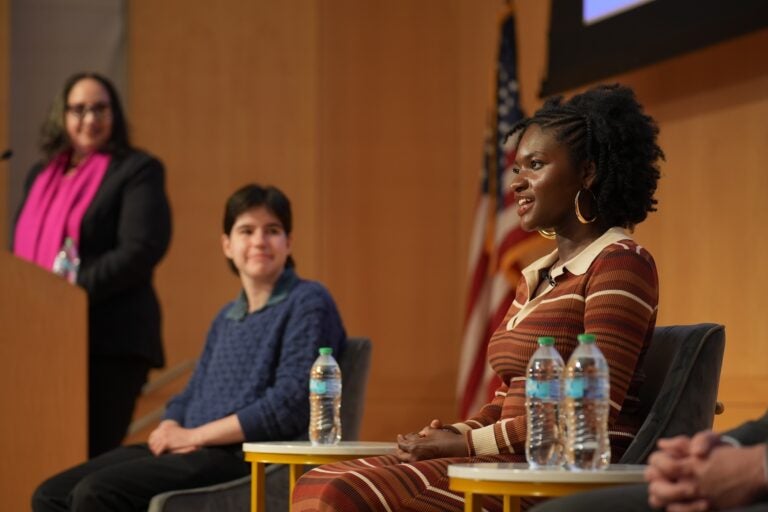
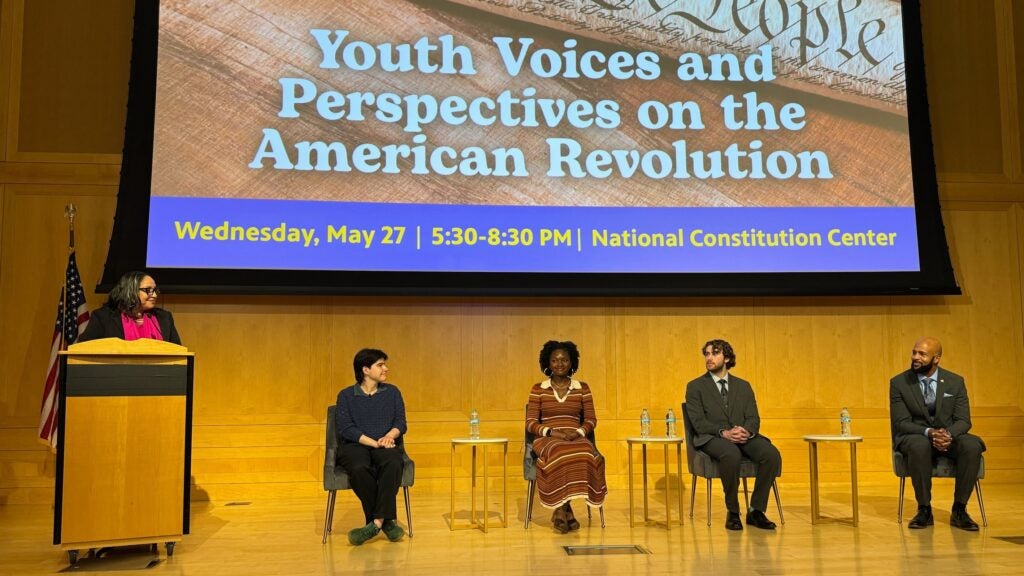
Panelist Maya Izzard, 17, talks about the significance of the American Revolution has on youth today at the National Constitution Center as part of an America 250th community conversation titled "Youth Voices and Perspectives on the American Revolution" on May 27. (Joe Kaczmarek for WHYY News)
From Philly and the Pa. suburbs to South Jersey and Delaware, what would you like WHYY News to cover? Let us know!
What does representation mean to a generation of Americans who have grown up amid political polarization, social media and uncertainty?
That question was at the center of Youth Voices and Perspectives on the American Revolution, a public conversation hosted by WHYY, the McNeil Center for Early American Studies at the University of Pennsylvania and the National Constitution Center on Wednesday night.
The event brought together students and history scholars to explore how the ideals of the American Revolution continue to shape civic life nearly 250 years later, as well as the enduring promises of American democracy.
“As we approach the milestone 250th anniversary of the founding of the United States of America, we are reminded what the revolution in America was about at its heart,” said Sarah Glover, WHYY vice president of news, who moderated the event. “It was a youth-led movement which included many thinkers, soldiers and writers who shaped the founding and were young people or under 30.”
Related Content
A new map spotlights Revolutionary War history in Bucks County
The educational tool provides information about more than a dozen historical sites connected with the American Revolution.
3 months ago
Listen 0:55The meaning of the founding
The event was part of a series “We the People: Revolutions for Everyone,” which uses the 250th anniversary of the signing of the Declaration of Independence as a starting point to examine how ideas about democracy, freedom, citizenship and belonging have evolved in Philadelphia and across the United States.
Maya B. Izzard, a student at the Philadelphia High School for Creative and Performing Arts and a youth civic engagement advocate, said the upcoming 250th anniversary brings forth a host of “contradictions” and that the Constitution and the ideals that the country was founded on didn’t apply to “people like me,” she said.
“When I think of 250 years, I have to think about 400 years of slavery still at that point going on,” she said. “I have to think about the women in America that still did not have the ability to vote, even though they have proven time and time again that they are intelligent and able to … run farms, businesses, how there are still Indigenous people still being mistreated, murdered out on their own land.”
Leon Smith, who was honored as the 2026 National Teacher of the Year, said Izzard’s words reminded him of Frederick Douglass’ speech “What to the Slave Is the Fourth of July?”
He noted that many of the rights that were advocated for during the American Revolution did not “come to fruition for African Americans,” but that the concept of those rights has evolved over the course of American history.
“A lot of people refer to Reconstruction as, like, the second founding,” he said. “By the time we get to 1865, you have newly freed people that are now advocating for all the rights and privileges that should be bestowed to all Americans. And we get the Reconstruction Amendments … So these laws and rights that people were gaining were not just for one group of people, it was for everyone.”
Related Content
Chief White Eyes toggled between British and American leadership to secure land for the Lenape.
6 months ago
Listen 3:38Learning history
Smith, who teaches Advanced Placement U.S. history and African American studies at Haverford High School, said teachers bear some responsibility for ensuring students like Izzard feel connected to history.
“Oftentimes when we look at history, it’s very much a narrow view and we don’t really get a chance to see all the people that were in that particular location,” he said. “Within my classroom, we really kind of think about establishing a panoramic view.”
He used the example of Elizabeth Freeman, also known as Mumbet, one of the first slaves to file and win a freedom suit, in which the Massachusetts Supreme Judicial Court ruled slavery inconsistent with the 1780 state constitution.
Tristan Worsham, a constitutional content fellow at the National Constitution Center, agreed. He said many individuals throughout American history are overlooked.
“There are so many different people that sort of get tossed to the wayside that aren’t the Washingtons or the Madisons that we continually talk about and write biographies about that are still very important,” he said. “And so to understand our history means digging a little bit deeper sometimes, and so that’s what inspires me most.”
-
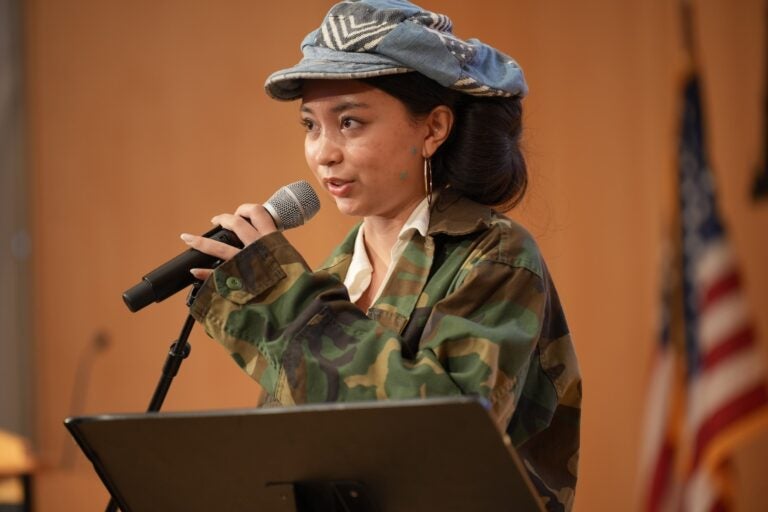
Malaya Ulan performs a poem to open the event. Ulan served as the 2024-2025 Youth Poet Laureate of Philadelphia and the 2025 Northeast Regional Youth Poet Laureate. (Joe Kaczmarek for WHYY News) -
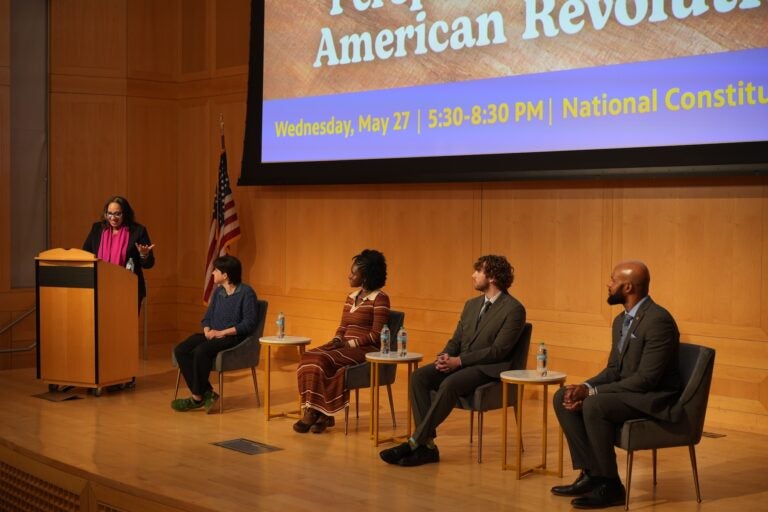
Moderator Sarah Glover (far left) and panelists from left, Sophia Gala, Maya Izzard, Tristan Worsham and Leon Smith discuss the impact of the American Revolution, representation and youth voices as America is set to celebrate the Semiquincentennial on July 4, 2026. (Joe Kaczmarek for WHYY News) -
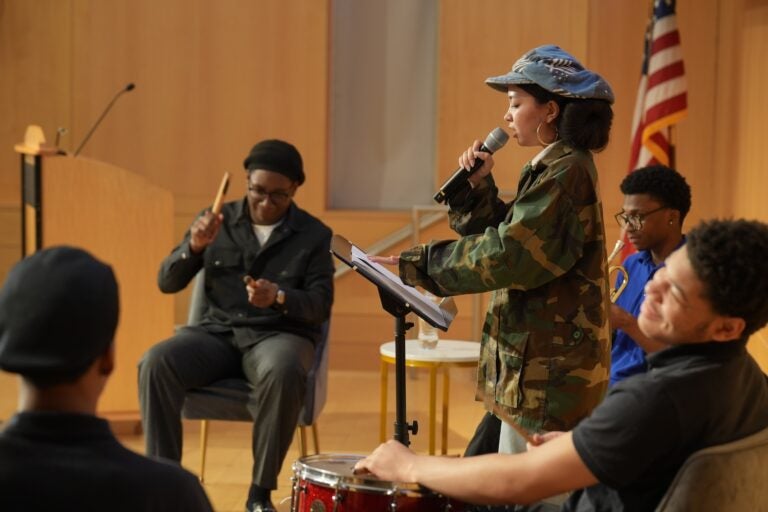
Malaya Ulan performs with the Equinox, a band consisting of High School for Creative and Performing Arts students Robert Randolph (trumpeter), Fahrad Austin (pianist), Cheo Mangum (bassist) and Zephaniah Jones (drummer). (Joe Kaczmarek for WHYY News) -
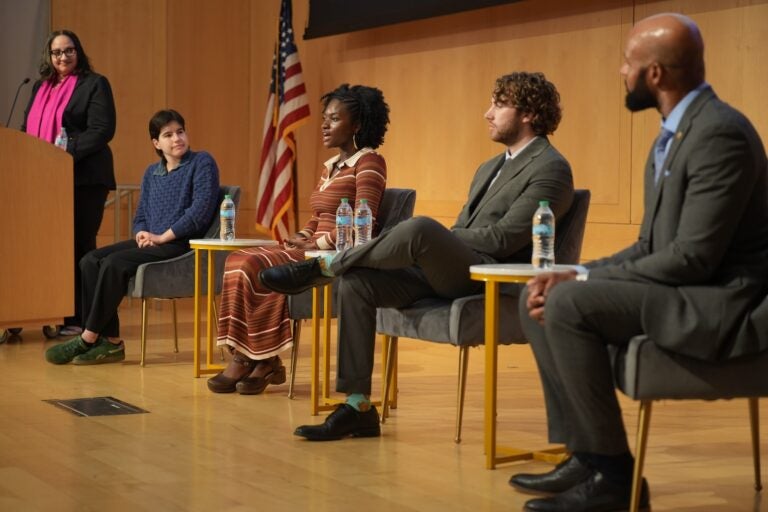
Moderator Sarah Glover (far left) and panelists from left, Sophia Gala, Maya Izzard, Tristan Worsham and Leon Smith discuss the impact of the American Revolution, representation and youth voices as America is set to celebrate the Semiquincentennial on July 4, 2026. (Joe Kaczmarek for WHYY News) -
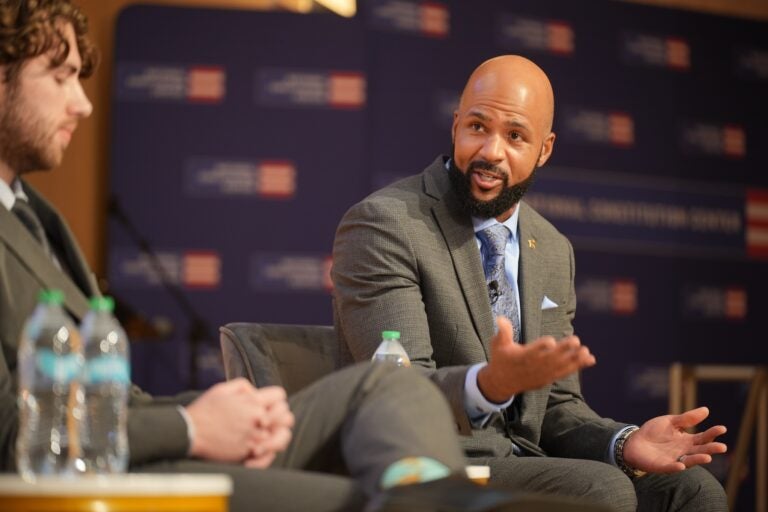
Leon Smith, the 2026 National Teacher of the Year and a history teacher at Haverford High School, compares the impact of the American Revolution and Reconstruction era on American society. (Joe Kaczmarek for WHYY News) -
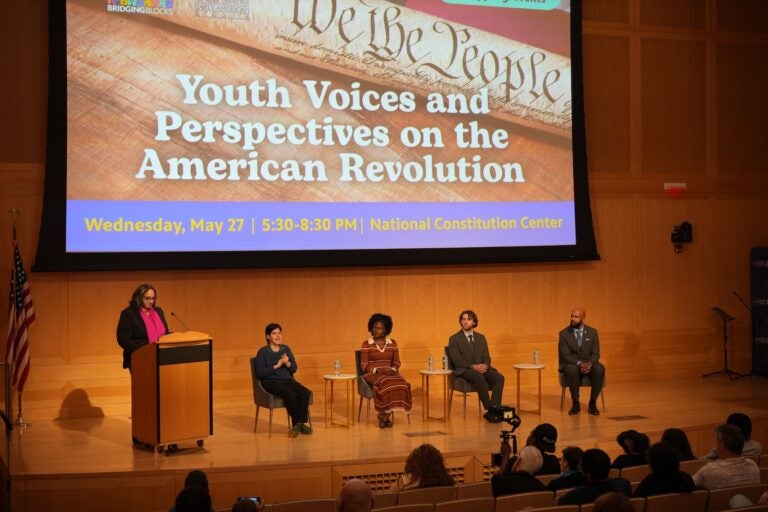
Moderator Sarah Glover (far left) and panelists from left, Sophia Gala, Maya Izzard, Tristan Worsham and Leon Smith discuss the impact of the American Revolution, representation and youth voices as America is set to celebrate the Semiquincentennial on July 4, 2026. (Joe Kaczmarek for WHYY News) -
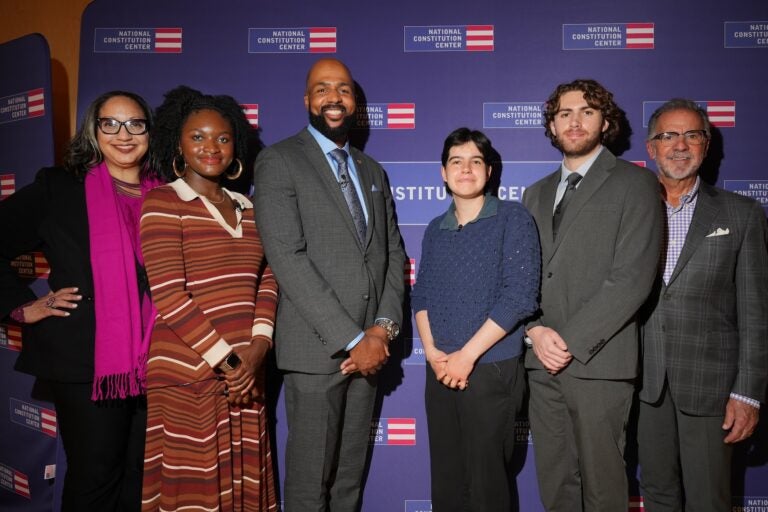
From left, Sarah Glover, Maya Izzard, Leon Smith, Sophia Gala, Tristan Worsham and Bill Marrazzo ahead of an America 250th community conversation titled "Youth Voices and Perspectives on the American Revolution" held at the National Constitution Center on May 27. (Joe Kaczmarek for WHYY News)
Related Content
Princeton University Library marks America’s 250th with Revolutionary War artifacts and stories
Among the artifacts are copies of the Declaration of Independence and U.S. Constitution, as well as a cannonball.
6 months ago
Listen 1:13The importance of civic education
Sophie Gala, a University of Pennsylvania history major who plans to become a public school educator, argued that civic education remains one of the most important ways to strengthen democratic participation, giving youth the knowledge of their own power to effect change.
“One thing that I think seems especially powerful to me is connecting the everyday lives and experiences and communities that young people are interacting with into the larger historical significance,” she said.
Gala said she has been inspired by local activist Debbie Wei, who has spent years fighting to protect Chinatown, starting from organizing against the Vine Street Expressway, which separated Chinatown, to the recent unsuccessful proposal for a 76ers basketball stadium.
One of her graduate education courses included a curriculum developed by Wei through which “students understood that social movements and these large looming historical events were actually made up of individuals with individual goals, motivations, beliefs and actions that kind of came together to organize.”
Izzard agreed that it’s important to help youth understand the power of their vote, but said it’s particularly powerful when it comes from those close to them.
“Especially now with the Voting Rights Act being gutted, it is more important than ever to make sure that you know the importance of voting, that everybody does, especially from a young age,” she said. “Since we are the future and because we are going into our own future, where we will be the adults and we will have to deal with our own problems more and more.”
The evening included performances by Malaya Ulan, who served as the 2024-2025 Youth Poet Laureate of Philadelphia, and Equinox, an instrumental quartet of four students at the Philadelphia High School for Creative and Performing Arts.
The WHYY, Penn 250th series of community conversations is made possible thanks to support from the Philadelphia Funder Collaborative for the Semiquincentennial.

Get daily updates from WHYY News!
WHYY is your source for fact-based, in-depth journalism and information. As a nonprofit organization, we rely on financial support from readers like you. Please give today.
Part of the series
Philadelphia 250
The United States is marking its semiquincentennial — or its 250th anniversary — in and around the City of Brotherly Love.
After days of oppressive heat, thunderstorms cut Philly’s July 4th concert short
After storms forced attendees to evacuate, the concert resumed around midnight with a shortened performance by The Roots, followed by fireworks.
1 month ago
Listen 0:55
Patriotic Pet Parade at Betsy Ross House in Old City celebrates America’s 250th birthday
The competition boasted 22 pets donning a range of red, white and blue attire.
1 month ago
Valley Forge National Historical Park, born on the Fourth of July, celebrates America250
The pivotal Revolutionary War site in the Philly suburbs hosted hundreds of people for live readings of the Declaration of Independence, a cannon fire demonstration and more.
1 month ago
Listen 1:45