
Free Library of Philadelphia expands Critical AI Literacy series with hands-on workshop
The Free Library's Critical AI Literacy series explores the technology, with a focus on disabling unwanted features, spotting scams and understanding AI's impact on the city.
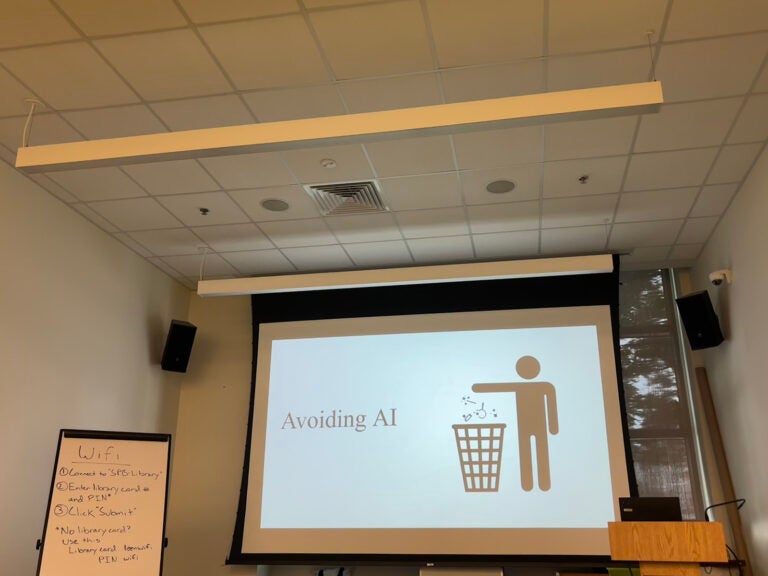
The "Avoiding AI” workshop returns after popular demand at The Free Library of Philadelphia in South Philly. (Chelsea Lubbe/WHYY)
From Philly and the Pa. suburbs to South Jersey and Delaware, what would you like WHYY News to cover? Let us know!
Artificial intelligence is increasingly built into search engines, phones and office software. Now, a South Philadelphia librarian is teaching residents how to turn it off.
On Tuesday, the Free Library of Philadelphia hosted “Avoiding AI: A Hands-on Workshop,” the second event in its Critical AI Literacy series, showing participants how to disable unwanted AI features in operating systems and popular apps while protecting their privacy.
Charlie Bailey, a librarian at the South Philadelphia Library, said people are increasingly frustrated as AI features appear across websites and apps, altering familiar interfaces without users actively choosing them.
“With AI specifically, it feels like it’s everywhere all at once in places … and it’s not something that people are enabling or or actively turning on,” Bailey said.
He said that understanding how to avoid AI is becoming just as important as learning how to use it.
Bailey partnered with the Library Freedom Project on the series to help Philadelphians understand not only how AI works, but also the broader social, environmental and civic implications of its use.
Teaching critical AI literacy
Bailey said helping people understand AI’s risks is a natural extension of the library’s role as a resource that communities turn to for support.
“Part of educating the public about the pitfalls of AI and how using AI can be destructive, can help them protect their data and privacy,” Bailey said.
Alison Macrina, founder of the Library Freedom Project, said librarians increasingly find themselves helping patrons navigate confusion created by AI-generated information.
“[AI] is causing really fascinating issues for library workers,” Macrina said. “I think that library workers are seeing a lot of confusion about what is real and what libraries can help them find.”
Rather than treating AI as an abstract concept, the workshops focus on practical skills, from explaining technical terminology to showing participants how AI tools actually work and what they can and cannot do.
“[We’re] trying to break down what are the actual technical capabilities of the tools that you are using,” Macrina said. “We try to connect them with ways that they can get organized in their community.”
Related Content

The “North Market” library opens Aug. 29 with free spaces for Delaware creators, small businesses and families.
3 days ago
Listen 1:33Libraries as trusted source for AI guidance
Among the attendees were Mary Smith and D’ahna Oakman, who found the event through social media. Both said they were concerned about privacy and the growing presence of AI in everyday life.
“I feel like there’s no neutral ground with it,” Oakman said. “I would at least like the option to use it instead of it being forced upon me.”
Smith said she has managed without AI and isn’t convinced she needs it.
“I’ve lived a life without AI, and so adding it, there’s no point. What does it serve me if I’ve already been able to do all this stuff myself?” she said.
As this technology becomes more deeply incorporated into daily life, some people feel using it is becoming unavoidable. But Macrina said the Library Freedom Project wants people to remember they still have choices.
“What LFP believes [is] we as human beings decide the future. And technology is a part of life for sure, but humans make technology and we can make decisions without it,” Macrina said.
“There are a lot of reasons why people trust the library,” said Tess Wilson, a representative of the Library Freedom Project. “We’re here, we’re not selling you anything. We provide you information and we want to give you the best information there is. So many librarians have become invested in a stronger information landscape.”
The Critical AI Literacy series will continue into November with sessions that broaden the conversation beyond opting out of AI. “A Skeptic’s Guide to AI” will examine what today’s AI systems can and cannot do, while “Is This For Real? AI Scams” will help participants identify AI-generated text, images, audio and video used in fraud. The series concludes with “Understanding Local AI Use,” which explores how artificial intelligence is being deployed in Philadelphia, including its effects on neighborhoods, public policy and community life, and how residents can engage with those changes.

Get daily updates from WHYY News!
WHYY is your source for fact-based, in-depth journalism and information. As a nonprofit organization, we rely on financial support from readers like you. Please give today.

The libraries closed due to cooling issues for a collective 3,900 hours — more than for staff shortages, July’s city workers strike or other building issues.
10 months ago
Listen 1:24
The first Latina Supreme Court justice spoke with WHYY’s Cherri Gregg and answered fan-submitted questions throughout the event.
11 months ago
Listen 1:19
Bridging Blocks event sparks heated discussion on the use of artificial intelligence in art
Artists, playwrights, teachers and more gathered to ask “Can art save us?” and converse on the effect art has on everyday life.
1 year ago