

Delaware City Refinery failed to immediately report accurate butane emissions
The refinery has received more than 50 violations over the last decade.
Listen 1:06
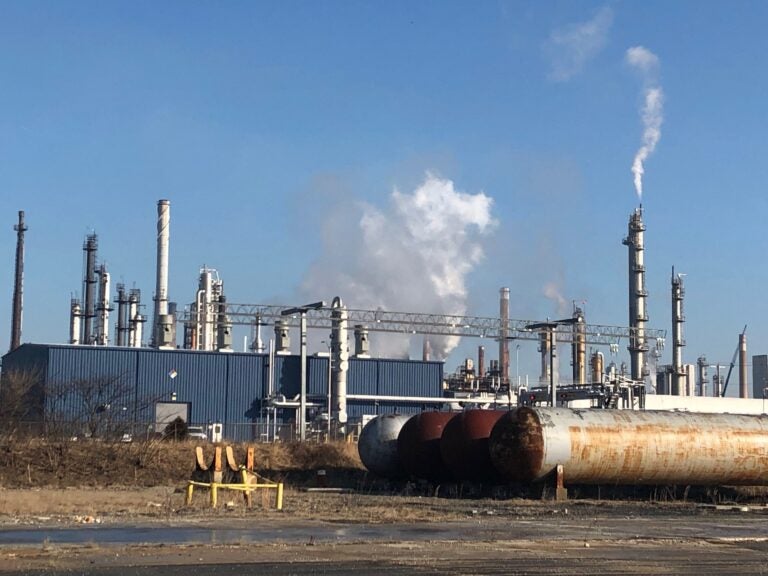
File - The Delaware City Refinery seen in 2024. (Cris Barrish/WHYY)
This story is part of the WHYY News Climate Desk, bringing you news and solutions for our changing region.
From the Poconos to the Jersey Shore to the mouth of the Delaware Bay, what do you want to know about climate change? What would you like us to cover? Get in touch.
The Delaware City Refinery must install fenceline air quality sensors after it failed to accurately report recent emissions of a hazardous chemical.
The refinery released unpermitted levels of butane, a flammable gas, following a mechanical failure last month.
The Delaware City Refinery originally reported that the incident lasted fewer than two hours during the afternoon of Nov. 27. However, the company later informed environmental regulators that the butane release lasted for about 19 hours, beginning the night of Nov. 26.
The refinery, owned by PBF Energy, has received more than 50 violations in the past 10 years. In May, a mechanical failure led to the release of sulphur dioxide for almost three weeks, prompting residents to call on the Department of Natural Resources and Environmental Control to take stronger action against the company. In March, the refinery discharged high levels of carbon monoxide and sulfur dioxide into the air for 10 hours.
The agency said that because last month’s butane emissions weren’t reported in a timely and accurate fashion, regulators had no opportunity to evaluate the impacts in real-time.
“Unfortunately, the refinery has had three significant environmental incidents this year,” DNREC Secretary Greg Patterson said in a statement.
“While DNREC has been working toward additional community monitors, demanding that the refinery quickly install fenceline sensors is a step that we believe is now necessary. But it is not the end of our response to ensure future releases can be detected sooner and the public can see the data directly.”
PBF Energy has not responded to a request for comment.
Based on the limited information provided, the Delaware Division of Public Health said there likely was no public health threat.
Butane is a colorless gas used in aerosol sprays, lighters and some industrial work. Though typically odorless, the butane released by the refinery could be detected by smell, DNREC said, because it contained the same odorant used in natural gas.
Once released into the air, butane spreads quickly and is unlikely to cause breathing problems, or skin and eye irritation, DNREC said. The agency believes the butane emissions traveled toward the Delaware River, and that concentrations around the facility were below occupational health limits.
Related Content
Delaware City Refinery receives violation for toxic emissions incident in March
The violation is separate from an incident in May that led to sulfur dioxide emissions, but involved the same pollution control device.
8 months ago
Listen 1:14DNREC has ordered the refinery to operate a real-time fenceline air sensor system that would measure emissions at the facility’s property line, and send alerts to DNREC and to the public.
If unpermitted chemical releases are detected, the company will be required to identify the source and fix the concern. PBF Energy operates similar air quality monitoring equipment at its refineries in California, according to DNREC.
The Delaware City Refinery could appeal the order to the state Environmental Appeals Board.
This year, state lawmakers set aside funding for the Clean Air Council to install air quality monitors around the refinery. However, a DNREC spokesman said the nonprofit’s proposal was rescinded to the U.S. Environmental Protection Agency because of cost changes. DNREC is working with the Clean Air Council on an agreement to move the project forward.
DNREC said it will also propose new regulations next year that would require fenceline monitoring at refineries across the state.
George X, who has lived 2 miles from the refinery for decades, said permanent and comprehensive real-time sensor readings would create transparency and help residents understand their health risks.
“We have an opportunity now to correct a historical wrong,” he said. “So rather than continue to repeat the wrongs that were created, I think this is the opportune time to encourage the refinery and all these companies in this state to be proactive.”
X added that the public should also be educated on how to understand the results of the real-time monitoring data.
Delaware City resident Steven Michael said air quality monitoring is a step in the right direction, but said he would like DNREC to take more action.
“Every time there’s a release, if they would shut down that plant, I guarantee you [the refinery] would either move or fix their equipment and stop polluting our air,” he said.
PBF Energy acquired the refinery in 2010 a year after its previous owner Valero shut down the facility. At the time, then-Gov. Jack Markell said PBF Energy was committed to running the plant more cleanly than its predecessors.
However, the refinery remains one of the region’s top polluters — releasing more than 4.6 million pounds of pollutants in the air and water in 2023, according to EPA data. According to the National Emissions Inventory, the refinery released more than 430,000 pounds of sulfur dioxide in 2020. Environmentalists have criticized state officials, arguing current laws don’t compel facilities like the refinery to stop polluting.
PBF said there has been about an 83% reduction in sulfur dioxide emissions alone since 2022 compared to the last three years that Valero owned and operated the refinery.
Lawmakers passed a bill this year to address that by increasing the fees associated with various environmental violations.
New Castle County Councilman Kevin Caneco has also urged DNREC to investigate the refinery’s pollution control equipment and operation procedures.
“From time to time, we’ll get these releases from their PR department saying something [about emissions] after the fact and we don’t have enough time to react to it,” he said.
“I’m happy that DNREC is now making them do at least this real-time fenceline monitoring. But PBF needs to stop being cheap. They need to make sure that they’re paying for all the right equipment, paying for all the right monitoring.”

Get daily updates from WHYY News!
WHYY is your source for fact-based, in-depth journalism and information. As a nonprofit organization, we rely on financial support from readers like you. Please give today.
Part of the series
How much water do data centers use? One in Delaware City could use up to 20 million gallons a year
A proposed data center in New Castle County would use tens of millions of gallons of water every year.
4 days ago
Listen 1:03
Proposed Delaware City data center hits major setback from environmental regulators
Environmental regulators in Delaware say the proposed data center, known as Project Washington, would be one of the state’s top polluters.
1 week ago
Listen 1:13
Delaware City Refinery receives violation for toxic emissions incident in March
The violation is separate from an incident in May that led to sulfur dioxide emissions, but involved the same pollution control device.
8 months ago
Listen 1:14