Cyrus Bustill baked for Washington’s army. Then he built Philly’s free Black Renaissance
Born into slavery, Bustill became an entrepreneur, a patriot and one of the founders of a thriving Black Philadelphia.
Listen 3:55
From Philly and the Pa. suburbs to South Jersey and Delaware, what would you like WHYY News to cover? Let us know!
A formerly enslaved baker from New Jersey was on the front lines feeding the Continental Army in Valley Forge, Pennsylvania, as it fended off disease and starvation during the winter of 1777-1778.
After the war, Cyrus Bustill, of Burlington, moved to Philadelphia and built a thriving Black community.
“Cyrus Bustill is a really early, important figure when you think of the presence of people of African descent here in Philadelphia,” said Michael Idriss, a historian with the Museum of the American Revolution. “He was one of the earliest voices that you were able to read in his own words, talk about his life and his time in Philadelphia.”
Lifting himself out of slavery
Bustill was born into slavery in 1732. His father, Samuel Bustill, was a white lawyer. Parthenia, his mother, was Samuel’s slave. Bustill was eventually sold to Thomas Pryor in Burlington, likely with the understanding that Pryor would eventually free him. Pryor taught him to bake bread and allowed him to earn money.
Bustill used his earnings to further his education.
“He hired a boy, paid him with his extra money from baking, and the boy taught him to read and to write,” said Joyce Mosley, Bustill’s descendant now living in Ardmore, Pennsylvania. “I have this image that, as bread is baking early in the morning, Cyrus is reading.”
It is unclear how Bustill became freed, whether through manumission or by buying himself out of slavery, but as soon as he was able, he started his own bakery.

“Baking was an important role within the community,” said Michael Idriss, a historian at the Museum of the American Revolution. “Most homes did not have an oven. You might have a fireplace, a hearth where you’re able to hang cast iron pots, but not necessarily an oven. You’re going to go to the baker.”
The baker was a crucial figure in colonial America. If a baker could not supply bread at a reasonable cost, riots could ensue. During the Revolutionary War, there were dozens of food riots, mostly led by women protesting the wealthy merchant class for manipulating the cost of basic goods. A major uprising in Philadelphia in 1779 outside the stately home of James Wilson on Walnut Street, the so-called Fort Wilson Riot, saw six people die.
Idriss said bakers had to earn their communities’ trust.
“When bakers were trying to shortcut, if they didn’t have certain ingredients, maybe they’d throw chalk in there,” he said. “It was highly regulated. It was a respectable trade. You had to work your way up in order to be considered a good baker.”
Related Content
Bucks County house highlights Revolutionary War history
Ahead of the United States’ 250th anniversary, two new exhibitions showcase Revolutionary War history and “Radical Americana.”
3 days ago
Feeding Washington’s army
The Continental Army provided each soldier with a pound of bread and a pound of meat daily, along with weekly rations of vegetables and rum. For many enlistees who came from poverty, the guarantee of daily food was a strong incentive to join.
Unfortunately, the Continental Army often did not live up to its own bargain because it competed with the British army for supplies and fell short of money due to the constant shortage of funds from the Continental Congress.
“The troops are worn out with fatigue, badly fed and almost naked,” noted Maj. Gen. Nathanael Greene in January 1778, cited in Ricardo Herrera’s “Feeding Washington’s Army” (2022).
The soldiers “have been on the eve of starving and the Army of mutinying,” Greene wrote.
To meet the hunger, Washington appointed Christopher Ludwick to create a network of bakers and strategically placed ovens across the colonies to supply the army, wherever it marched, with a constant supply of bread.
Bustill was one of Ludwick’s army of bakers.
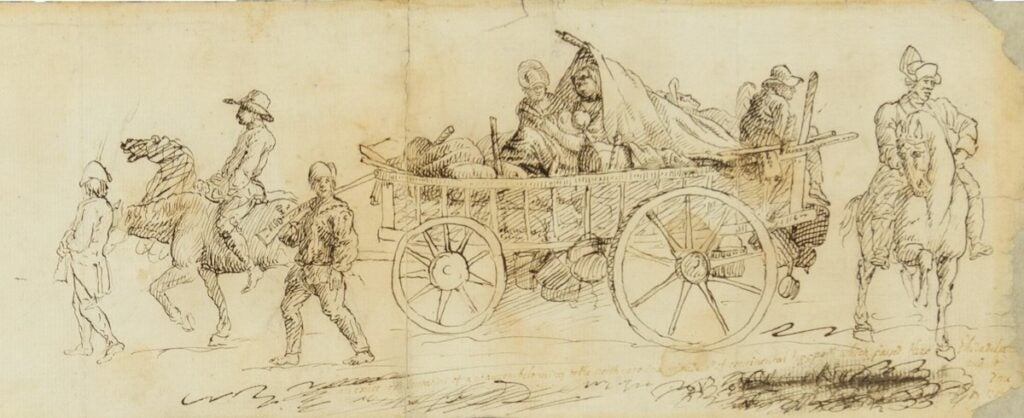
“They would get flour at the port of Burlington and for one month, Cyrus was commissioned to bake that bread. Then they drove the bread to Valley Forge,” Mosley, Bustill’s descendant, said. “They would leave Burlington, New Jersey, take the ferry to Pennsylvania and then drive up to Valley Forge.”
Mosley said Bustill likely had a face-to-face meeting with Gen. George Washington.
“In my family history, there is a story that George Washington gave Cyrus a gold coin,” she said. “In the late 1800s, it’s mentioned that one of my ancestors had that in her possession. Two Quakers certified that she had it. But I don’t know what happened to it.”
Around the time of the Revolution, Bustill married and became part of one of Philadelphia’s founding Black families, and one of America’s first Black landowning communities.
His wife, Elizabeth Morrey, a mixed-race woman, was the granddaughter of Philadelphia’s first mayor, Humphrey Morrey, and the daughter of a formerly enslaved woman of Lenape and African descent, Cremona Satterthwaite, who worked as a freed servant for the Morrey family. Humphrey’s son Richard had a relationship with Cremona that history suggests was a committed one, which produced five biracial children.
Richard Morrey ultimately ended the relationship but transferred 198 acres to Cremona in what is now Glenside, Pennsylvania. When her daughter Elizabeth married Bustill, the couple acquired 12 acres of land in what was then known as Guineatown after its residents of African descent.
Elizabeth’s sister, also named Cremona, married John Montier. From them descended a successful bootmaker in the early 19th century who posed with his wife for what is now the oldest surviving pair of portraits of an African American couple, at the Philadelphia Museum of Art. They became the subjects of a WHYY documentary film.
Building a Black community
After the war, Bustill moved to Philadelphia to open a new bakery. The city’s Black community was going through a historic period of transition. About 10 years before the war, the ratio of enslaved to free Black Philadelphians was about 10-to-1. Ten years after the war, that ratio flipped: About 90% of Black Philadelphians were free.
The reasons for that swift and enormous population change were, in part, legal. Pennsylvania had passed the Gradual Abolition Act of 1780. This era also saw a rise in abolitionist fervor, mostly among Quaker meetings who insisted their followers free their slaves, which many did through mass manumissions.
Philadelphia’s free Black community was growing exponentially and needed someone to show them how to thrive. As a formerly enslaved entrepreneur, Bustill shepherded newly freed residents into affluence.
“He bridged the difference between the people being enslaved and then people being free,“ Mosley said. “He was able to walk that line.”
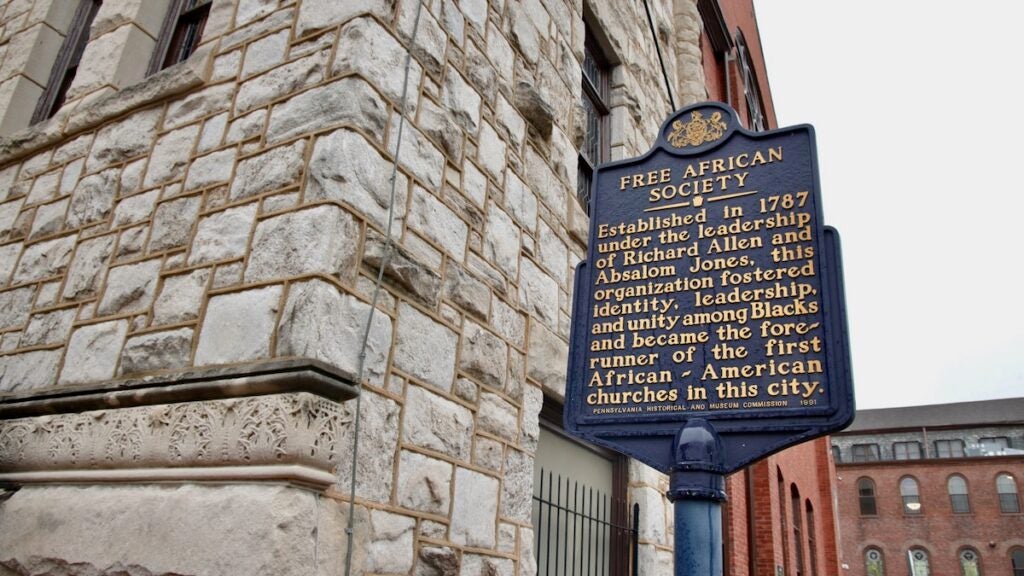
Bustill joined Absalom Jones and Richard Allen as founding members of the Free African Society, a benevolent organization that provided religious services and mutual aid to Philadelphia’s Black residents. The organization expected members to donate money monthly to a community fund and to lead moral lives that forbade indulgent feasting, gambling and drinking.
Jones and Allen later became prominent figures in Black American history: Jones was named the first Black Episcopal priest and Allen founded the African Methodist Episcopal Church.
By this time Bustill was already seen as a revered elder. He was 55 years old when the Free African Society was founded and 62 when the AME Church was created.
Idriss, who often bodily interprets Bustill while in costume as an 18th-century baker, believes his bakery became a hub of Black life in Philadelphia.
“As one who was enslaved and one who has that business and had to move on his feet quickly in order to meet the needs of those in his community, I think people of African descent are coming to Cyrus, to his bake shop, to understand and make connections with this person of African descent who is doing well for himself,” he said.
The Free African Society did not survive long, lasting from 1787 to 1794. Still, it was the first Black mutual aid society in a city that would develop over 100 similar organizations over the next four decades. Many members followed Jones and Allen into their respective religious congregations.
Bustill did not join Jones and Allen’s congregations because he was a practicing Quaker, even though he could never become a member. He was allowed to attend meetings but not to join.
“Because of the color of his skin, he didn’t get membership,” Mosley said. “His daughter and his granddaughter were almost lifelong Quakers. Not member-Quakers, just practicing Quakers. They had to sit on the Negro bench.”
Related Content
Anandibai Joshee came to Philly in 1883 to study medicine. Her tragic life is the grit of a South Asian American Digital Archive songwriting project.
5 days ago
Listen 3:39Teaching the next generation
In 1797, at 65, Bustill founded a school in his home in Northern Liberties for Black children. The Quaker-based Committee to Improve the Condition of Free Blacks, a project of the Pennsylvania Abolition Society, briefly sponsored Bustill’s school, along with other independent Black schools, which were plentiful in Philadelphia. The committee ultimately pulled funding from Bustill’s school and later opened its own Black schools.
Bustill opened another school at Third and Arch streets, where a historic marker in his name now stands. Coincidentally, that blue street marker is in front of a bakery called Tartes.
“Cyrus builds a thriving black population in Philadelphia by illustrating that it can be done through his own lived experience,” said Mijuel Johnson, a tour guide with The Black Journey: African American History Walking Tour of Philadelphia.
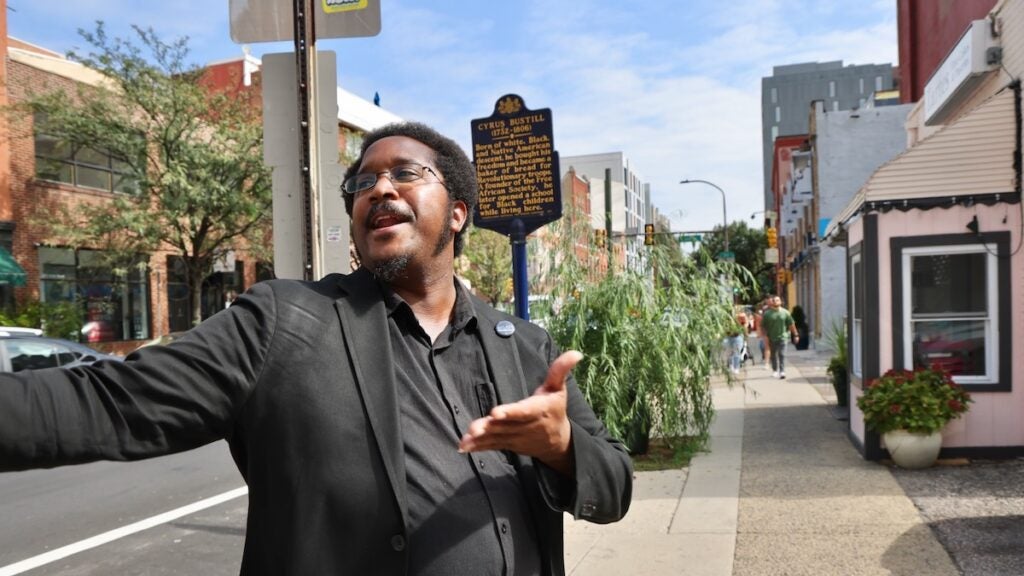
“He does start to lay the groundwork that then goes on to become a tremendous Black community in Philadelphia,” he said. “Not only a tremendous Black community but a Black community that would be key when it comes to the establishment of Black society across the country.”
In his own words
Bustill is one of the few 18th-century Black figures whose thoughts were written down and preserved. In 1787, he was invited to deliver remarks to a group of enslaved Black people, likely organized by the Pennsylvania Abolition Society.
An observer wrote down his speech. In the early 1970s, it was discovered in the archives of the Historical Society of Pennsylvania and published in the William and Mary Quarterly in 1972. It was later included in the 1998 anthology “Lift Every Voice: African American Oratory 1787 – 1900.”
When Idriss studied history at Temple University, Bustill’s voice became a clarion call from two centuries earlier, he said.
“The only places, typically, that you can find the names of people of African descent are in different types of documentation, whether it was birth certificates, a baptismal record, debt papers,” Idriss said. “If you wanted to know about people of African descent, you had to look at runaway ads.”
“Cyrus’s words really gave us just a small snapshot of some of the possibilities and the thoughts of people of African descent during this period,” he said.
In his speech, Bustill speaks of his life as a former enslaved person and his rise in the Philadelphia community. He leaned into his Quaker beliefs, urging the enslaved people gathered to put their trust in divine faith to gain freedom.
“I am 56 years of age. I have seen numbers laid in graves at a time some of them little expected. I know not how soon it will be my turn,” Bustill said. “I would therefore that we work while it is called today. For night cometh wherein no man may work. Which way shall we turn ourselves but unto the Lord that made us?”
“Cyrus was saying to them: ‘There’s a path forward. There are some steps that you might have to do. They might be a bit uncomfortable as far as how you want to carry yourself,’” Idriss said. “But at the end of the day, the goal is for us to get some agency, to be able to have something for ourselves and to be able to build community from within.”

Get daily updates from WHYY News!
WHYY is your source for fact-based, in-depth journalism and information. As a nonprofit organization, we rely on financial support from readers like you. Please give today.
Part of the series
Philadelphia 250
The United States is marking its semiquincentennial — or its 250th anniversary — in and around the City of Brotherly Love.
‘Seeking profit and power’: Seaport Museum exhibit traces the first U.S.-China trade
A newly independent America needed international trading partners. China was the big fish.
1 week ago
Listen 1:26
Pennsylvania Hospital, founded in 1751, treated patients in the Pine Building. The museum will feature the original surgical theater and other exhibits.
1 month ago
Listen 1:16
Chief White Eyes toggled between British and American leadership to secure land for the Lenape.
1 month ago
Listen 3:38