

WHYY series on Revolutionary era and its lasting impact begins with Free Library event on women, power and equality
WHYY is partnering with Penn’s McNeil Center for Early American Studies for a series of events this spring examining the impact of the American Revolution.
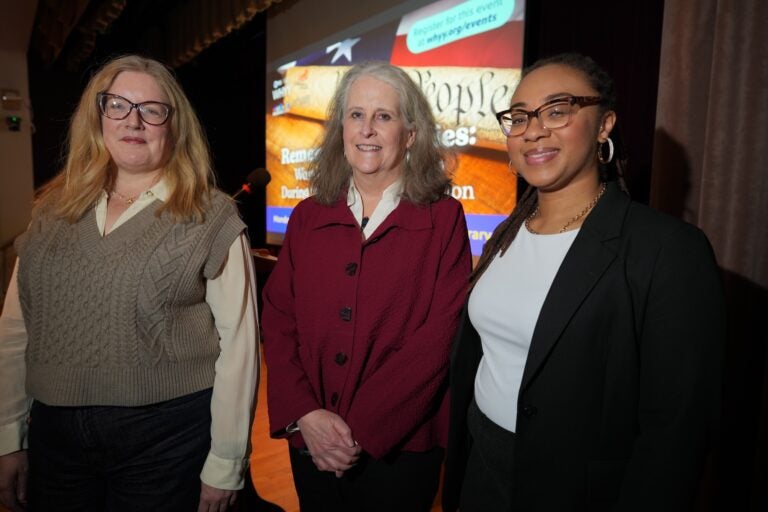
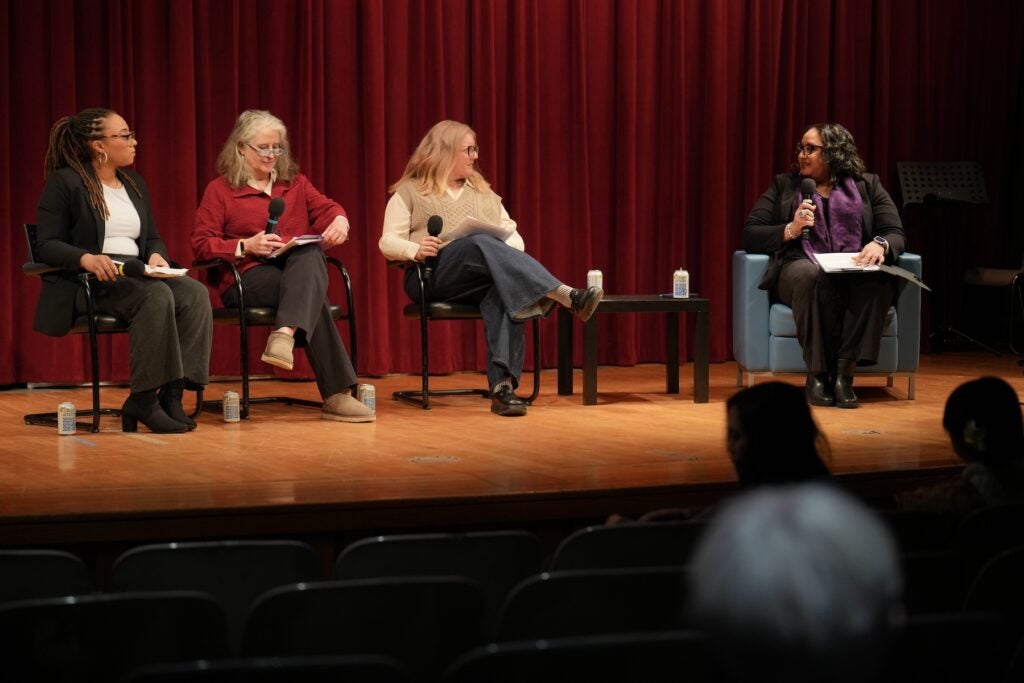
Emma Hart, Kathy Brown and Melissa Benbow Flowers at the event at the Free Library of Philadelphia on March 23. (Joe Kaczmarek/For WHYY News)
From Philly and the Pa. suburbs to South Jersey and Delaware, what would you like WHYY News to cover? Let us know!
As Philadelphia prepares to celebrate the 250th anniversary of the nation’s founding, historians say the Revolutionary era was more than just a war for independence: People lived entire lifetimes as America fought for its freedom, and not everyone experienced this period in the same way. It shaped the futures of women and free and enslaved Black Americans for generations to come.
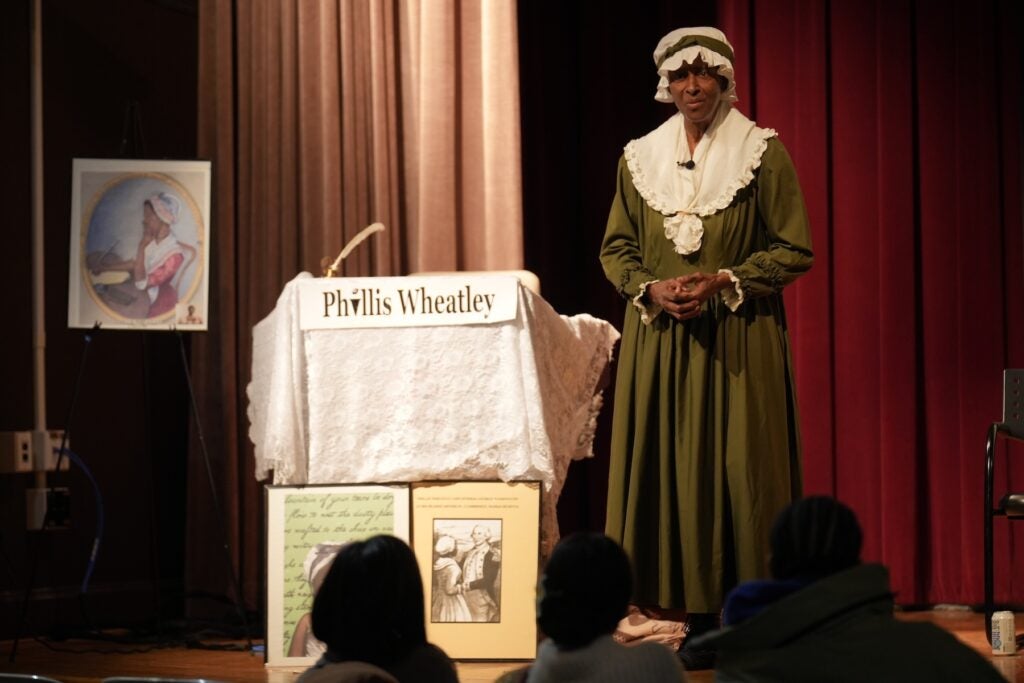
Those ideas were the focus Monday night, when WHYY, in partnership with the Free Library of Philadelphia and the McNeil Center for Early American Studies at the University of Pennsylvania, launched a new series on influential voices during the founding era. Monday’s event, at the Parkway Central Library, focused on women’s roles in colonial history, included a retelling of renowned poet Phillis Wheatley’s life in slavery, a screening of excerpts from Ken Burns’ “The American Revolution” documentary, a panel discussion and a reading from Philadelphia’s youth poet laureate.
“We’re excited to be hosting this event tonight,” Sarah Glover, WHYY’s vice president for news and civic dialogue, said in her opening remarks to a room of about 100 people. “We are delighted with the level of expertise that we are able to be in the company of tonight from the Penn community.”
The event began with a performance from historical interpreter and educator Daisy Century, who portrayed Wheatley, describing her life’s journey. Taken from her home in West Africa, transported to the American colonies and sold as a slave to the Wheatleys of Boston, she learned Greek, Latin and English and how to read and write from the family, later becoming the first African American poet to publish a book of poetry.
The excerpts shown from Burns’ documentary focused on prominent women — including America’s second first lady, Abigail Adams, who cemented her own place in history with a plea to her husband John to “remember the ladies” when considering legislative efforts that would provide the foundation for the United States.
The screening led into a panel on women’s roles in the Revolutionary era. Glover moderated the discussion, which featured Penn history professors Kathy Brown and Emma Hart and public historian Melissa Benbow Flowers, who also works with Philadelphia’s 1838 Black Metropolis project.
“‘Ladies’ would not have been a term that people at the time would’ve applied to a very large group of women,” Brown said, noting that it was often reserved for “privileged” women and excluded groups like working-class, enslaved and Native American women. “There’s some class and race and status all baked into that term.”
Brown later added that as more women entered public and professional life during this era, “some women [had] power over other women. Women are a complex group with lots of different competing interests, and more important, that they don’t all stand in the same position of power in relation to men.”
Related Content
Anandibai Joshee came to Philly in 1883 to study medicine. Her tragic life is the grit of a South Asian American Digital Archive songwriting project.
6 months ago
Listen 3:39Burns’ documentary traces American history from 1754 to 1780, summarizing the entirety of the Revolutionary War but ending before the drafting and ratification of the Constitution. Hart called the Revolutionary era “a lifetime of a young person.”
“I always tell my students that if they were born at the beginning of the Revolution, at the Stamp Act in 1765, they would still have not lived through the entirety of the events” at the age they are now, she said.
Flowers told the story of James Forten, a Black abolitionist who was transported to New York as a war prisoner and later traveled to Philadelphia. She said that he was present for the first reading of the Declaration of Independence and later passed his revolutionary ideals on to his daughters, who helped create the Philadelphia Freedom Antislavery Society.
“The Black community, free and enslaved, was aware of what was going on, had a lot of thoughts about what was going on, and had their own vision of what freedom and liberty would look like” during the Revolution, Flowers said.
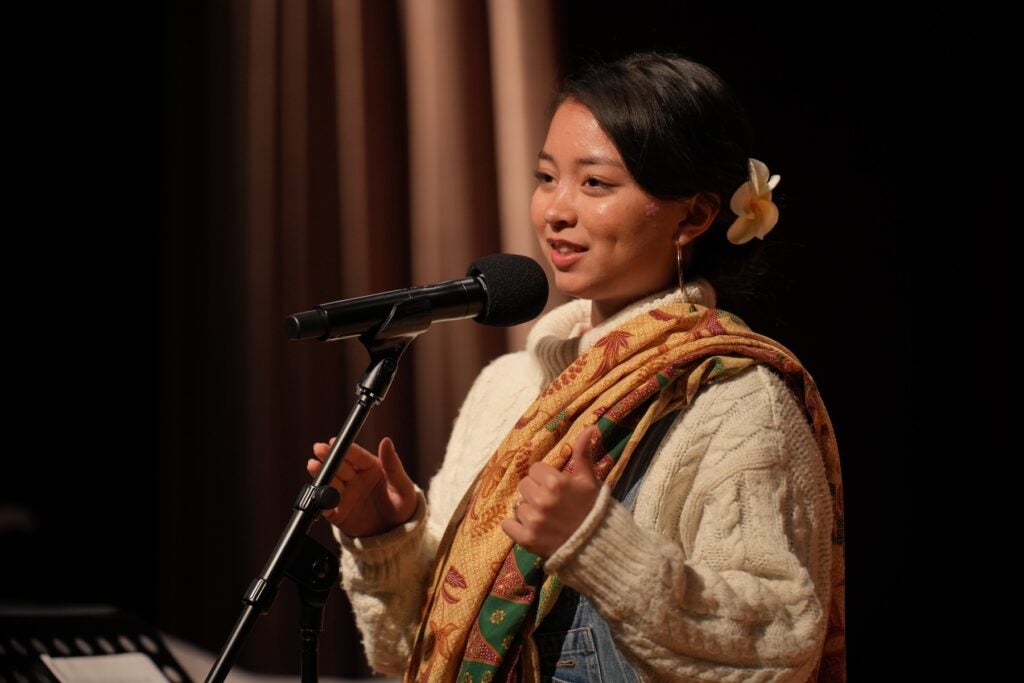
The event concluded with two readings from Malaya Ulan, the 2024-25 youth poet laureate of Philadelphia. One of her poems connected Wheatley’s story to the poet’s own Filipino American identity and explored the “white saviorism” narrative, while the other honored a “loss of spirituality” tied to colonization and enslavement.
“Having a performance artist and then a movie and then the poet laureate — I thought it gave nice texture to the event, not only for significance but for information,” Kristin Long, of Philadelphia, said.
Lansdowne resident Daniel Callahan, a self-proclaimed “history buff,” said that he is drawn to learning about all types of history.
“To me, part of our history is you learn what happened, and then you learn from it so you try and prevent it from happening again. And if it’s something good, then you try and repeat it,” he said.
WHYY’s partnership with the McNeil Center will continue throughout the spring, featuring events on how revolutions improve citizens’ lives, youth voices during revolutionary eras, early American life during the Revolution and the power of dissent. The series is funded by the Philadelphia Funder Collaborative for the Semiquincentennial.

Get daily updates from WHYY News!
WHYY is your source for fact-based, in-depth journalism and information. As a nonprofit organization, we rely on financial support from readers like you. Please give today.
Part of the series
Philadelphia 250
The United States is marking its semiquincentennial — or its 250th anniversary — in and around the City of Brotherly Love.
El muralista Christian Kanienberg afirma que le interesa “más crear obras de arte que, simplemente, resultan ser murales capaces de suscitar conversaciones”.
2 months ago
Muralist Christian Kanienberg says he’s “more interested in creating pieces of art that just happen to be murals that are conversation starters.”
2 months ago
Listen 2:11
The city’s free July Fourth concert on the Parkway is still on. Organizers say Saturday's star-studded show will happen rain or shine.
2 months ago