

Philly progressives taking a victory lap after Rabb win; supporters credit old-school grassroots organizing
The groundwork for Rabb’s success may have been laid over the last several years as progressives fought for control over local Democratic committees.
Listen 1:09
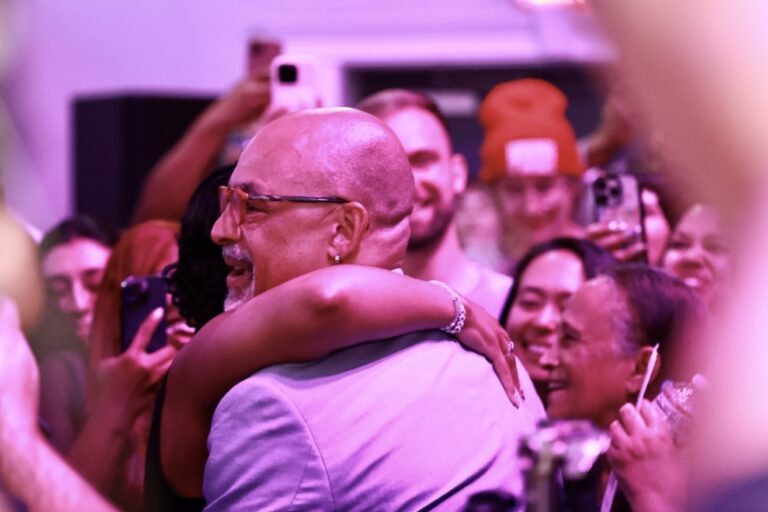
Chris Rabb hugs a supporter at his campaign party on prim Election Day in Philadelphia, May 19, 2026. (Kimberly Paynter/WHYY)
What questions do you have about the 2026 elections? What major issues do you want candidates to address? Let us know.
Progressives in the city are reveling in an upset victory following state Rep. Chris Rabb’s win for the Democratic nomination for the 3rd Congressional District.
With no serious Republican opposition in this deep blue district, Rabb is expected to coast to victory in November’s general election and succeed retiring incumbent U.S. Rep. Dwight Evans in January.
For many on the left, Rabb’s success reflects a growing dissatisfaction among the Democratic Party about its direction and a desire for a more ambitious platform involving big ideas that benefit Philadelphia’s working class.
Maurice Mitchell, national director for the Working Families Party, called Rabb’s Tuesday night victory “a shockwave” heard around the country.
“What this means is that there’s potential for a new working class alignment of voters… [who are] saying the same thing to the political establishment and the political machine in both the Republican and Democratic Party,” Mitchell told WHYY News shortly after the results were released.
Mustafa Rashed, the president of Bellevue Strategies and a political commentator who lives in the district, agreed that Rabb tapped into an anti-establishment zeitgeist.
“There’s dissatisfaction with the establishment,” Rashed said. Voters “want someone different and if you can unapologetically present yourself as an outsider, as someone that’s going to give you a different outcome, I think people will be receptive to that message and respond to it. And I think that’s what happened yesterday.”
However, Rabb supporters among the Working Families Party and Philadelphia Democratic Socialists of America also credited old-school grassroots organizing.
“Field is the world and knocking doors often gets undercounted in elections like this,” Patrick Wargo of the DSA said.
Wargo said that the DSA alone had 40 field leads, which trained “hundreds of canvassers each weekend” across the city and that was supplemented by the field efforts by other organizations such as the Working Families Party, One Pennsylvania and Reclaim Philadelphia.
“We had armies of volunteers knocking doors, people who are deeply rooted in our community, people who care about our politics,” Wargo told WHYY News. “And I think we saw the cracks in the facade of Democratic machine that is not inspiring candidates and messaging and voters to get out.”
Related Content
Progressive Rabb wins 3rd District race with boosts from ‘the squad’ and local grassroots activism
Rabb’s victory is an upset to the Democratic establishment and may provide a glimpse into the direction of the party.
4 months ago
Listen 1:20Opening the wards
Rabb may have also benefitted from organizing that started long before he was even a candidate.
For years, local progressive activists around the city have been running for positions on the Democratic ward committees. Ward committees typically serve to help party candidates reach their neighborhoods and are historically seen as the foundation of Philadelphia’s political machine.
However, Wargo and other activists saw the ward committees as being closed off to participation or influence by community members and party rank-and-file.
“That sort of culminated in some strategic orientation for how we think we should be building power to push the needle for the left’s path to victory in Philadelphia, not just for Congress, but for state House and state Senate seats,” Wargo said. “And I think that we see the ward system as a critical way of doing that.”
That “open wards” effort culminated in November with the launch of Wards That Work, a coalition of groups including Philadelphia Democratic Socialists of America, Riverwards Area Democrat, Reclaim Philadelphia and the Philadelphia chapter of the Communist Party U.S.A. They recruited more than 350 candidates for committee seats in Tuesday’s election.
In some cases, activists have filled vacant seats though, at times, they have run in competitive campaigns. Regardless, some other committee members and ward leaders see them as outsiders and political ideologues upending the process of getting Democrats elected.
Related Content
Pa. primary election 2026: Here’s who won and who lost, plus full results
Pennsylvania’s primaries will tee up high-stakes midterms in November, with Democrats hoping to retake control of Congress.
4 months ago
The pushback
Carol Jenkins, leader for the 27th ward, accused democratic socialists of “flooding” and “attacking” local wards and defended her committee’s process.
“We’re not a closed ward,” Jenkins told WHYY News in an interview before the election. “If we have an empty seat and committee seat, we allow them to come in and be part of the ward. Unfortunately, some of the people we brought in the last year or so have decided that they’re going to want to turn [this ward] into a DSA ward. So it’s become contentious.”
Jenkins’ ward hosted a candidate debate during the primary with Rabb and his opponents state Sen. Sharif Street and Dr. Ala Stanford. A clip of that debate went viral, when a member of the audience demanded Stanford use the word “genocide” to describe Israel’s war in Gaza.
Jenkins blamed members of the DSA for the incident and accused Wards that Work members of making nomination recommendations based on labels and pointed to the second ward, one of four wards that endorsed Rabb.
“[Members of DSA] could care less whether they’re actually competent,” she said. “We look at the competency of the candidates, which I think makes the city work better. I don’t think saying that you’re a progressive or you’re a reclaim or whatever does a thing to make the city work better.”
Second ward leader Will Gross was an early participant in the “open wards” movement and ran for a seat on Philadelphia’s 2nd Ward Democratic committee in 2018, eventually becoming ward leader in 2023.
Gross defended his ward and said that it’s become more democratic since they “opened” it.
“Wards that Work is to really give power to committee people and to the people and so it’s a less concentrated source of power,” Gross said. “Traditionally, it’s really the ward leaders that do a lot of the shot calling. The message was generally given from above them, as well from whoever the chair was at that time.”
He also pushed back against the idea that the new committee members are interlopers. He explained that he had great-grandparents from the city and he now runs a small business in South Philly. He added, however, none of that should even matter to anyone else.
“We all live here in this moment,” he said. “We’re all walking the same streets. We’re all riding the buses, the subways, we’re all interacting with one another. These are our neighborhoods together and we have to realize that we’re not addressing the issues that working folks and folks that are living on the margins or struggling are facing.”
Jenkins disputed the characterization of her ward as “closed.”
“We do not carry the ballot that the Democratic City Committee gives out,” she said. “We decide ourselves who we think is the most capable of the candidates that are on the ballot for that particular cycle.”
Related Content

Bob Harvie wins Democratic primary for Pa.’s 1st Congressional District
Harvie will face off against Republican U.S. Rep. Brian Fitzpatrick this fall in one of several key contests that Democrats hope will gain them a majority in the U.S. House.
4 months ago
Listen 1:01Progressive victories
Such organizing may have helped set Rabb up for his victory years before the race and even before Evans announced his retirement last June.
Wargo said that all of that effort to help elect progressive progressives in local offices “just happened to coincide with this congressional race.”
“Many, if not all, of our candidates were supporting Chris Rabb for Congress, so that adds up across the city,” he said.
Rashed said that a candidate for Congress cannot rely on doorknocking in such a large area to ensure a win, but that it can make a difference.
“It’s a massive district, but it seems that there was no part of the city where [Rabb] didn’t have people working on his behalf to deliver his message,” he said. “I think when you have a 15-point lead, you have to attribute it to a little bit of everything.”

Subscribe to PlanPhilly
WHYY is your source for fact-based, in-depth journalism and information. As a nonprofit organization, we rely on financial support from readers like you. Please give today.

Supreme Court lets Trump administration use revamped federal voter eligibility database for now
The Supreme Court is allowing states to resume using a controversial federal tool to check voter eligibility before the November elections.
22 hours ago
Michigan governor campaigns for Josh Shapiro at South Philly diner
Michigan Gov. Gretchen Whitmer joined Gov. Josh Shapiro at Morning Glory Diner, an unabashed anti-MAGA restaurant.
22 hours ago
Listen 1:07
Delaware election 2026: Midterm voter guides, key races and more
Election Day is Tuesday, Nov. 3. Here’s what Delawareans should know beforehand, from what’s at stake to who’s on the ballot and beyond.
1 day ago