

The American Red Cross urgently wants your blood as Greater Philly snowstorm affects blood bank supply
The snowstorm caused more cancellations at local blood donation drives and centers, at a loss of about 1,000 blood and platelet donations.
Listen 1:09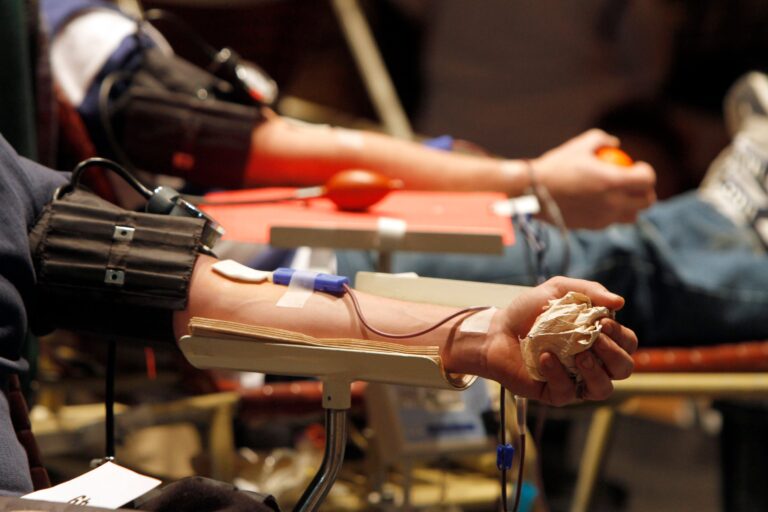
FILE - In this Dec. 20, 2011 file photo, donors give blood at a drive attempting to set a record for most single-day donations in Rutland, Vt. (AP Photo/Toby Talbot, File)
From Philly and the Pa. suburbs to South Jersey and Delaware, what would you like WHYY News to cover? Let us know!
Blood banks around the country were already trying to recover from a severe winter shortage when this week’s snowstorm caused a setback in those efforts with additional cancelled donor drives and appointments.
Meanwhile, demand for blood at hospitals and health centers continues to outpace supply locally and nationally at a concerning rate, said leaders at the American Red Cross. They are urging people to donate as soon as possible.
“Because of all the weather and colds and flu, and it was the holiday season, the supply has just not rebounded the way that we have seen happen in the past,” said Jennifer Graham, CEO of the Red Cross’ Southeastern Pennsylvania Region. “The need for blood doesn’t take a holiday, it doesn’t take a vacation, it doesn’t take a sick day. It takes everybody giving, every single day.”
The latest calls to action follow the American Red Cross’ declaration of a severe national blood shortage in January. The national blood supply fell by about 35% in just a month’s time as donations slowed.
“That’s a big number,” Graham said. “I’ve been at the Red Cross for over 26 years, and to see that kind of number gives me pause.”
All nine American Red Cross donation centers in the Southeastern Pennsylvania Region were forced to close Monday and Tuesday following this week’s storm, leading to a loss of about 1,000 blood and platelets donations, Graham said.
Keeping regional blood banks stocked and able to support local hospitals and health systems is a constant effort, she said. As there is no alternative to human blood for most medical uses, this effort relies heavily on volunteer donors.
An estimated 62% of people in the United States are eligible to donate blood because they’re old enough, in good health and have no or few medical complications, but only about 3% ultimately do each year, according to America’s Blood Centers.
That means blood banks like the ones in Philadelphia, its suburbs, Delaware and New Jersey have less at the ready to respond to a major disaster or event.
Blood banks may also have to triage daily supply and distributions to local health centers, Graham said, which often need donated plasma, platelets and whole blood for all kinds of patients and conditions.
“It’s also programs to support cancer patients, our sickle cell patients, some of our more rare blood donor types,” she said, “making sure that we have that universal donor of O-negative ready and available on those shelves for the emergencies and traumas that come in.”
Related Content
Blood Bank of Delmarva urges donations amid winter challenges during National Blood Donor Month
As winter challenges reduce blood donations, the Blood Bank of Delmarva highlights lifesaving stories and urges Delawareans to give.
9 months ago
Listen 1:07A local blood drive collects, on average, between 25 and 40 pints of blood. That amount and more can be used for a single patient in the emergency department following a car accident or other trauma, experts say.
A person with a chronic blood disorder who needs regular transfusions may need 2–3 pints of blood every week for treatment, according to the Mayo Clinic.
The process of donating blood can be completed in under an hour, Graham said. Newer technology that can speed up sign-in and intake at the beginning of someone’s appointment can cut that time down significantly, she added.
The donation itself of one pint of blood typically takes about seven to 10 minutes, Graham said. It later gets sent to a processing and distribution center, where blood is labeled, tested, separated into red cells, platelets and plasma, and packaged.
Blood units can be ready to use in as quickly as 48 hours after donation, Graham said, or stored in refrigerators until they’re needed. The shelf life for donated blood cells is 42 days.
Now, American Red Cross volunteers and chapters are working to reschedule appointments and find ways to inspire new people to donate and help save lives, Graham said.
“There’s something very powerful about that,” she said. “It has to take the generosity of one person giving to another in order to make sure that the blood supply is safe and stable.”

Get daily updates from WHYY News!
WHYY is your source for fact-based, in-depth journalism and information. As a nonprofit organization, we rely on financial support from readers like you. Please give today.
Staying fit in 2025: Tips from NBA coach, health columnist
Many people start the year with a resolution to get fit. Whether it’s weightlifting, cycling, or getting outside for some fresh air, we’ll help you get up and going.
Air Date: January 9, 2025 12:00 pm
Listen 50:30
How Philly area hospitals are dealing with a national shortage of blood culture bottles
Hospitals routinely use these bottles to check for infections in patients’ blood — now they are cutting back on tests.
2 years ago
Listen 1:51
Paying people for their organs, Independence Dragon Boat Regatta
Would you give your kidney to a stranger? What if you could get a $50,000 tax credit for it? That's just one proposal for upping organ donation in the US.
Air Date: May 30, 2024 12:00 pm
Listen 50:03