

Philadelphia’s Weitzman Museum tells the forgotten story of Caribbean Jews who supplied the American Revolution
“The First Salute” pulls artifacts from Sint Eustatius to tell the “hidden” story of the colonies’ crucial island allies.
Listen 1:38
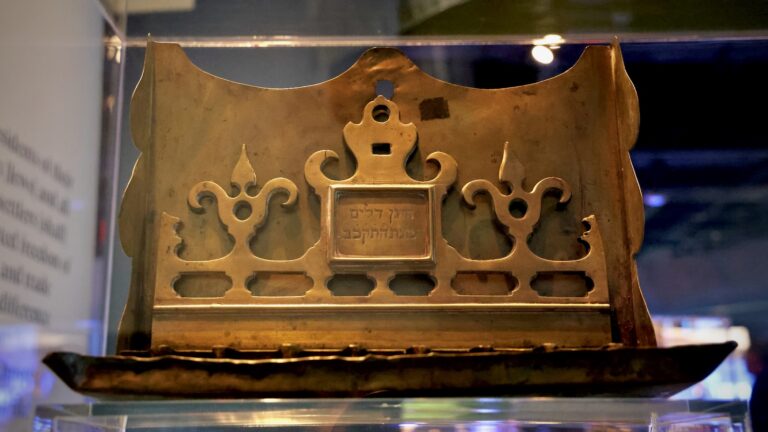
A Hanukkah lamp from St. Eustatius bears an inscription in Hebrew, ''Honen Dalim, year 5522.'' Honen Dalim was the synagogue on St. Eustatius built in 1739. (Emma Lee/WHYY)
From Philly and the Pa. suburbs to South Jersey and Delaware, what would you like WHYY News to cover? Let us know!
The governor of Sint Eustatius, a tiny Caribbean island about 100 miles east of Puerto Rico, came to Philadelphia on Wednesday to inaugurate a semiquincentennial exhibition that shows how the island played a critical role in the American Revolution.
Gov. Alida Frances said a person can stand at one point on St. Eustatius and see the ocean in every direction.
“We, as a small island, always felt that our story was hidden,” she said. “But we did everything ourselves to keep the story alive. When we tell people of the world that we played this important role in American history, especially in the independence of America, it seems farfetched to most people.”
“The First Salute” at the Weitzman Museum of American Jewish History pulled about 100 objects and manuscripts, many directly from St. Eustatius and its neighboring islands, which tell the story of smuggling, trade, weapons and international networking that was crucial to supply the War of Independence.
-
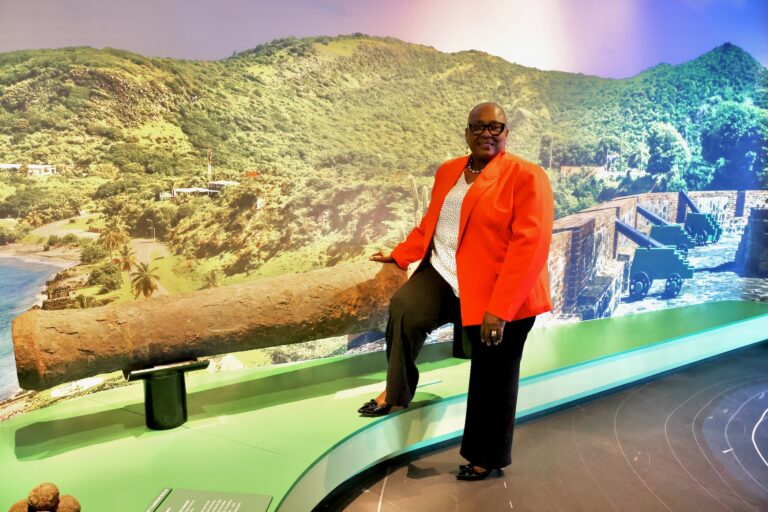
Gov. Alida Francis of St. Eustatius poses beside an 18th-century cannon transported from St. Eustatius to the Weitzman for ''The First Salute'' exhibit. (Emma Lee/WHYY) -
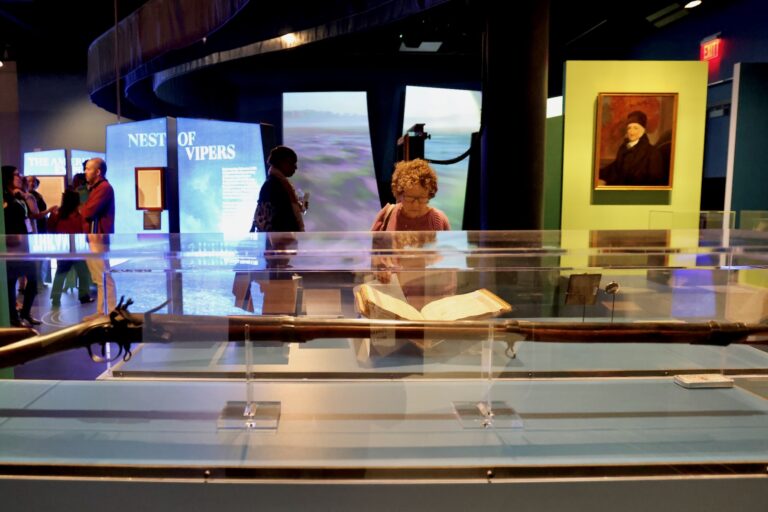
''The First Salute: An Untold Story of the American Revolution'' at the Weitzman National Museum of American Jewish History explores the roles of Jews in the American Revolution, particularly the Jews of the Caribbean island St. Eustatius, who supplied arms and gunpowder to the Continental Army. (Emma Lee/WHYY) -
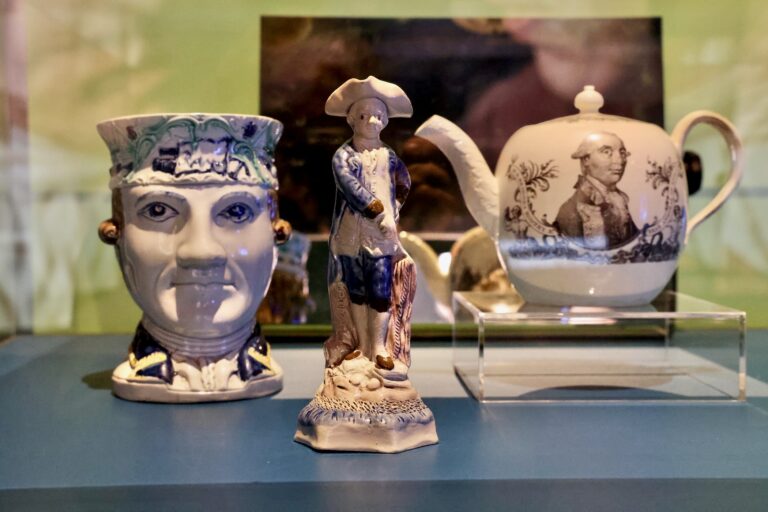
Admiral George Rodney, whose likeness in pottery celebrates his victory over the French at the Battle of the Saintes, was prosecuted for plundering St. Eustatius in 1781 for personal profit. (Emma Lee/WHYY) -
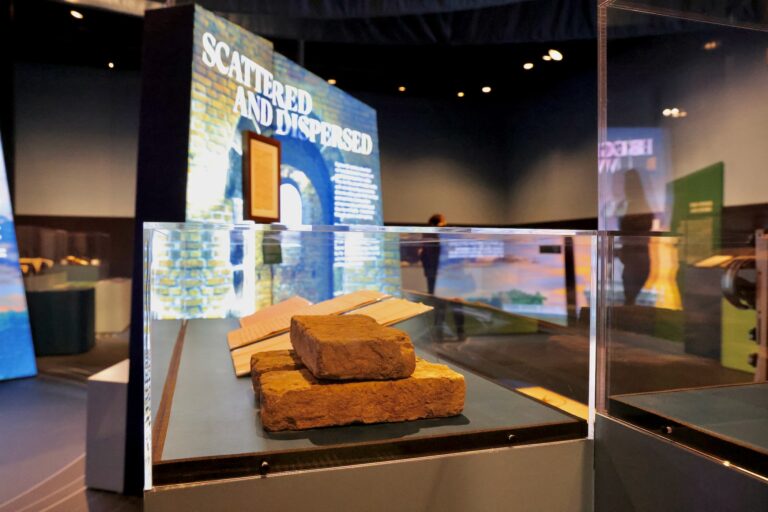
Bricks from the Honen Dalim synagogue on St. Eustatius built in 1739 are on display at the Weitzman. After the British plundered the island, disposessed Jews began leaving and the synagogue fell into disrepair. The current residents of St. Eustatius have preserved the ruin. (Emma Lee/WHYY) -
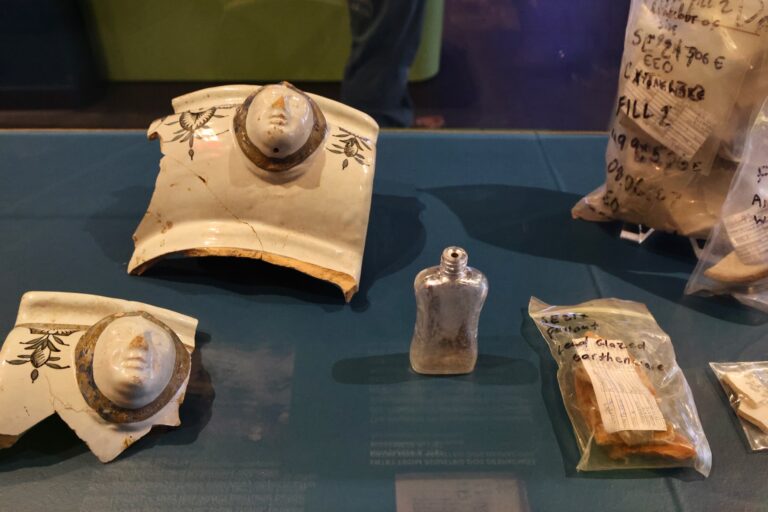
Items preserved from archaeological excavations of Honen Dalim and its adjoining mikveh (ritual bath) are displayed at the Weitzman in ''The First Salute.'' (Emma Lee/WHYY)
St. Eustatius, or Statia as it is known on the island, was and still is a territory of The Netherlands. The first ships of the newly minted U.S. Navy arrived in the island port in 1776 to pick up supplies, including critically needed gunpowder, just a few months after the Declaration of Independence was signed.
The island greeted the incoming navy ships with a 13-cannon salute, representing the 13 colonies. It was the first foreign entity to officially recognize the sovereignty of the United States.
The first artifact seen in “The First Salute” is a thoroughly rusted 18th-century cannon from St. Eustatius. Its provenance is murky, but the cannon may have been one of those fired in the titular salute.
“I don’t know if a cannon from St. Eustatius has ever been exhibited in the United States,” curator Josh Perelman said.
Related Content
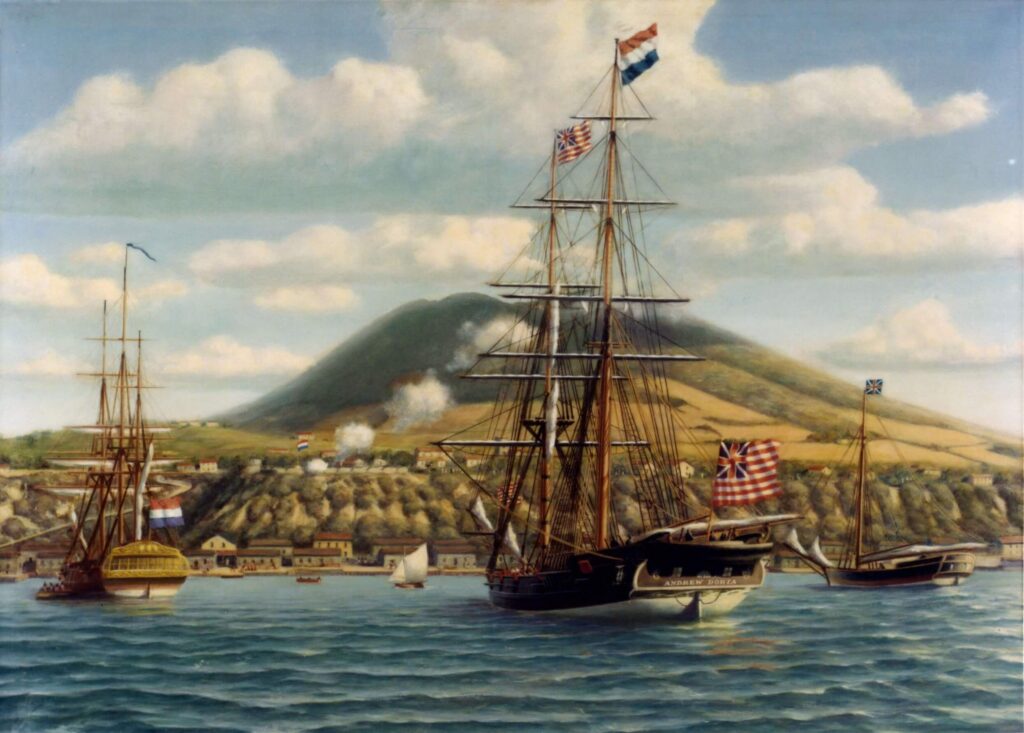
Weitzman museum plans an America250 exhibition from an island in the Caribbean
“The First Salute,” opening in April, will tell the story of a tiny, largely Jewish island that played a key role in the Revolutionary War.
11 months ago
Listen 1:12The ‘First Salute’ is a Jewish story
In 1777, St. Eustatius, like many Caribbean islands, had large Jewish populations. Many Jews fleeing European countries, particularly antisemitic oppression in Spain, Portugal and Eastern European countries, migrated to more favorable countries, such as Holland.
Many continued onto Caribbean territories to take advantage of trading opportunities. Positioned along favorable Atlantic trade winds between Europe and Africa and the Americas, the Caribbean islands were essential and lucrative shipping ports.
St. Eustatius became a strategic military position for shipping military support from European allies to the American revolutionary effort, including weapons and gunpowder.
“There have been books written about St. Eustatius and its role in the Revolution,” said Laura Arnold Leibman, professor of American Jewish Studies at Princeton University, who consulted on the Weitzman exhibition.
“Those books, weirdly, have not told much about Jews,” she said, “which we think was a huge missed opportunity.”
-
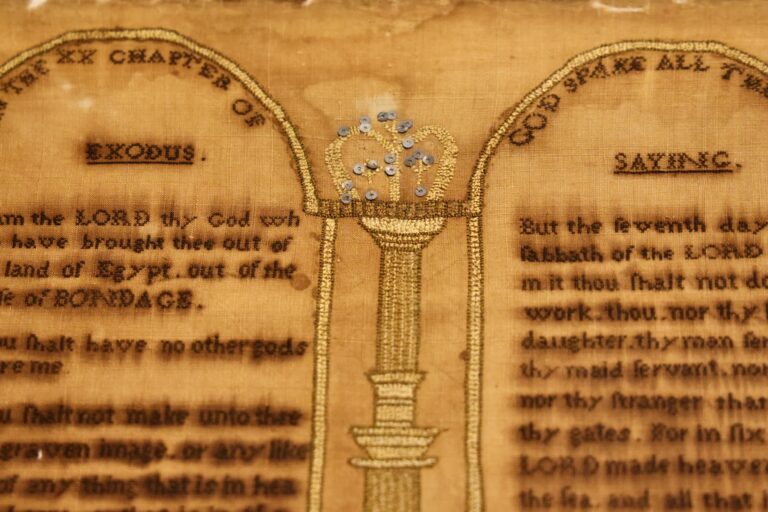
A sampler stitched by Rebecca Hendricks, a 15-year-old Jewish girl living in New York in 1780, features the Ten Commandments and a crown, signifying her father's loyalty to the British. (Emma Lee/WHYY) -
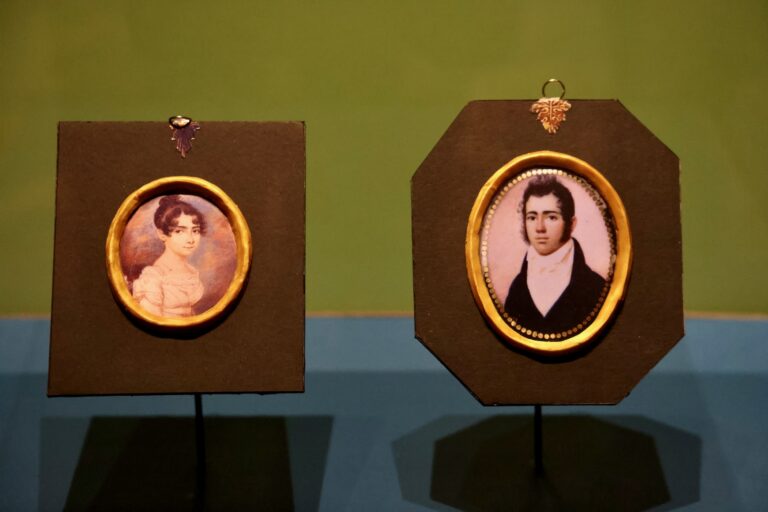
These portraits of Sarah Brandon Moses and Isaac Lopez Brandon are the earliest known paintings of Jews of African descent in North American history. They were born enslaved in Barbados to a multiracial mother and a Jewish slave owner. (Emma Lee/WHYY) -
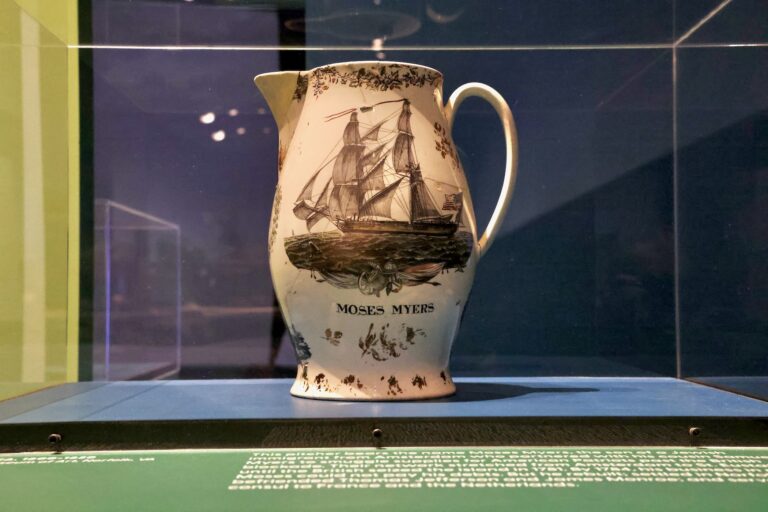
Shipping merchant Moses Myers and his cousin Samuel Myers smuggled war supplies for American Patriots until the British seized the island of St. Eustatius in 1781. (Emma Lee/WHYY) -
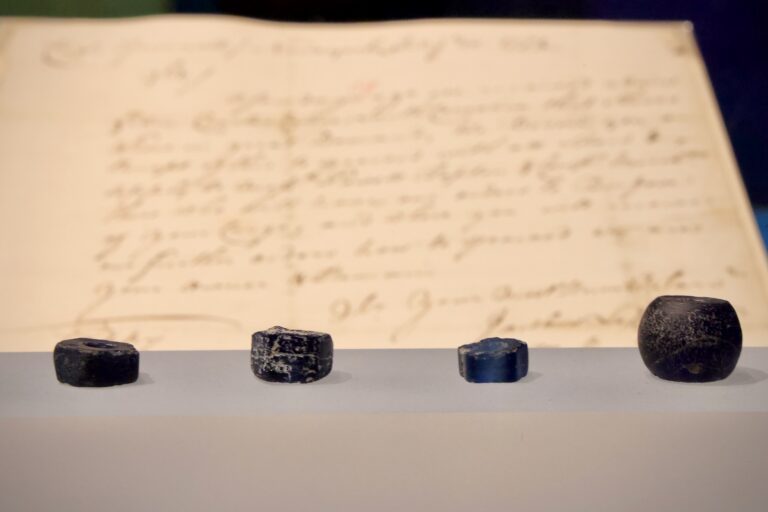
Blue glass beads on loan from the Cultural Heritage Institute of St. Eustatius represent the island's history of slavery. Many people who live on the island today are descended from slaves. The beads were used by Europeans as incentives or rewards and were used by slaves as currency and status markers. Slavery ended on the island in 1863. (Emma Lee/WHYY) -
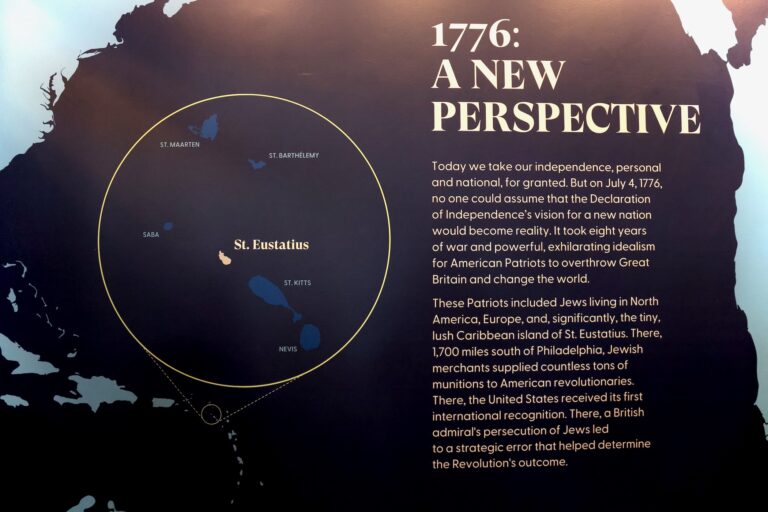
The tiny island of St. Eustatius played an important role in supplying war material to the United States during the American Revolution. (Emma Lee/WHYY)
In the late 18th century, St. Eustatius had a population of about a tenth of Philadelphia’s, but its Jewish population was larger than that of any North American city. In all of the colonies, there were only two established synagogues — in New York City and Newport, Rhode Island.
“Many people don’t know, but before 1825 the largest Jewish communities in the Americas were all in the Caribbean,” Leibman said. “St. Eustatius, a relatively small island geographically, had about twice the Jewish population of either Philadelphia or New York at the time.”
American Jews were not unanimous in their support of the American Revolution. One of Leibman’s favorite objects in the exhibition is a piece of needlework by a 15-year-old Jewish girl in New York, Rebecca Hendricks, depicting the 10 Commandments. Leibman said Hendrix’s father signed a loyalty oath to King George III, seen right next to the sampler.
“This is a good example of us trying to make sure we are not just saying ‘Rah! Rah! Rah! Patriots!’ all the time,” she said. “Jews, like every other group of people, were on both sides of the conflict.”
Related Content
Why Yiddish is experiencing a grassroots revival in West Philadelphia
A rag-tag group of younger adults has rediscovered the West Germanic language and culture for heritage and politics.
6 months ago
Listen 4:41The downfall of the Jews on St. Eustatius
Regardless of which side of the War of Independence they aligned on, Jews on St. Eustatius ultimately suffered. Many were financially wiped out by the war.
The British Admiral George Rodney captured the island in 1781 to suffocate American supply lines. There, he discovered the merchants of St. Eustatius were fabulously wealthy. Targeting the Jews in particular, Rodney systematically plundered anything and everything of value on the island for his personal benefit.
“They were robbed blind,” Francis said. “Their ships were intercepted, robbed of all of the cargo that they brought in for trade. Their shops were robbed. They were exiled. Gradually, they started to move away from the island because they felt no longer safe. The whole economy of the islands went downhill.”
Frances said there is no longer a Jewish community on St. Eustatius. Nevertheless, the residents have preserved the island’s Jewish legacy. The walls of the original synagogue, now in ruins, still stand. Artifacts such as Dutch Delft plateware and sundry Judaica objects have been preserved.
“The First Salute” includes a Hanukkah oil lamp, believed to be the only 18th-century object of Jewish ritual from St. Eustatius to survive.
-

Historians and visiting dignitaries use confetti cannons to celebrate the opening of a new exhibit at the Weitzman National Museum of American Jewish History, ''The First Salute: An Untold Story of the American Revolution.'' (Emma Lee/WHYY) -
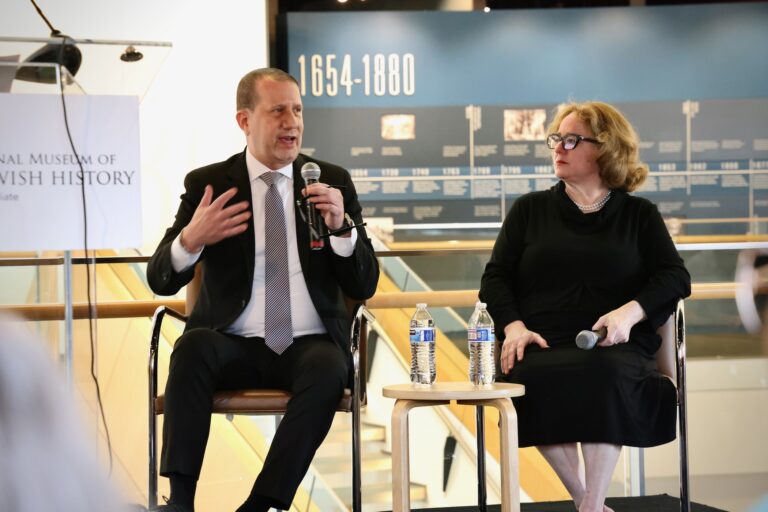
Josh Perelman (left), curator and senior advisor at the Weitzman National Museum of American Jewish History, leads a discussion with historians, including Laura Arnold Leibman (right), at the opening of the exhibit, ''The First Salute: An Untold Story of the American Revolution.'' (Emma Lee/WHYY) -
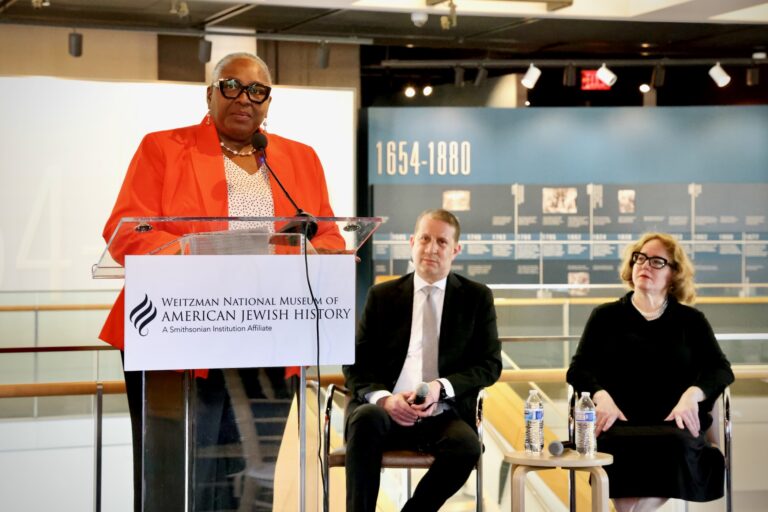
Gov. Alida Francis of St. Eustatius visits the Weitzman Museum in Philadelphia for the opening of ''The First Salute,'' an exhibit that details the role of the tiny island in the American Revolution. (Emma Lee/WHYY)
“We know that it was there at the time of The First Salute, at the time of the Revolution,” Perelman said. “It’s incredible to have it here in Philadelphia and to give visitors the opportunity to see this remarkable object that is humble but tells such a massive story.”
“The First Salute” will be on view at the Weitzman Museum of American Jewish History through April 2027.

Saturdays just got more interesting.
WHYY is your source for fact-based, in-depth journalism and information. As a nonprofit organization, we rely on financial support from readers like you. Please give today.
A new map spotlights Revolutionary War history in Bucks County
The educational tool provides information about more than a dozen historical sites connected with the American Revolution.
5 months ago
Listen 0:55
Bucks County house highlights Revolutionary War history
Ahead of the United States’ 250th anniversary, two new exhibitions showcase Revolutionary War history and “Radical Americana.”
6 months ago

Sisters team up to explore the lives of Black women in Revolution-era New Jersey
Artists Anika Grant and Nandi Jordan are producing “Ceremony for Revolutionary Seeds” this fall at historic sites in Camden, Fort Lee and Trenton.
9 months ago
Listen 1:16