

‘Swarthmore 9’ appear in court to face trespassing charges tied to Gaza protest encampment
The students and activists, who could be the first convicted for a campus protest encampment, are facing up to a year in jail.
Listen 1:19
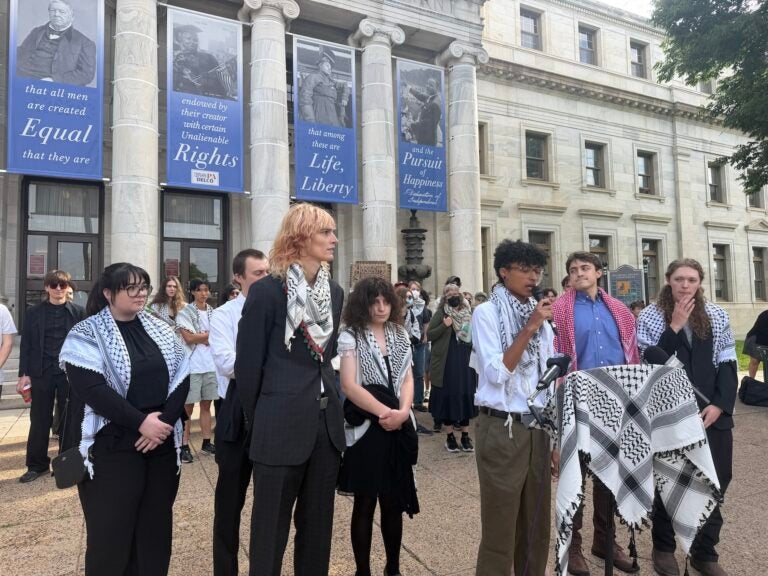
Swarthmore junior Jace Boland, who is facing criminal trespass charges for a protest at his college, speaks to supporters before a court hearing. (Carmen Russell-Sluchansky/WHYY)
From Philly and the Pa. suburbs to South Jersey and Delaware, what would you like WHYY News to cover? Let us know!
Nine protestors arrested during the dismantling of a pro-Palestinian encampment at Swarthmore College campus made their first court appearance Tuesday morning in Delaware County, in what appears to be one of the few remaining criminal cases stemming from last year’s wave of campus Gaza protests.
The defendants, who are facing misdemeanor trespassing charges, joined a rally and press conference before the court hearing in which they criticized the historically Quaker institution for choosing “violence” over their “community.” More than 50 supporters joined them at the courthouse.
“Swarthmore College claims that they had no choice but to arrest us, that their hand was forced because we constituted a threat to a community they were trying to protect, but we know the truth,” Jace Boland, a class of 2027 student, said, reciting a joint statement from the defendants. “Swarthmore College lashed out against us in defense not of their community, but of their investments.”
The group filed a motion to dismiss the charges, which the court will hear on June 22. The trial is, otherwise, scheduled to start on June 29.
How the Swarthmore encampment ended in arrests
Students at Swarthmore set up the encampment more than a year ago to protest Israel’s ongoing military actions in Gaza, which have killed tens of thousands of Palestinians. Those attacks were in retaliation of the Oct. 7 attack by Hamas on Israel in which they killed about 1,200 people and took another 251 hostages, dozens of which died while in captivity.
In early 2024, students at colleges and universities around the region established protest encampments, demanding their universities divest from Israel among other concessions. The University of Pennsylvania swiftly banned encampments and called in police, who arrested 33 protestors.
However, Swarthmore did not initially condemn one such encampment established by its students.
“In keeping with the College’s long standing values around peaceful protest and free expression, we have not interfered with the encampment,” Vice President for Communications Andy Hirsch said in a statement to the student paper at the time.
However, that changed in May of last year, when the new encampment was forcefully removed, and nine activists — now known as the “Swarthmore 9” — were arrested. Cara Anderson, assistant director of media relations at Swarthmore, said that “circumstances were different” between 2024 and 2025.
“In 2025, the College received an influx of complaints from other students, their families, and faculty and staff who expressed mounting concern about the encampment’s implications for their own safety and security,” she said. “Another important distinction is that in 2024, the vast majority of those protestors were actually Swarthmore College students, and, in stark contrast to 2025, were not completely disguised.”
That event coincided with the college issuing other punishments for protest-related activities, including a suspension for using a bullhorn close to college staff and a threat of expulsion over the distribution of protest literature.
Thousands of American college students have been arrested or detained by authorities since the start of nationwide protests over Gaza in 2023. However, few — if any — have been convicted of crimes, with most cases being dismissed. None of the students at the Penn encampment faced criminal charges, though some likely had to pay civil fines.
Related Content
The literature included a scope’s crosshairs placed over a photo collage of the board of managers. A spokesperson said expulsions are rare.
5 months ago
Listen 1:13Defendants say case could set a precedent
The Swarthmore protestors, however, face up to one year in jail and thousands of dollars in fines if they are convicted. While the maximum penalty is unlikely to be applied, the defendants say a conviction would set a precedent.
“Our case is a crucial crossroads for the future of student activism,” Boland said, reciting the joint statement. “If we lose, Swarthmore becomes an environment in which police violence against protestors is the norm. If the college can deploy state violence to protect its interests without consequence, there is no telling what levels of repression future generations of student activists will face.”
Only Boland was a student at the college at the time. Another, Brendan Cook, was enrolled but had been suspended for protest activity months earlier. Some of the others were students not affiliated with Swarthmore.
“We all showed out in solidarity with the people who had started the encampment because we felt that it was morally right to do so,” said Winnie Malcarney, one of the defendants. “I don’t necessarily think that our status as students had any impact on that other than the fact that we’re all people of conscience.”
Adi Chattopadhyay, a Swarthmore student who spoke at the event but who is not one of the defendants, called Swarthmore an “open campus” where people from outside the community regularly congregate.
“Probably right at this moment, there are families who are not Swarthmore students, who the college cannot identify, who are walking their dogs, who are bringing their kids, who are playing in the creek,” he said.
The defendants admitted that they had received “a lot of threats” of suspension and arrest during the encampment but said they were still “surprised” that the police were eventually called.
“It was completely unprecedented,” Boland said. “I think that not just us in the encampment, but a lot of the Swarthmore community was incredibly shocked by just the spectacle of that many police officers coming onto the campus. Nobody had seen anything like that before.”
That included Mark Wallace, a professor of religious studies at Swarthmore.
“The college has betrayed its fundamental ideals,” he said in front of the courthouse. “Colleges should be places where large, uncomfortable questions are asked and struggled with. So when Swarthmore last year called the police on students peacefully protesting against the violence in Palestine, in my judgment, the college signaled its failure to realize its own educational mission. A mission that consists of fostering open discussion about some of the most pressing issues of our time.”
The protestors, however, are continuing to push the college on those issues. In a statement they issued about the case, they reaffirmed a demand for Swarthmore to “cut all ties with Cisco Systems, as part of a broader demand for the college to divest from all companies linked with the ongoing genocide in Gaza.”
San Jose, California-based Cisco provides servers, data centers and other technology to the Israeli military as a primary vendor.
Editor’s note: This story was updated after publication to include comments from the administration at Swarthmore and to clarify that some of the students charged were not affiliated with Swarthmore.

Get daily updates from WHYY News!
WHYY is your source for fact-based, in-depth journalism and information. As a nonprofit organization, we rely on financial support from readers like you. Please give today.
Penn, Bryn Mawr and Swarthmore back Harvard in lawsuit to defend international student enrollment
The colleges say blocking international enrollment would harm U.S. higher education and the economy.
5 months ago
Transgender runner Evie Parts sues NCAA and Swarthmore College for removal from track team
The claim states the NCAA is not a governmental organization and doesn’t have jurisdiction over Pennsylvania state law or Title IX.
11 months ago
Federal judge transfers Columbia student activist Mahmoud Khalil’s case to New Jersey
Khalil, 30, a legal U.S. resident with no criminal record, was detained by federal immigration agents March 8 for participating in pro-Palestinian demonstrations.
1 year ago