

‘Passing this ordinance was crucial’: Sussex Council adopts county’s first forest preservation law after months of public deliberation
The Sussex County Council voted unanimously to adopt a set of standards that protects trees amid ongoing development. The rules go into effect in three months.
Listen 1:02
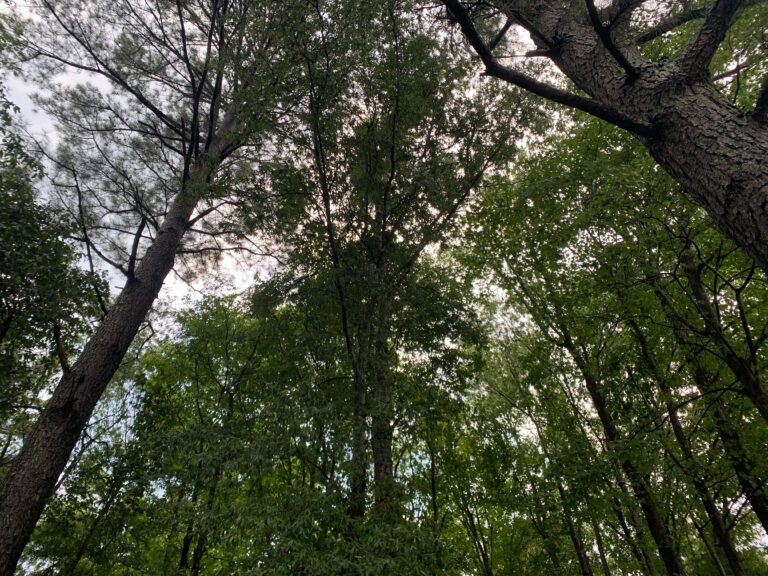
A forested area off of Neptune Road in Milton, Del. (Sarina Grossi/WHYY)
What are journalists missing from the state of Delaware? What would you most like WHYY News to cover? Let us know.
The Sussex County Council adopted a measure that protects trees from ongoing and widespread development, after months of discussion and debate. Prior to the council’s unanimous vote Tuesday, the county did not have a forest protection law written in its code.
The adopted law requires developers to preserve at least 30% of forests on properties in growth areas, or 50% in rural areas. The county’s Future Land Use Map designates growth and rural areas.
“Passing this ordinance was crucial to protecting one of the qualities that makes Sussex County such a special place,” County Council Vice President John L. Rieley said in a statement. “Trees are an essential part of our landscape, and quality of life. This vote is a bold step forward to preserve the natural beauty and character of Sussex County for generations to come.”
Forest preservation has been an ongoing topic of discussion for the county for years, dating back as far back as when the county had begun to work on its 2018 Comprehensive Plan. That’s according to Rich Borrasso, a board member with Sussex Preservation Coalition, a local environmental advocacy group that has rallied in favor of protecting forests from development.
Kent County and New Castle County included forest preservation standards in their codes before Sussex.
“What the public wanted in terms of saving trees wasn’t something that was outlandish,” Borrasso told WHYY News. “It was just to be consistent with the thought that trees are just as important in Sussex as they are in the other counties.”
Borrasso said the ordinance is ultimately a step in the right direction.
“It’s been such a hard fought battle to get a forest preservation ordinance, like all of our neighboring jurisdictions,” Borrasso said.
Sussex County has the most forestland in Delaware. However, it lost an estimated 43,000 acres of forests between 1998 and 2021 from development, according to the state forest service.
The adopted ordinance was initially proposed at a council meeting in April, as recommended by the Sussex County Land Use Reform Working Group. The group formed in 2025, with its main purpose being to review land use trends and provide recommendations to update the county’s zoning codes.
The county’s Planning and Zoning Commission held a public hearing on the proposed preservation ordinance in early June, later recommending that it be approved.
The county council held its own public hearing on the measure in July, receiving about 50 written public comments on the matter. At that meeting, the council voted to defer action on the ordinance for further consideration.
Since then, the council has reviewed potential amendments to the written ordinance three times.
County Councilmember Matt Lloyd said at this week’s meeting that it was important for the council to adopt the measure, as it helps decide Sussex County’s future. However, the council must strike a balance.
“If every field became a subdivision, if every wooded tract disappears, if every road becomes overwhelmed, then growth may have succeeded on paper while Sussex County itself lost something,” Lloyd said. “At the same time, if we regulate people so heavily that families can’t use their land, farmers lose value and responsible investment leaves, then we failed the county in an entirely different way.”
The law will go into effect in December.
Related Content
Sussex County considers regulations to preserve Delaware forests in the face of development
The law would protect a percentage of trees on a given property from being cleared. Some residents support adopting the law, with a few reservations.
3 months ago
Listen 1:03How to define a forest?
At the meeting, the council voted on amended changes to the original ordinance before voting to adopt the measure as a whole.
One change focused on how the ordinance defined a forest. Early drafts defined it as “a vegetative community dominated by trees and other woody plants covering a land area of 10,000 square feet or greater, including land that formally had forest cover and will be naturally or artificially regenerated.”
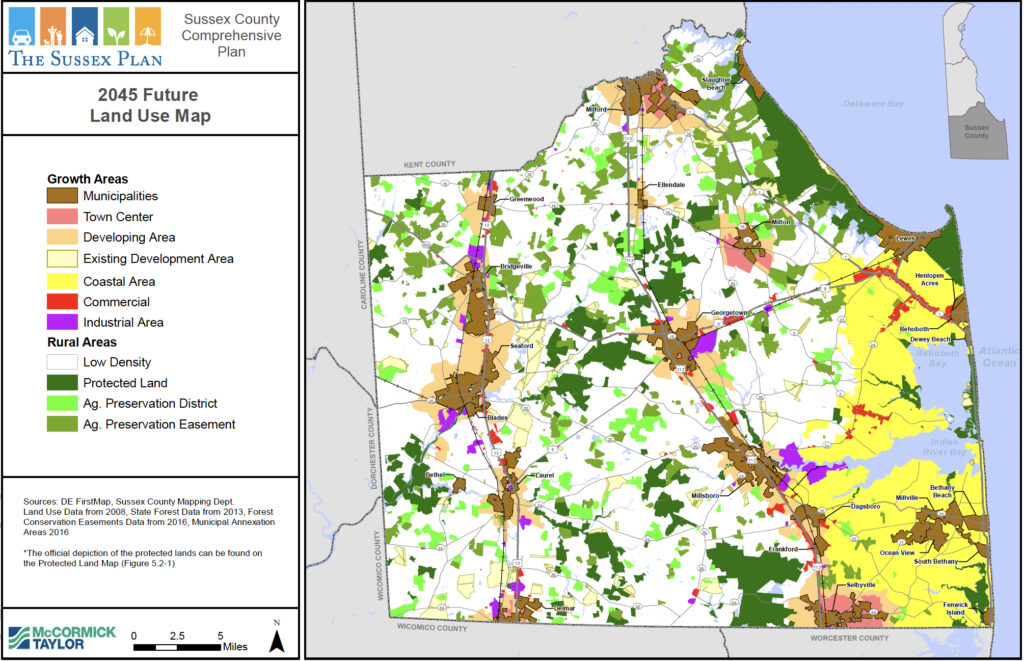
Land Use Map. (Sussex County)
The amendment expanded the definition of a forest to 1 acre or greater, with a width of 120 feet. A forest must have at least 100 trees per acre, excluding invasive species. These trees would also need to have a diameter of 4 inches or more, and stand at least 4 and 1/2 feet off of the ground.
This differed from proposed forest definitions from the Sussex Preservation Coalition. Borrasso said using a 4-inch diameter in particular favors mature forests with larger trees and ignores younger trees.
“There could be forests that are even an acre, but if the trees are less than 4 inches, it doesn’t meet the definition of a forest and those trees could be cut down,” he said.
Judy Rose Seibert, a member of the coalition and a biologist, said during the public comment period that many native trees in Delaware take a long time to reach a 4-inch diameter.
“The American holly, which is our Delaware state tree, is a very slow grower,” Seibert said. “At 2 inches of diameter at breast height, that age is 12 to 20 years. Whereas a 4-inch tree is 25 to 30 years [old].”
The council did unanimously adopt the new definition, though Councilmember Jane Gruenebaum said she would not have written the definition that way herself. Gruenebaum formerly was the president of the Sussex Preservation Coalition before she assumed office.
Another change to the ordinance deals with perimeter buffers, or the property line of developments. The county previously adopted protections and planting regulations for buffers, but drafts of the ordinance did not include perimeter buffers in its preservation requirements.
However, the council voted 4 to 1 to accept an amendment that allows perimeter buffers to be included in what’s considered protected forestland in growth areas. Gruenebaum was the sole dissenting vote.
Perimeter buffers in rural areas will not count toward forest preservation, as outlined in a separate accepted amendment.
Related Content
Sussex County Land Trust celebrates preserving 88-acre farm in Lewes
The Ard Na Gréine farm was owned by the same family in Lewes for decades. Now, it will be protected from development and, eventually, made open for public recreation.
2 months ago
Listen 0:59Fee-in-lieu option left in the air
Another amendment would allow developers to remove trees in special circumstances in which the land itself makes it difficult to meet building requirements. They would need approval from the Planning and Zoning Commission.
In these cases, developers would also need to create a mitigation plan, and replant trees in another area. They would be required to replant at least double the amount of the trees cut. If trees are removed without approval, developers would also pay a fine estimated at about $43,000 per acre.
The county council discussed at previous meetings the possibility of a “fee-in-lieu” option, where developers who needed to remove trees due to hardships could pay an additional fee that would pay for preserving trees in another location. It was not included in the adopted ordinance after at least three council members said they were not in favor of it at last week’s meeting.
Gruenebaum, specifically, was a strong opponent to the idea, and said at the last meeting that it favored developers rather than preserving forests.
“I don’t want to create multiple avenues for getting out of protecting the forest, and this avenue is particularly obnoxious to me,” she said at last week’s meeting. “‘Let me give you some money and go preserve it somewhere else because I’m going to tear down on this one.’ I can’t support the fee-in-lieu-of. I can’t support it.”
Lloyd supported a fee-in-lieu option, and at this week’s meeting said that it was a way to “stick it to developers,” and not including it in the ordinance was a missed chance.
“There’s two ends of the extreme here, stopping everything and then there’s floor on the accelerator for everything, and the happy medium down the middle is if you prioritize growth for growth areas and in another way preserve the rural areas,” Lloyd said. “That’s splitting the baby on the issue.”
Gruenebaum said that they could consider the fee-in-lieu option, as well as a different forest definition, after adopting the ordinance to establish a county forest protection law.
“I would rather go ahead with this, either agree to the mitigation proffered here or not, and then, if you feel strongly about coming back at another time and adding fee-in-lieu of, we can do that,” she said.
Related Content
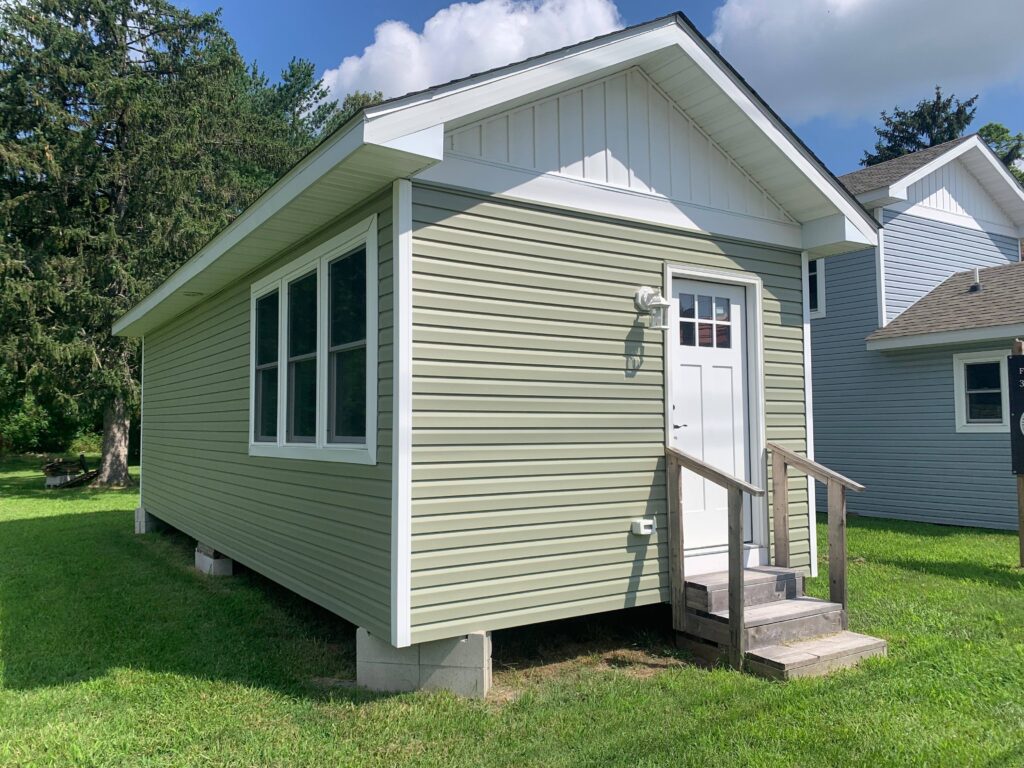
The zoning changes adopted back in December allowed for dense cottage communities to be built in town.
2 months ago
Listen 1:07Moving up the timeline
The effective date for the ordinance was also changed from the original proposal draft. Initially, the measure was expected to go into effect six months after it was adopted, to offer developers a grace period. But Gruenebaum had argued at past meetings that it should have an immediate effective date instead.
“We’ve been debating this for I don’t even know how many months. So, there’s been a lot of forewarning that this is coming,” said Gruenebaum at this week’s meeting. “But more importantly, I don’t understand the reason for making this effective date any different than the other ordinances we have introduced in the past.”
The proposed amendment pushed the effective date to three months from adoption as a compromise. The council voted 3 to 2 on this amendment, with Gruenebaum and Council President Doug Hudson dissenting. This will apply to any new subdivision applications.
Borrasso said the Sussex Preservation Coalition worries that developers will rush to submit applications to bypass the ordinance’s effective date.
“It’d be a rash of applications coming in and that would mean just more potential tree loss going forward,” Borrasso said. “I think there’s a lot of folks that are going to be monitoring the rate of applications that are coming in that would again be grandfathered by the new ordinance.”
However, Borrasso also said that if the ordinance is not working to protect forests as it stands, the council should be open to amending it.

Never miss a moment with the WHYY Listen App!


WHYY is your source for fact-based, in-depth journalism and information. As a nonprofit organization, we rely on financial support from readers like you. Please give today.
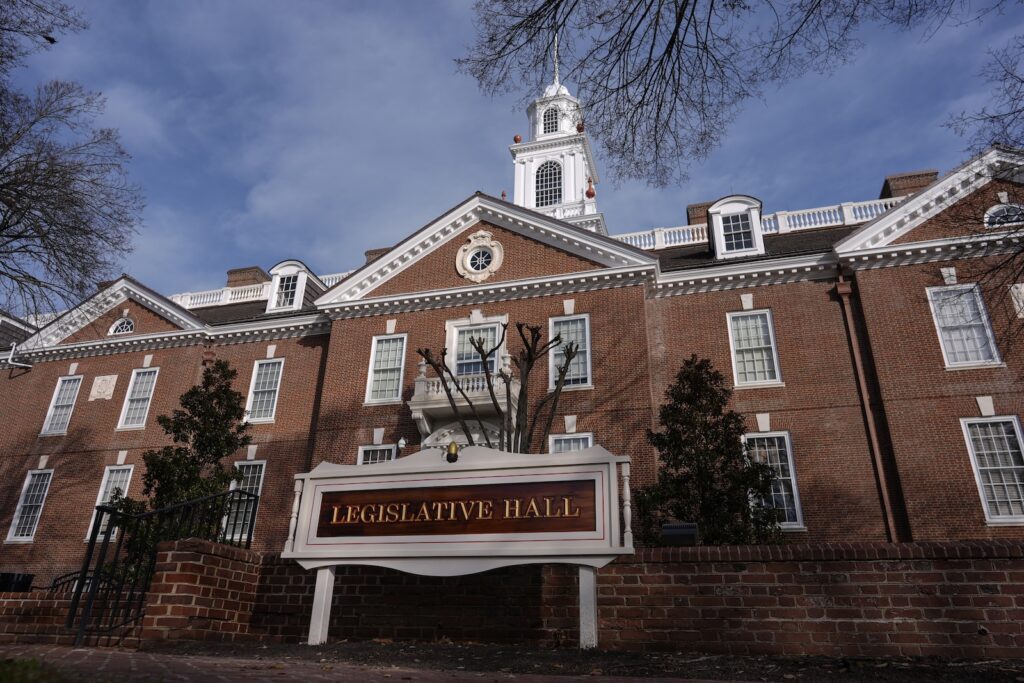
Delaware recently implemented 2 land-use laws. Here’s what they mean for affordable housing
House Bill 450 and Senate Bill 23 both require Delaware counties and local governments to make changes in the way they approve developments.
2 weeks ago
Listen 1:02
The zoning changes adopted back in December allowed for dense cottage communities to be built in town.
2 months ago
Listen 1:07
Jeff Balk spent several years in a Missouri prison for abusing teen boys. He first resisted calls to resign as county chair but ultimately stepped down.
12 months ago
Listen 2:02