
Pa. Gov. Shapiro says investor-owned utilities are making too much profit at the expense of ratepayers
Shapiro’s plan includes heightened scrutiny of utility profits by state regulators and getting rid of “junk fees.”
Listen 1:06
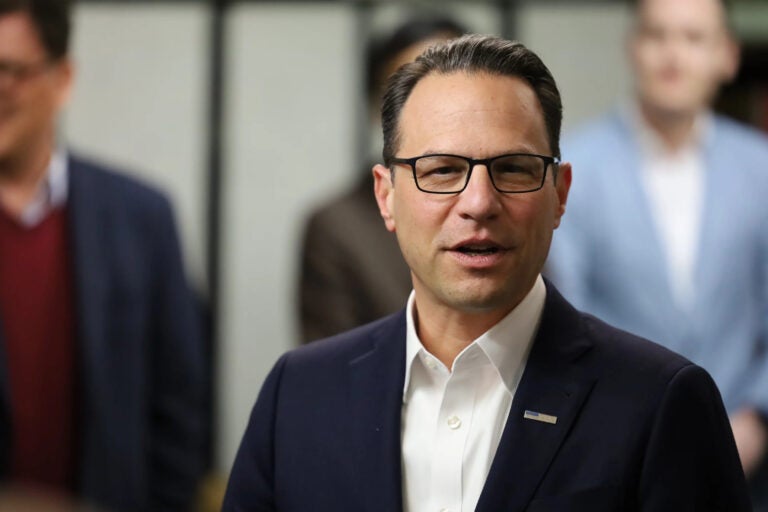
FILE - Gov. Josh Shapiro speaks at Al-Aqsa Islamic Society in Philadelphia on Tuesday, March 25, 2025. (Carmen Russell-Sluchansky/WHYY)
This story is part of the WHYY News Climate Desk, bringing you news and solutions for our changing region.
From the Poconos to the Jersey Shore to the mouth of the Delaware Bay, what do you want to know about climate change? What would you like us to cover? Get in touch.
Pennsylvania Gov. Josh Shapiro said the state’s investor-owned electric utilities make too much profit at the expense of ratepayers. The governor laid out a plan to tackle rising costs during his annual budget address Tuesday in Harrisburg.
“Our utility companies in Pennsylvania make billions of dollars every year — while at the same time they’ve increased the cost for consumers with too little public accountability or transparency,” Shapiro told the General Assembly to rousing applause. “That has to change.”
Electricity rates are on the rise in part because of a gap between supply and demand. As older plants shut down, new facilities have not come online fast enough to make up for the decrease. At the same time, demand from data centers driven by a rise in artificial intelligence has put a strain on the grid.
Because utilities have a monopoly, they have to seek approval from the Pennsylvania Public Utility Commission to raise rates. Their profits are not made on the cost of the electricity, which is passed on to the ratepayer. Instead, they seek a return on their investments in infrastructure. The profits come in the form of distribution payments.
“We need to have a hard conversation about the amount of profit utilities and their investors can make on the backs of hardworking Pennsylvanians,” Shapiro said. “S&P Global Ratings currently ranks Pennsylvania as one of the top four states in the country for utilities to make a profit.”
Shapiro created a new watchdog to scrutinize company profits. He wants the PUC to better examine their books and make financial details of their rate-hike requests more transparent. He asked lawmakers to pass legislation that provides guidelines for the PUC and limits on utility profits.
“We grant these utilities a monopoly — and in exchange, they have a legal responsibility to keep their costs just and reasonable,” Shapiro said. “They shouldn’t get one dollar more than what they need to meet their customers’ needs.”
He also wants to eliminate “junk fees,” including costs to turn on electricity after a shutoff.
Related Content
Pa. Gov. Josh Shapiro wants more data centers but they need to bring their own power
Gov. Shapiro said his data center proposal includes greater transparency, community outreach and water conservation.
2 months ago
Listen 1:11Reaction to Shapiro’s plan to lower electricity rates
Community Legal Services attorney Rob Ballenger represents PECO customers who have suffered electricity shutoffs. He said shutoffs can be devastating.
“Our clients can get displaced from their homes,” said Ballenger. “They can be required to place their children with relatives or be involved with DHS potentially, and there’s research that really highlights that these kinds of disruptions cause lasting mental and physical health risks.”
Ballenger said shutoffs can also be life-threatening and hopes to work with lawmakers on legislation to carry out the governor’s plans.
POWER Interfaith, a climate and racial justice organization, said the organization is “cautiously optimistic” about the governor’s plan.
“We welcome the Governor’s commitment to hold giant utility companies accountable for raking in huge profits while raising our utility bills and failing to do enough to reduce the reliance on fossil fuels,” said POWER’s Sara Melton in a statement. “Communities deserve a real seat at the table when decisions affect their air, their water, and their monthly bills.”
PECO defended its practices, saying in a statement its plans to invest about $10 billion in infrastructure upgrades over the next five years will improve reliability.
“Investments like these have resulted in service reliability ranking PECO among the best in the nation as benchmarked against our peers, and as our performance during Winter Storm Fern showed, a resilient, well-funded grid is essential when customers need it most,” the statement read. “These investments also drive economic growth and support thousands of local jobs.”
Pennsylvania’s deregulated energy market allows independent producers to supply electricity. It also decouples energy production from distribution as a way to encourage more competition, something the electric utilities have been seeking to reverse.
PECO’s statement pointed to independent suppliers, saying their profits should also be scrutinized. The company encouraged “accelerating new power plant connections, expanding solar and battery storage, and exploring utility-generated energy to serve as a potential backstop solution to meet growing energy demand.”
Shapiro also pointed to his set of energy proposals announced last year called the Lightning Plan, which includes green energy tax credits and increases the amount of renewable energy utilities would be required to tap. Conservative critics have rejected the push for renewables as an additional tax and say Pennsylvania needs to build more power plants to replace retiring coal and natural gas facilities.
“We’re very concerned that the governor’s proposals would actually make electricity more unaffordable and less reliable,” said Elizabeth Stelle, a policy analyst with the Commonwealth Foundation. “It will have exactly the opposite impact of what he claims.”
Stelle said renewable energy projects are expensive to build and would not be enough to replace the loss of baseload power from fossil fuel plant closures.
Stelle said in addition to data centers, electrification efforts, including EVs, have put additional demand on the grid.
“What we want to see is more reliable generation added to the grid,” said Stelle. “So if that means coal, fine, if that’s gas, fine. If someone has a way to improve the efficiency of batteries and we can run solar so that it can be a 24/7 resource, great.”
“We’re more concerned with special tax incentives, those types of corporate welfare handouts to a favorite industry,” Stelle added.
The Public Utility Commission said in a statement that it will continue to “review and scrutinize the operations of all regulated utilities and looks forward to working with the Governor and the General Assembly on shared goals to assist all Pennsylvanians.”
Related Content
N.J. Gov. Mikie Sherrill issues state of emergency on energy costs: Here’s what to know
Sherrill ordered state regulators to boost renewables and natural gas in light of rising electricity prices.
2 months ago
Listen 1:06Shapiro points the finger at grid operator for higher electricity costs
Shapiro also took aim at the region’s grid operator, PJM Interconnection, saying the agency is not moving fast enough to bring new energy projects onto the grid or helping to shrink the gap between supply and demand.
PJM spokesman Jeff Shields wrote in an email that the agency “is doing its part to bring new generation onto the system, and any suggestion otherwise is just not true.”
PJM runs the grid for 13 Mid-Atlantic and Midwestern states, an area that includes about 67 million people. One of its roles is to conduct capacity auctions with suppliers to make sure there is enough electricity available during peak times – like heat waves or this most recent winter cold spell. In recent years, those auctions have produced record-breaking prices that are then passed on to the consumer.
Shapiro sued PJM two years ago over the high rates produced by what he called a “flawed” and “broken” system. He negotiated a price cap that he said has saved ratepayers more than $18 billion. In an effort with a bipartisan group of governors that included Shapiro, President Donald Trump urged PJM to bring more power sources onto the grid and extend the cap last month.
PJM pushed back on Shapiro’s assertion that it has control over pricing, emphasizing that is the role of the PUC in conjunction with the investor-owned utilities like PECO, PPL and Duquesne.
“PJM does not set the retail rates that are charged to any class of electricity customer, whether residential, commercial or industrial,” said Shields in an email.
“PJM does run wholesale power markets and the wholesale costs those markets produce do make up a portion of a retail bill,” Shields wrote, adding that the increase in demand comes from “the proliferation of data centers that are powering the digital economy.”
Shields also wrote that there are currently more than 55 gigawatts of energy approved to come online that are delayed “by factors unrelated to PJM – including primarily state and federal permitting but also supply chain backlogs and financing.”
“We look forward to working with the state to make sure projects get built. Our interconnection queue is reformed, and any projects that come in now will be cleared from an engineering standpoint in 1 to 2 years, which is well in advance of any construction timelines,” Shields wrote.

Get daily updates from WHYY News!
WHYY is your source for fact-based, in-depth journalism and information. As a nonprofit organization, we rely on financial support from readers like you. Please give today.
Part of the series
Parents of victims of explicit AI-generated images called for better responses from school districts.
3 weeks ago
Listen 1:09
Shapiro pitches $1B housing program to build new stock, reduce barriers to ownership in Pennsylvania
The plan is part of Shapiro’s budget pitch and includes a $1 billion proposal, renter protections, zoning reforms and a strategy to tackle rising housing costs statewide.
2 months ago
Listen 1:07
Why Gov. Shapiro wants to scrutinize electric utility profits
Gov. Josh Shapiro has a plan to scrutinize utility profits. Investor-owned utilities say it's important to invest in infrastructure that keeps the lights on.
2 months ago
Listen 5:35