
What some Philadelphia students will learn in the new MOVE bombing curriculum, and what’s not included
The curriculum will discuss the organization's history and the context of the bombing, but not the current controversies surrounding the group.
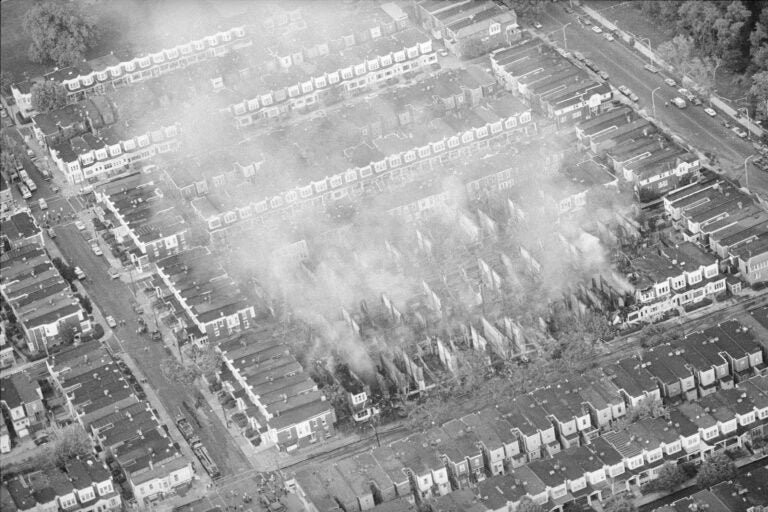
FILE - Smoke rises from the ashes of a West Philadelphia neighborhood, May 4, 1985, the morning after a siege between Philadelphia police and members of the radical group MOVE left 11 people dead and 61 homes destroyed. (AP Photo/Peter Morgan, File)
From Philly and the Pa. suburbs to South Jersey and Delaware, what would you like WHYY News to cover? Let us know!
Mike Africa Jr., legacy director of MOVE Activist Archive and son of original MOVE members, has launched the MOVE Curriculum to educate Philadelphia students about the 1985 bombing of the organization’s Osage Avenue compound. The program will be implemented in 59 classrooms across the city, Africa Jr. said.
Africa Jr. helped design the four-week curriculum, along with Tiferet Ani, Krystal Strong and Philadelphia teachers.
Nearly 40 years after the bombing, the course intends to educate younger Philadelphians about the event’s history, Africa Jr. said. However, the lessons do not address any present controversies surrounding allegations of abuse within the organization.
What is MOVE and what happened
John Africa founded MOVE in Philadelphia in 1972. The organization leaned in on Black revolutionary and environmentalist ideologies.
Throughout the late 1970s and 1980s, MOVE stood at odds with the Philadelphia Police Department, resulting in armed confrontations. A 1978 standoff between police and MOVE members resulted in an officer’s death.
On May 12, 1985, police attempted to arrest MOVE members in their West Philly rowhome. After a daylong standoff and shoutout between law enforcement and the organization, police dropped a bomb on 6221 Osage Ave.
The bombing killed 11 people and displaced 61 families.
The “On A MOVE” program
The curriculum includes 20 lessons and incorporates materials from MOVE’s family archive. Some teachers have already begun to implement the lesson plans.
In addition to the MOVE bombing, students will learn about why the organization exists and the challenges it faced, including opposition by former Philadelphia mayors Frank Rizzo and Wilson Goode.
Mike Africa Jr. said the curriculum is intended to educate students about the historical event and the context surrounding it. He spoke to the significance of creating a program to inform young Philadelphians about the history of the bombing, but also said the lessons don’t glorify MOVE.
“There’s no time in the history of America, even with all the challenges that Americans have dealt with, that a bomb was dropped on one singular group,” Africa Jr. said. “It was important for us to create a curriculum that to tell that history.”
Timothy Welbeck, director of the Center for Anti-Racism at Temple University and professor of Africology and African-American studies, said that it is “incredibly important” for cities such as Philadelphia to discuss and contextualize historical events like the MOVE bombing.
“I think there is a strong benefit from those who directly experienced it to help teach and shape the understanding of an experience like the MOVE bombing and why it still matters today,” Welbeck said.
Related Content
MOVE at 40: Looking back at the 1985 commission and its ‘unconscionable’ findings
After five weeks of hearings with more than 90 witnesses, the MOVE Commission determined the city’s bombing was an “unconscionable” act.
12 months ago
Listen 7:32Creation of the curriculum
Africa Jr.; Strong, archive director of MOVE Activist Archive and an associate professor of Black Studies in Education at Rutgers University; and Ani, a doctoral candidate at the University of Pennsylvania, worked together to create the program.
Strong said that conversations about a MOVE curriculum germinated around 2020, following national outrage over George Floyd’s killing. There was an organic interest in revisiting the activist group’s story and the overall history of state violence, he said.
“We were reminding people about MOVE’s history,” Strong said. “We don’t have to look to Minneapolis to talk about police violence and police murder.”
In October 2022, Ani joined the project. They said they had 15 years of experience as a history educator and curriculum developer and came to Philadelphia as a doctoral student interested in learning more about the impact of students learning local histories and critiquing systems of oppression.
Strong gave Ani a list of MOVE media so they could educate themselves and learn the group’s history.
“Oftentimes, curriculum is very top-down,” Ani said. “The state makes standards and then somebody writes the curriculum, and there’s rarely this exchange between scholars and people in public school districts to write curriculum, let alone community activists.”
The media has dehumanized MOVE for most of its history, according to Ani.
“It was extremely important to us, as it is with any history we tell, not just MOVE, to humanize historical actors that have been dehumanized,” Ani said.
In March 2023, Strong and Ani met with teachers interested in the program and received feedback, they said. A year later, Ani taught the course to students in West Philadelphia and gained more community feedback.
Most recently, in October 2025, a teacher at Carver Engineering and Science instituted a pilot of the MOVE Curriculum, culminating in a symposium where students presented on their learnings from the course.

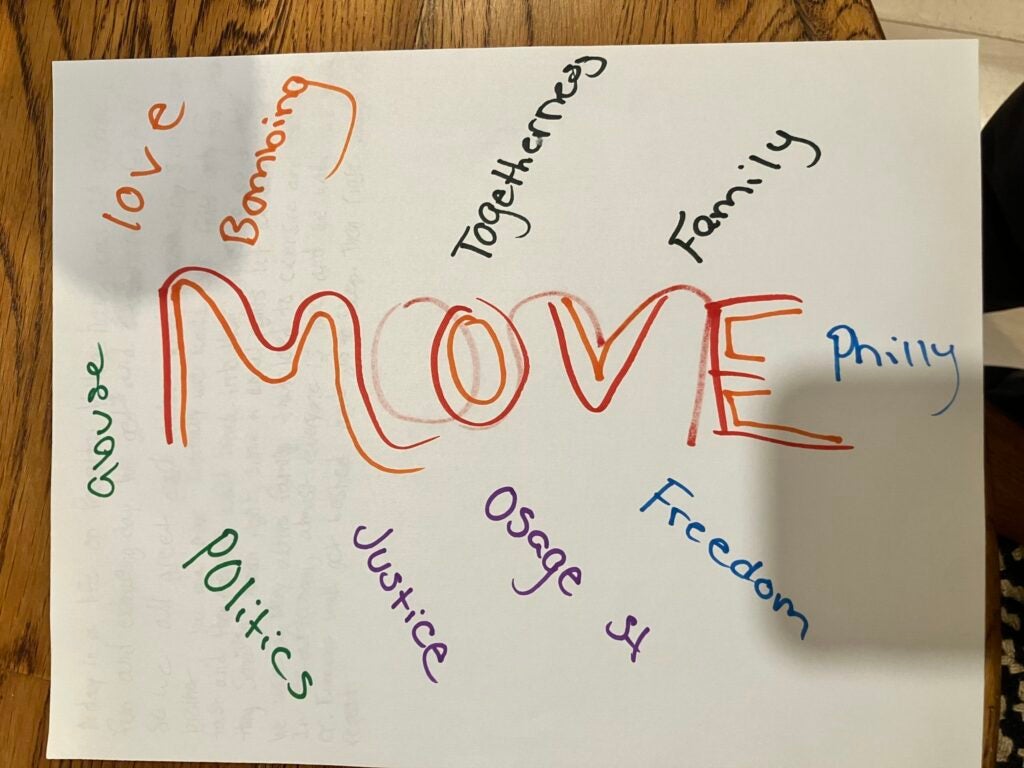
“To see these young people so engaged and so passionate because they’re engaging with local history that feels real to them, that was really affirming of the value of this kind of approach,” Strong said.
Related Content
The ongoing struggle over the meaning of the MOVE bombing
Forty years on, journalists, activists and archivists discussed who does the telling, and how.
12 months ago
Not addressing recent allegations
While the program dives into the history of MOVE and the context surrounding the bombing, the curriculum will not address the allegations of abuse raised by former members against the group.
In July 2021, three former MOVE members alleged that they witnessed abusive behaviors as children. Following the initial release of allegations, over a dozen ex-members of MOVE came forward with claims of physical and mental abuse inside the organization.
“We’ve reached out to them for different things and just to try to have conversations about things,” Africa Jr. said. “We had conversations and some of them are good, but I guess we’re all healing on our own time.”
Welbeck said the allegations are an example of the need to emphasize a holistic view when discussing historical events, figures or movements.
“I do think it’s important that allegations raised are taken seriously, they’re investigated and to the extent that they can be substantiated, are also included in the telling of the history of the movement,” Welbeck said.
However, the Temple professor added that he would not want the alleged abuse to overshadow the 1985 bombing.
What happened was a “grave injustice” worth teaching about, he said.
“I don’t ever want that to be lost,” Welbeck said. “Even if the allegations are raised and acknowledged as well, I think both can be held simultaneously.”
Not officially approved by the Philly School District
While some teachers have begun implementing the MOVE curriculum in city classrooms, the School District of Philadelphia told WHYY News in a statement that the program has not been officially approved.
“While the School District of Philadelphia understands the importance of the MOVE bombing in Southwest Philadelphia to our local history in Philadelphia, we have not officially adopted or approved any curriculum on MOVE. When we officially review content we hope to embed teaching content into our local African American History curriculum for High Schools,” the statement said. “As always, when units are designed or received, we review the materials prior to including them in our curriculum. Following internal review, we engage internal and external stakeholders in feedback sessions on our curriculum.”

Get daily updates from WHYY News!
WHYY is your source for fact-based, in-depth journalism and information. As a nonprofit organization, we rely on financial support from readers like you. Please give today.
Frederick Douglass’ descendant delivers free memoirs to Philly students
Against the backdrop of recent book bans, Kevin Douglass Greene's efforts have been highlighted as a way to help preserve American history.
2 years ago
Listen 1:33
America’s oldest HBCU aims to be driving force again in producing teachers
Once heralded as a training ground for educators, Cheyney University is taking steps to increase racial diversity in the teacher workforce.
4 years ago

The local Black history hidden in Philadelphia’s school names
In this handful of names with city roots, there are stories long forgotten and glimpses of an overlooked past.
5 years ago
Listen 4:06