


Philly landlords escalate fight over legislation aimed at protecting city renters
A motion filed Monday seeks to add new allegations to a rare lawsuit that alleges a City Council committee violated state law.
Listen 1:05
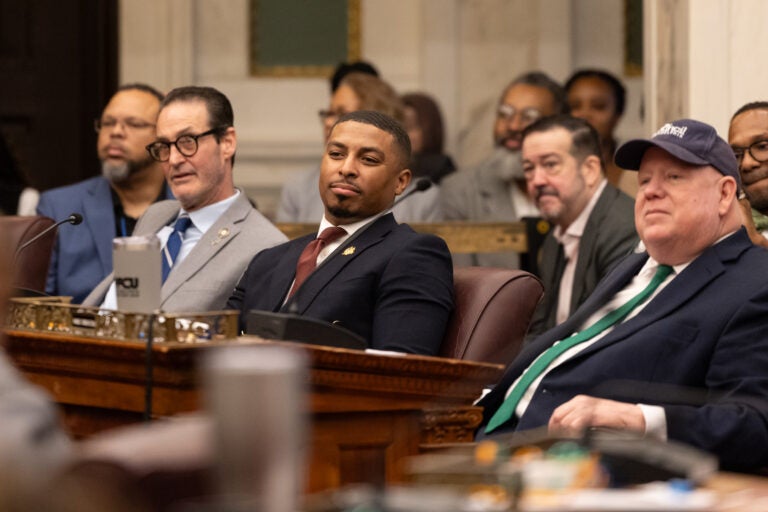
Philadelphia City Councilmember Nicolas O’Rourke listens the Mayor Cherelle Parker’s budget address on March 13, 2025. (Kimberly Paynter/WHYY)
Have a question about Philly’s neighborhoods or the systems that shape them? PlanPhilly reporters want to hear from you! Ask us a question or send us a story idea you think we should cover.
Two Philadelphia landlords are trying to invalidate City Council legislation aimed at strengthening protections for city renters.
They filed a motion Monday seeking permission to amend an existing lawsuit with new allegations that the bills are unconstitutional because they violate “fundamental property rights.” If granted by a judge, the complaint would also be modified with additional claims that Council’s housing committee violated the state’s open meetings laws.
The filing escalates an ongoing battle between fair housing advocates and independent landlords over two bills that are part of the Safe Healthy Homes Act, a legislative package that Councilmember Nicolas O’Rourke introduced last April.
Supporters say the legislation will help reduce instances of landlord retaliation and empower tenants to speak out about dangerous living conditions. Landlords argue the legislation will instead harm their businesses while doing little to hold bad actors accountable.
“It could be catastrophic,” said Seth Floyd, one of the landlords behind the lawsuit. “I could run into the wrong tenant with this legislation, not be able to make my mortgage on my properties and then end up in foreclosure or myself out of business.”
Related Content
Bills to protect Philadelphia renters are poised for passage following landlord lawsuit
The bills are part of the Safe Healthy Homes Act, a legislative package that has drawn considerable opposition from independent landlords.
5 months ago
Listen 1:00Floyd filed the suit with fellow landlord Erica Hadley.
A spokesperson for the city’s Law Department declined to comment, stating in an email that the city “will allow the litigation to play out.”
Lawmakers advanced the legislation Monday following a public hearing prompted by Floyd’s original complaint, which alleged that the committee violated the Pennsylvania Sunshine Act by deliberating and reaching a consensus on the bills behind closed doors before the the start of an earlier hearing.
Monday’s hearing was a condition of the settlement the landlords reached with the city.
What new allegations may be added?
O’Rourke, one of Council’s fiercest tenant advocates, has called Floyd’s complaint a “bad faith attempt to delay and to distract.” During Monday’s hearing, he went a step further, saying HAPCO Philadelphia, the city’s largest advocacy group for independent landlords, has been misleading its members.
HAPCO is not a party to the lawsuit, but both Floyd and Hadley belong to the group, which has about 1,000 members.
“I’ve been willing to stand with small landlords on issues that I believe actually affect bottom lines. And if the folks claiming to represent you were doing the same, they would be fighting just as hard on those fronts as well, not misrepresenting a bill that is focused on the worst actors in the industry,” O’Rourke said.
Floyd said Tuesday he is deeply concerned about a provision meant to clarify when a tenant can sue for a rental rebate. Under the legislation, a tenant could file for relief if a landlord collected monthly rent without having an active rental license or certificate of rental suitability. Both are required for landlords to legally collect rent.
He argues that could put small landlords out of business, especially if they are required to repay an amount equal to several months’ rent.
“How can anyone run a business on a small margin and have the risk associated with giving back a year of income? There’s no business that can sustain that,” Floyd said, adding that landlords are “already under a lot of strain.”
Opposition to O’Rourke’s legislation also centers on his proposal to expand “good cause” protections to all renters, regardless of the term of their lease. If passed, the law would require landlords to justify — in writing — why they want to terminate or not renew a lease.
Under the legislation, if a landlord fails to notify their tenant, “the lease shall renew on a month-to-month basis, unless the tenant elects otherwise.” Attorneys for Floyd and Hadley argue that provision effectively “compels” landlords to keep a tenant they want to evict — potentially to their own detriment.
“These restrictions materially alter the economic expectations associated with property ownership by removing predictability in lease duration, limiting exit options, and increasing the risk of prolonged, involuntary tenancies. This uncertainty directly impacts property valuation, financing, and the ability of small landlords to manage risk in an already constrained housing market,” according to the lawsuit.
Advocates say landlords are overstating the potential impacts of expanding “good cause” protections. For example, a landlord could still move to terminate or not renew a lease that has automatically become month-to-month under the law — if they provide proper notification.
It’s just one of the reasons why OnePA Renters United Philadelphia, which helped craft the legislation, is decrying the new allegations.
Frankford renter Theresa Howell said the fight demonstrates the “stark and obvious” power imbalance between landlords and tenants.
“Landlords can hire high-priced lawyers to run into court again and again to stop legislation from passing,” Howell said. “Meanwhile, renters can’t get water leaks fixed or rodents exterminated. And if we dare say anything about it, our landlord can force us out of our home without explaining why.”
The full Council is currently expected to take a final vote on the legislation on April 16. It is unclear what effect the new allegations will have on that timeline.

Get daily updates from WHYY News!
WHYY is your source for fact-based, in-depth journalism and information. As a nonprofit organization, we rely on financial support from readers like you. Please give today.
Brought to you by PlanPhilly

PlanPhilly
In-depth, original reporting on housing, transportation, and development.

Why Philly’s public housing costs an average of $315,000 per unit
PHA’s $6.3 billion plan would remake its aging housing portfolio. Its per-unit estimate, which rivals the value of many Philadelphia homes, doesn’t tell the full story.
1 week ago
Listen 1:59
North10 is helping contractors and households pay to dispose of waste legally, diverting thousands of pounds of trash from illegal dumpsites.
1 week ago
Listen 0:59
A vacant 126-year-old school in Strawberry Mansion will become senior housing
The $34 million project will repurpose the historic property through a partnership with the Philadelphia Housing Authority.
3 weeks ago