Philadelphia Asian American Film Festival in a ‘critical’ financial position
The film festival is feeling the pinch after cuts in federal funding, particularly in areas focused on diversity.

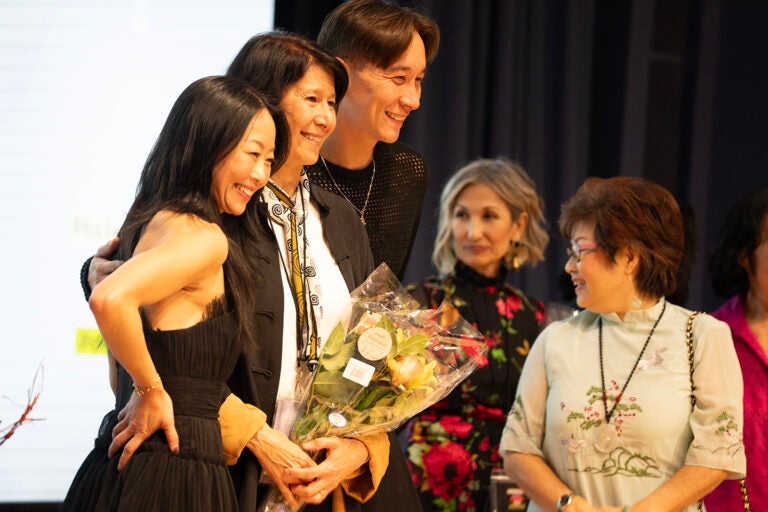
Director Jennifer Lin (center standing) with Sun Mi Cho and Paul Chan at a screening of Lin's documentary "About Face" at the 2025 Philadelphia Asian American Film Festival. (Courtesy the Philadelphia Asian American Film Foundation)
From Philly and the Pa. suburbs to South Jersey and Delaware, what would you like WHYY News to cover? Let us know!
In 2024, the Philadelphia Asian American Film Festival had a banner year. It was the organization’s 17th festival and the one that marked a definitive victory over the COVID-19 pandemic slump. The fall festival of films from the Asian diaspora saw an audience increase of 200%.
The year before, in 2023, the festival had finally gotten a paid, full-time staff of three employees after having been run chiefly by volunteers since 2008.
Executive Director Nani Shin started to think big.
“We wanted to become more structured and professionalized,” Shin said. “That’s really the shift that allowed us to focus more on how we build this organization to sustain itself and build beyond the annual festival.”
After years of being fiscally sponsored by the Greater Philadelphia Film Office, the festival became an independent nonprofit organization in 2025, calling itself the Philadelphia Asian American Film Foundation and anticipating new fundraising opportunities to develop year-round programming.
But the foundation’s optimistic expectations ran headlong into reality.
In the spring of 2025, federal support of the arts was disrupted by the Trump administration, particularly in areas focused on diversity.
“What we didn’t expect was these major cuts on the federal level trickle down and affect the smaller grants that we were going after,” Shin said.
Then in the fall of 2025, one of the festival’s’s major corporate sponsors pulled out.
When the festival came around in November, Shin did something the foundation had never done before, launch a public fundraising campaign. So far, it has not performed as hoped, generating about 10% of its $150,000 goal, with a March 1 end date.
Shin had anticipated a longer runway toward establishing sustainable revenue streams. She described the campaign as “absolutely critical” with less than six months of cash reserves to pay for operations. But she is confident the foundation will ultimately find its financial footing.
“What we weren’t prepared for was the timeline, the urgency of it,” she said. “We were already out doing the work that we have committed to do, so we definitely had to pivot and scale it down.”
Shin is preparing to turn the foundation’s finances inside-out during two public town hall-style meetings on Monday, Feb. 9, and Wednesday, Feb. 11 at 5 p.m., inviting filmmakers, partners and interested parties to hear the internal struggles of the organization and, maybe, share their own.
“I’m hoping what that does is spark conversation where it can become very interactive and hear from all the attendees if they feel that it resonated with them,” Shin said. “Whether they want to share their own story or have some recommendations, I just really want it to be an open space.”
Related Content

14th annual Philadelphia Latino Arts and Film Festival comes to an end with closing ceremony
The six-week festival concluded Sunday with film screenings, live music and exhibitions highlighting Latino culture.
10 months ago
Collaborations across the cultural sector
Since the pandemic slowdown starting in 2020 and the federal funding disruptions of 2025, arts organizations have taken collaborations and partnerships more seriously as a way to soldier on.
Across the Philadelphia arts sector, organizations have been looking toward one another for aid, such as smaller theater companies doing more co-productions and even larger ones engaging in cross-promotions: Right now, the Arden Theatre, Wilma Theatre and Philadelphia Theatre Company, all of which are producing plays written by Pulitzer Prize winner James Ijames, are collectively offering a ticket package deal.
“In a challenging funding climate, it is imperative arts organizations work together collaboratively, strategically, and with generosity to support our fantastic Philadelphia artists, serve our communities, and ensure young artists have a creative home for the future,” said Tyler Dobrowsky, co-artistic director of the Philadelphia Theatre Company, in a statement.
In the visual arts, the Pennsylvania Academy of Fine Art is opening three exhibitions with three partners. With the Philadelphia Museum of Art, it is curating a massive exhibition of American art. The art school and museum has already opened a show about its graduates who had artist apprenticeships at the Fabric Workshop and Museum. Next month, the academy will open a joint exhibition with the Woodmere Museum in Chestnut Hill featuring selections from the collection of Robert and Frances Coulborn Kohler.
The Woodmere Museum is also in a collaborative mood right now, not just with the academy, but in a sprawling retrospective of work by Philadelphia sculptor Syd Carpenter presented in coordination with Maguire Museum at St. Joseph’s University and the Berman Museum at Ursinus College.
Woodmere President and CEO William Valerio said collaborations ease the burden of overhead costs, such as marketing and publishing an exhibition catalogue, and multiple institutional perspectives can make a more interesting result.
“I used to work in museums in New York. Museums in New York are not collaborative. It’s competitive in New York,” he said. “The brotherly love that is in the DNA of Philadelphia actually does translate into real things, and the willingness and desire and the fun of collaborating between institutions.”
“We have each other’s back”
The Philadelphia Asian American Film Foundation has plans to develop regular, annual programming outside of its fall festival, especially in May during Asian American Pacific Islander Month.
Until it can establish its own season programming, the organization has done pop-up events piggybacking on other organization’s programming, such as film screenings with the Welcoming Center, the Chinatown Development Corporation and the Academy of Natural Sciences at Drexel University’s Confluence Film Festival.
“It’s a small community in Philadelphia thriving with arts and culture, and we definitely lean on each other for support, resources and grants. We try to collaborate on some projects together,” Shin said. “It’s great to know that we have each other’s back. It’s honestly very therapeutic leaning onto and speaking with a lot of other organizations at this time.”

Never miss a moment with the WHYY Listen App!


WHYY is your source for fact-based, in-depth journalism and information. As a nonprofit organization, we rely on financial support from readers like you. Please give today.
14th annual Philadelphia Latino Arts and Film Festival comes to an end with closing ceremony
The six-week festival concluded Sunday with film screenings, live music and exhibitions highlighting Latino culture.
10 months ago
From Blob to Noir: Colonial Theatre hosts Philly debut of ‘Noir City’ festival
Eddie Muller’s festival of classic film noir has been around for 20 years, touring through a dozen cities. It’s coming to the home of The Blob.
3 years ago
BlackStar Film festival returns for its 10th year
The mostly online festival of Black, brown, and Indigenous filmmakers will feature a one-day mini-festival of in-person screenings at the Mann Center.
5 years ago
Listen 5:40