
Federal judge orders Penn to turn over information on Jewish staffers as part of discrimination investigation
Penn argued that complying with the request for information would put employees and students at risk.
Listen 0:59
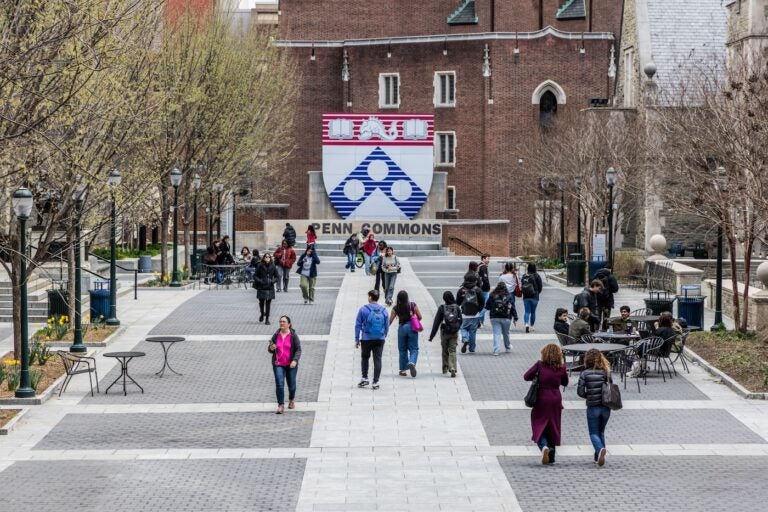
Students on the campus of the University of Pennsylvania. (Kimberly Paynter/WHYY)
From Philly and the Pa. suburbs to South Jersey and Delaware, what would you like WHYY News to cover? Let us know!
A federal judge has ordered the University of Pennsylvania to comply with a federal government subpoena demanding information on Jewish faculty, ostensibly part of an investigation into antisemitism on campus.
U.S. District Judge Gerald J. Pappert said employees can refuse to take part in the U.S. Equal Employment Opportunity Commission investigation, but the agency “needs the opportunity to talk to them directly to learn if they have evidence of discrimination.”
Pappert, who was appointed by former President Barack Obama, determined that the EEOC request fell within its authority to investigate workplace discrimination and that the agency is entitled to obtain relevant information for its inquiry. The investigation was opened in 2023 following complaints of antisemitism following the Oct. 7 attack.
Penn challenged the scope of the EEOC’s request, arguing that it was overly broad and raised legal and privacy concerns for students and staff. Jewish-oriented groups, including the American Academy of Jewish Research and the Jewish Law Students Association of the University of Pennsylvania Carey Law School, supported Penn on Tuesday.
Anti-Defamation League Philadelphia Senior Regional Director Andrew Goretsky told WHYY News that the organization is still reviewing the decision. He pointed to a November statement, in which ADL Philadelphia said it “shares the EEOC’s commitment to combating antisemitism and protecting Jewish employees from discrimination and harassment on college campuses and we appreciate that the EEOC has undertaken a number of critical investigations to help do just that.”
“We are, however, concerned about the privacy and constitutional implications of any effort (even those that are well-intentioned) to force the production of a list of Jewish faculty, staff, and students by religious affiliation, along with confidential responses from participants in Penn’s internal Antisemitism Task Force,” Goretsky said in the statement. “History has taught us to be vigilant when governments compile lists of people based on religious identity, and we hope that the EEOC’s important work can continue without such a list.”
Vic Walczak, legal director at ACLU of Pennsylvania, which joined the case representing faculty, called the ruling an “unfavorable court decision” in a statement. He said that although Penn would not have to disclose organizational affiliations, the order would still produce a list that could put those on it at risk.
“The historical dangers of compiling lists based on religious affiliation are well documented, and we remain steadfast in our commitment to protecting our clients’ constitutional rights to anonymous association, among other fundamental freedoms at stake,” he wrote. “While we respect the court’s decision, we will vigorously appeal to ensure our clients’ identities remain secure and their First Amendment liberties are fully safeguarded.”
Related Content
Pennsylvania Gov. Josh Shapiro promotes tax break for working families
Individuals can get up to $805 back on their state return, with more for dependents. But with two weeks until the deadline, only half of eligible residents have claimed it.
2 weeks ago
Listen 0:58Pennsylvania’s two senators, Democrat Sen. John Fetterman and Republican Sen. David McCormick, issued a joint statement Wednesday morning applauding the decision, without addressing the ADL’s or ACLU’s concerns.
“No student or faculty member should face illegal discrimination based on race, gender, religion, or national origin,” the statement read in part.
“We have long spoken out against the despicable treatment Jewish students and faculty have faced since October 7, including on University of Pennsylvania’s campus. We fully support the EEOC investigations into Title VII discrimination.”
The EEOC did not immediately respond to a request for comment.
President Donald Trump had accused prominent universities of antisemitism as far back as his first term. In 2019, he signed an executive order to make Title VI of the 1964 Civil Rights Act apply to antisemitic acts.
Last year, the White House opened investigations into dozens of universities — including Penn — and started withholding federal funds.
Editor’s Note: This article has been updated to include comments from Anti-Defamation League Philadelphia, the ACLU and Pennsylvania’s U.S. senators.

Get daily updates from WHYY News!
WHYY is your source for fact-based, in-depth journalism and information. As a nonprofit organization, we rely on financial support from readers like you. Please give today.
Part of the series

Trump administration buys Berks County warehouse for potential use as ICE detention center
The Trump administration has previously eyed the facility in Upper Bern Township as a site for an immigration detention center.
2 months ago
Scanlon, who represents Delco and parts of Philly and Montco, conducted congressional oversight of the facility after one of her constituents died in ICE custody.
2 months ago
Listen 0:51
Advocates estimate ICE has detained at least 140 people in Montco since the crackdown began. “What people are seeing in Minnesota,” said one resident, “is happening here."
3 months ago
Listen 1:01