

‘The Jewels of the Forest’: Scarlet tanagers proposed as Pennsylvania’s ‘migratory bird’
Scarlet tanagers migrate to Pennsylvania’s forests each year to breed before heading back to South America.
Listen 1:21
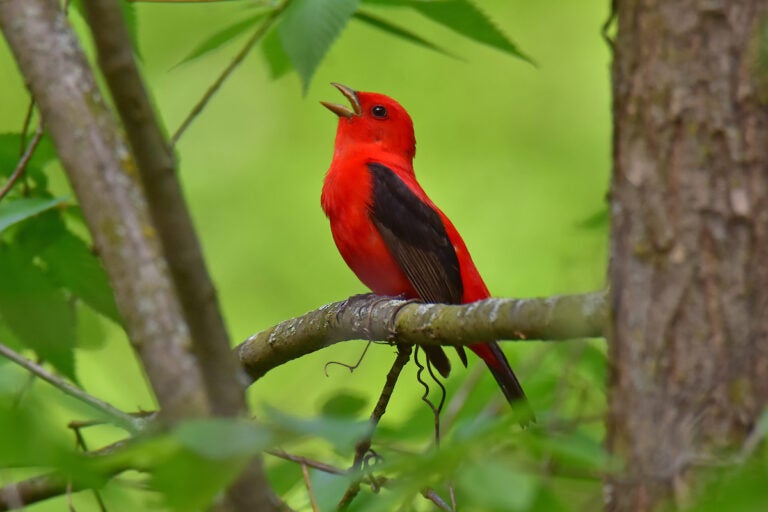
Pennsylvania lawmakers want to designate scarlet tanagers as the state's official "migratory bird". (Courtesy of Meryl Lorenzo)
This story is part of the WHYY News Climate Desk, bringing you news and solutions for our changing region.
From the Poconos to the Jersey Shore to the mouth of the Delaware Bay, what do you want to know about climate change? What would you like us to cover? Get in touch.
New Jersey flaunts the bright yellow goldfinch as its state bird. Delaware has its Blue Hen.
The red cardinal, the overachiever of all state birds, is claimed by Virginia and six other states.
And Pennsylvania? Well, it’s the only U.S. state without a designated state bird. But that could soon change.
About 100 years after the General Federation of Women’s Clubs petitioned states to designate state birds — and flowers — the Keystone state could finally get its own designated bird — or, sort of.
State lawmakers have introduced legislation to assign the scarlet tanager as the state’s official “migratory bird.”
The colorful songbird makes its way from South America to Pennsylvania to breed in the state’s forests.
“Does that mean we’re in a situation where we still don’t have a state bird?” said David Toews, a biology professor at Pennsylvania State University who has researched song birds.
Pennsylvanians claimed the ruffed grouse as the state’s official “game bird.” Bird enthusiasts say they are happy about adding a “migratory bird.”
“There’s a lot of love for the grouse. There’s a long history of conservation and hunting culture in Pennsylvania. It’s the sort of logo of the Game Commission,” Toews said. “I don’t think anyone wants to knock the grouse off its pedestal, but if there’s room for two, I would say the scarlet tanager is an absolutely wonderful bird, deserving to be a pair for Pennsylvania.”
What is a scarlet tanager?
Each spring, scarlet tanagers travel from South America to the eastern United States and parts of Canada to breed, before migrating back in early fall.
An estimated 13% of the breeding population of scarlet tanagers is found in Pennsylvania, mostly in the state’s large forests. In the Philadelphia region, they can be found in Wissahickon Valley Park and Pennypack Park.
Related Content
Pa. wants to reduce vehicle collisions with animals using wildlife corridors
Across the U.S. between 1 and 2 million large animals are involved in vehicle collisions each year, according to the Federal Highway Administration.
1 month ago
Listen 1:06The proposed legislation’s sponsor, state Rep. Mandy Steele, a Democrat who represents part of Allegheny County in Western Pennsylvania, said that designating the bird “is a chance to celebrate our natural heritage while inspiring the next generation to protect it.”
Scarlet tanagers are important because they indicate whether the state’s forests have a clean bill of health, Toews said.
“The scarlet tanager is a symbol of a healthy forest,” he said. “I think that’s something that we should keep in mind as proposals for chipping away at forests, be it at the state level or local levels, are being proposed, that we can think about not just the trees, which are easy to see, but also all the species that inhabit those forests, like migratory birds.”
Scarlet tanagers, particularly males, are known for their bright red feathers and jet-black wings. Their singing style is often compared with that of an “American robin with a sore throat.”
“They’re so bright and colorful, they stand out pretty amazingly against the green backdrop,” Toews said. “A lot of people will be in the forest, they’ll hear what they think is a common species like a robin, and they’ll look up and they’ll see just like an explosion of red and black in the canopy.”
Related Content

What to do if you find injured, sick or orphaned wildlife in Philadelphia
Here’s how to safely capture an injured animal and where to take it for help.
5 months ago
Listen 0:56Though Pennsylvania has a significant number of scarlet tanagers, their populations have declined since the 1960s because of habitat loss and forest fragmentation.
“I remember being at Carpenter’s Woods and seeing in one tree, at one time, about 20 scarlet tanagers,” said Keith Russell, a birder and program manager for urban conservation at Audubon Mid-Atlantic. “That will be unthinkable today. You’re lucky if you see three or four in one woodland in one day.”
The Audubon Society, which helped draft the legislation, is working to conserve forests for migratory birds. Russell said he hopes the bill will help spread awareness about the importance of the state’s forests.
Though designating a state bird doesn’t provide special legal protections, it does elevate their profile and spread public awareness, which can help boost local conservation efforts.
“I think it helps people to just be aware of the fact that our forests are not just here to log or to have recreation in, but they’re also places that are nurseries for all these beautiful birds,” Russell said.

Get daily updates from WHYY News!
WHYY is your source for fact-based, in-depth journalism and information. As a nonprofit organization, we rely on financial support from readers like you. Please give today.
Part of the series

How to save a few dollars on your electricity bill in the Philadelphia region
From switching to LED light bulbs, to turning down your hot water heater, here are a few things you can do to save on your electricity bill.
6 days ago
Listen 6:08
Pennsylvania Gov. Josh Shapiro calls PECO rate hike request ‘pure greed’
PECO seeks to raise rates again by 12.5% for Philly and suburban electric customers. The governor's office says Shapiro believes the rate case should be withdrawn immediately.
1 week ago
Listen 1:33
Pa. data centers: How lawmakers are responding, from electricity and water use to tax breaks
Dozens of data centers are planned for the Philly region. Some lawmakers want to put up guardrails, while others want to speed their development.
1 week ago
Listen 1:02