Shapiro wants more money for education, minimum wage increase in budget proposal
Gov. Josh Shapiro’s budget includes plans to spend $565 million to close long-standing gaps between wealthy and underfunded school districts.
Listen 1:15
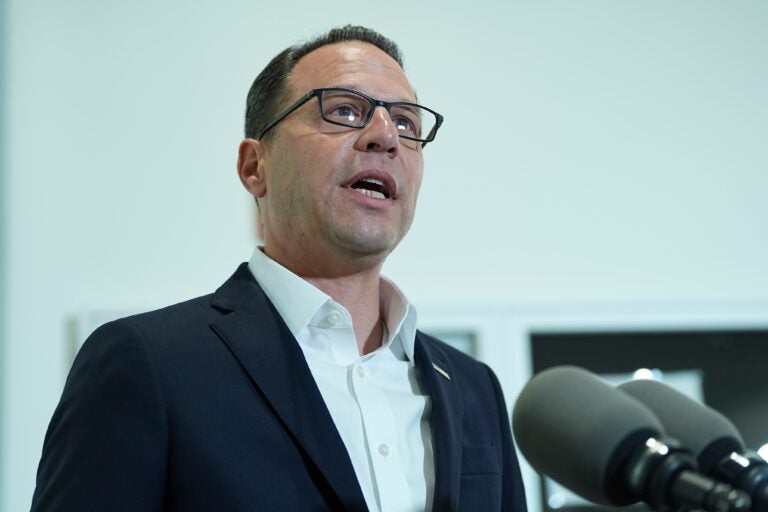
FILE - Pennsylvania Gov. Josh Shapiro visits the Hershey Company's new manufacturing plant in Hershey, Pa., Wednesday, April 16, 2025. (AP Photo/Matt Rourke)
From Philly and the Pa. suburbs to South Jersey and Delaware, what would you like WHYY News to cover? Let us know!
Pennsylvania Gov. Josh Shapiro delivered his 2026–27 budget address Tuesday before a joint session of the General Assembly, laying out a fiscally cautious but ambitious plan aimed at strengthening education, addressing housing and energy costs, and advancing key policy priorities in an election year.
The package totals $53.2 billion, an increase over the $50.1 billion budget that was approved late last year after a protracted battle that left the commonwealth without a budget for more than four months.
Shapiro started his address with an enthusiastic state of the state, highlighting positive developments since he took office, saying, “Pennsylvania is rising.”
“Our kids are getting a better quality education,” he said. “Our workers have more opportunity to chart their own course. Our economy is growing and our communities are safer.”
Shapiro framed the budget as a forward-looking, fiscally responsible plan that balances investments in people and communities with structural reforms — all without broad-based tax increases.
“This budget doesn’t raise taxes — in fact, it continues to cut taxes,” Shapiro said. “It doesn’t require a broad-based tax increase today, tomorrow or at any point in the next five years.”
He called on the legislature to avoid the delays that plagued the 2025–26 budget process, which was signed into law more than four months past the deadline.
“We learned that we all need to be at the table, and that we all need to be at the table sooner,” Shapiro said. “When we all sat together, majority and minority, we made progress.”
State Republican leaders said that they were also hopeful that the budget would get passed on time but criticized the size of the governor’s budget request.
“The governor simply wants to spend too much money in this budget, full stop,” said Senate Majority Leader Joe Pittman, R-Indiana. “At the end of the day, we’re going to go through a very complicated and difficult process again, but we’re committed to working together to make sure… the people of Pennsylvania and their needs are addressed in the budget that’s in front of us.”
Building on schools
Education once again dominated the governor’s address, with Shapiro highlighting nearly $900 million in additional funding for pre-K through 12th grade public schools. The proposal includes a $565 million increase in adequacy funding aimed at closing long-standing gaps between wealthy and underfunded districts, along with a $105 million boost in Basic Education Funding and $40 million more for special education.
Shapiro said the administration has increased school funding by nearly $3 billion since he took office, calling the effort both a moral obligation and an economic necessity.
“We’ve increased funding for education by nearly 30%,” he said. “School attendance is up, graduation rates are up and more young people are finding their passion in the trades.”
The budget continues funding for universal free school breakfasts and includes $30 million for the Student Teacher Stipend Program, designed to strengthen the educator pipeline amid persistent staffing shortages. Shapiro also highlighted $25 million for the Solar for Schools initiative, which he said would help districts manage long-term energy costs.
Shapiro argued that the state’s investments are already showing results, noting that “schools have served more than 224 million free breakfasts,” and that “the number of new teacher certifications is increasing, after more than a decade of decline.”
In a press conference after the budget address, Pittman said that “it’s not just money that makes schools effective.”
“We believe that parental choice in a student’s education is what makes education effective,” he said, a nod to his party’s preference for school vouchers. Shapiro has previously expressed support for vouchers but has since dropped that support after opposition from his own party.
Pittman added that his caucus supported “robust career and technical education programs,” which Shapiro also highlighted in his address.
SEPTA can wait
Shapiro also addressed funding for public transportation, including SEPTA, which has been a perennial point of difference in past budget debates.
Shapiro again proposed shifting an additional 1.75% of sales and use tax revenue to SEPTA, but not until next summer. Until then, the budget proposal includes continued state funding for mass transit agencies while lawmakers debate a longer-term solution for transit financing.
He said reliable public transportation is critical to the state’s economy, particularly in the Philadelphia region, where hundreds of thousands of residents depend on buses, trains and subways to get to work.
“This budget calls for sustainable, recurring funding for mass transit to begin in 2027,” he said. “I bought us two years — but we have to keep working at this, because this isn’t a problem we can ignore. Mass transit helps drive our economy — this is an issue of economic competitiveness.”
Data centers and artificial intelligence
Shapiro devoted a portion of his address to the rapid growth of data centers and artificial intelligence, framing the issue as both an economic opportunity and a policy challenge that requires stronger guardrails.
He said Pennsylvania is well positioned to compete for large-scale data center projects, citing the state’s role as the second-largest energy producer in the country and its research strength at institutions such as Penn State, Carnegie Mellon and the University of Pennsylvania. Shapiro pointed to recent wins, including Amazon’s $20 billion investment in Pennsylvania, as evidence that the state is becoming a national hub for the sector.
At the same time, the governor acknowledged concerns from communities about the impact of data centers on energy costs, water use and transparency. To address those concerns, Shapiro announced what he called the Governor’s Responsible Infrastructure Development standards, or GRID, a framework that would set conditions for state support of large data center projects.
Under the proposal, developers would be required to pay for any new power generation their projects require, rather than shifting costs onto homeowners and businesses. They would also have to commit to community engagement and transparency, hire and train local workers, enter into community benefit agreements and meet strict environmental and water conservation standards.
“If companies adhere to these principles, they will unlock benefits from the Commonwealth,” Shapiro said, including faster permitting and access to available tax credits. He urged lawmakers to codify the standards in statute, arguing that Pennsylvania can compete for data center investment while still protecting residents and ratepayers.
When asked about his take on data centers, Pittman expressed concerns over energy affordability, saying past policies have increased energy costs.
“We’re going to have a conversation about data centers, not only how we handle local communities, not only how they pay their fair share, but the conversation has to be rooted in the fundamentals, the affordability and availability of electricity go hand in hand,” he said.
Temple University boost
The budget proposal also includes new funding for public higher education, with increased state support for Pennsylvania’s state-related universities, including Temple University. The proposal sets aside $30 million to distribute based on outcomes such as graduation rates, affordability, enrollment of low-income students and how many students pursue degrees in fields the state considers critical.
“We’ve got this important tool in place. We established the metrics. Now it’s time to fund it,” he said, referring to the performance-based approach created to guide new state support for universities.
The plan maintains funding for the Pennsylvania Higher Education Assistance Agency and expands student aid programs, including grants for low- and moderate-income students pursuing postsecondary education or job training.
Raising the minimum wage
Shapiro also renewed his push to raise Pennsylvania’s minimum wage, which has remained at $7.25 an hour for 16 years.
“In that time, every single one of our neighboring states has raised the wage for their workers,” he said. New Jersey’s minimum wage is at $15.92 per hour, and Delaware’s is at $15.
Shapiro argued that raising the minimum wage to $15 would not only help workers but also reduce state costs.
“Raising the minimum wage to $15/hour will save this commonwealth $300 million a year on entitlement programs like Medicaid,” he said, urging lawmakers to send a bill to his desk.
Pittman called the debate over the minimum wage “misplaced.”
“Quite frankly, if an individual’s making $7.25 an hour or $15 an hour, they’re not going to be able to effectuate the American dream. They’re not going to be able to buy a home,” he said. “And that’s why we’ve continually been focused on pro-growth economic policies that bring all wages up to maximum wages.”
He again referenced “career and technical education.”
“We’re willing to have a conversation about minimum wage and to see if we can come to a compromise, but based on the way the governor delivered that message, I think he’s more interested in the political talking point than actually getting something done on the issue,” Pittman said.
Related Content
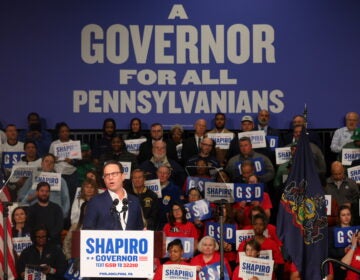
Gov. Josh Shapiro officially launches reelection campaign
The governor starts his campaign with a record fundraising advantage in the likely faceoff against the popular state treasurer in November.
3 months ago
Listen 1:03Marijuana and skills games
Shapiro also renewed his call for lawmakers to regulate and tax skill games and to pass comprehensive legislation legalizing recreational marijuana, arguing that inaction on both issues is costing the state billions in lost revenue while creating uncertainty for law enforcement and communities.
“What this budget does do is finally regulate and tax skill games and pass comprehensive cannabis reform,” Shapiro said. “We’re putting our communities at risk and losing out on billions of dollars in revenue by doing nothing on both.”
The governor said district attorneys across Pennsylvania have urged the legislature to act on skill games, which operate in a legal gray area and have spread rapidly in bars, convenience stores and social clubs. Shapiro argued that regulation would provide clear guidance for law enforcement while generating new revenue without raising broad-based taxes.
Shapiro made a similar case for legalizing marijuana, framing it as a public safety and economic issue. He said neighboring states that have already legalized recreational cannabis are reaping the benefits while Pennsylvania continues to lag behind.
“Everyone knows we need to get this done,” Shapiro said. “So let’s come together and finally get it over the finish line.”
Republican lawmakers have expressed skepticism about both proposals, raising concerns about social impacts and regulatory oversight.
Pittman said state Republicans are still willing to negotiate, but said he still has yet to see Shapiro’s ideas “on paper.”
“The governor talks about gaming reform, but we have yet to see a legislative proposal put in front of us,” he said. “Applause lines and speeches don’t deliver action. Words on paper deliver action.”
Pittman also pointed out that House Democrats passed a recreational cannabis bill last year “and they came up with that crazy plan to have the state stores implemented.”
“We heard nothing from the governor on whether or not he’d even signed the bill as an example,” he said.
Public safety
Shapiro also touted public safety results from his first years in office.
“As a result, violent crime is down 12% — and fatal gun violence is down 42%,” Shapiro said. “And last year, Philly and Pittsburgh experienced the fewest homicides in decades.”
Shapiro further called for four additional Pennsylvania State Police cadet classes, enough to train at least 250 new troopers, along with continued support for municipal police recruitment and retention.
The budget increases funding for the Violence Intervention and Prevention program by $5.65 million, bringing total state investment to $62 million. Shapiro said the funding reflects evidence that prevention programs reduce crime, and he urged lawmakers to maintain the state’s two-track approach.
“We know our two-pronged approach is the smart way to ensure public safety,” he said.
Emergency preparedness funding would double from $20 million to $40 million, which Shapiro said reflects the federal government’s desire to shift the cost burden for emergency preparedness and response to the states.
Health care and mental health services
Shapiro’s proposal boosts funding for health care and behavioral health services, including additional support for county mental health programs and substance use disorder treatment.
The governor tied those investments to increased demand for crisis support and emphasized the role of the statewide 988 mental health hotline.
“We know the need is real — because when people call our 988 call centers when they’re struggling, they’re connected to these licensed professionals,” he said. “This work is bipartisan; let’s keep going.”
The budget also continues investments in maternal health initiatives and services for individuals with intellectual disabilities and autism.
Containing energy costs
The proposal includes continued support for energy efficiency programs aimed at lowering long-term costs.
Shapiro argued that controlling utility costs will require more transparency and oversight, as well as steps to curb excessive profits.
“We grant these utilities a monopoly — and in exchange, they have a legal responsibility to keep their costs just and reasonable,” he said. “They shouldn’t get one dollar more than what they need to meet their customers’ needs.”
Shapiro said his administration’s planned actions would drive significant savings.
“Together, these steps will save Pennsylvanians over $500 million on their energy bills every year,” he said.
He also pitched a broader energy plan he called the “Lightning Plan, a comprehensive plan to build more energy generation here in the commonwealth, reform our permitting and siting laws, and diversify our energy sector to generate more renewables.”
He said it would save consumers $664 million and create 15,000 energy-sector jobs.
Republicans agreed with Shapiro about the need for bringing down energy costs but disagreed on how they would do that.
“We believe that escaping the specter of the Regional Greenhouse Gas Initiative and the carbon tax will absolutely help energy development in Pennsylvania,” said Pennsylvania House Republican Leader Rep. Jesse Topper.

Get daily updates from WHYY News!
WHYY is your source for fact-based, in-depth journalism and information. As a nonprofit organization, we rely on financial support from readers like you. Please give today.
Parents of victims of explicit AI-generated images called for better responses from school districts.
3 weeks ago
Listen 1:09
Gov. Josh Shapiro officially launches reelection campaign
The governor starts his campaign with a record fundraising advantage in the likely faceoff against the popular state treasurer in November.
3 months ago
Listen 1:03
Pennsylvania governor’s residence to get an ‘anti-climb’ fence
It's been less than a month since a late-night intruder jumped the existing fence, broke into the home and started a damaging fire inside the Harrisburg home of Gov. Shapiro.
11 months ago