Pa. Gov. Shapiro signs ‘compromise’ state budget shortly after passage on Sunday
Both sides called it a compromise with $2.4 billion less in spending than Shapiro’s proposal, no new revenues and leaving the rainy day fund alone.
Listen 1:16
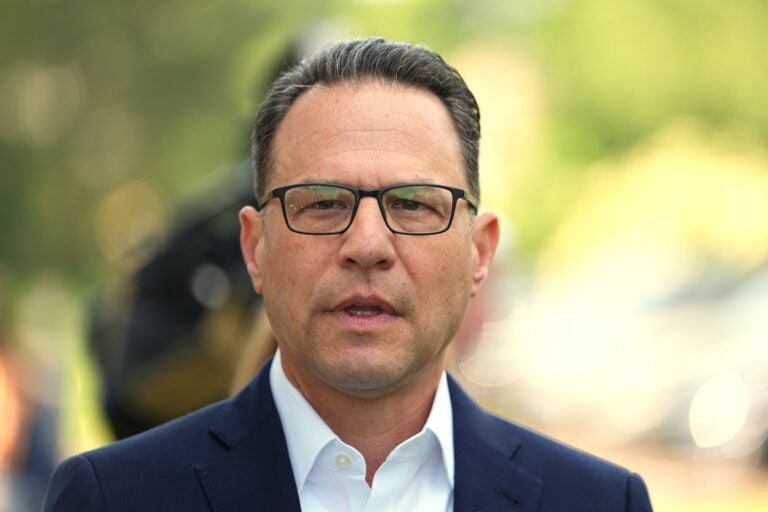
Pennsylvania Gov. Josh Shapiro speaks with members of the media outside his polling place in Rydal, Pa., Tuesday, May 19, 2026. (AP Photo/Matt Rourke)
From Philly and the Pa. suburbs to South Jersey and Delaware, what would you like WHYY News to cover? Let us know!
Lawmakers in Harrisburg passed Pennsylvania’s latest budget over the weekend, less than two weeks after a state constitution-mandated deadline.
On Sunday, Gov. Josh Shapiro signed the $50.8 billion spending plan into law, calling it another example of bipartisan compromise in a politically divided Harrisburg while touting new investments in education, infrastructure, workforce development and mental health services.
While roughly $2.4 billion smaller than the $53.2 billion proposal Shapiro unveiled in February, it passed with broad bipartisan support despite opposition from members of both parties. It got approval from 211 of the General Assembly’s 252 lawmakers.
“This is the fourth year in a row where — despite working with one of the only divided legislatures in the country, where we have some really profound differences — we stayed at the table and brought Democrats and Republicans together to get stuff done, again,” Shapiro said shortly before signing the legislation. “We managed to find compromise — without compromising our core values.”
The agreement leaves several of Shapiro’s major policy priorities unresolved. Lawmakers did not reach deals on raising Pennsylvania’s minimum wage, establishing a long-term transit funding package or expanding affordable housing initiatives. The governor’s proposals to legalize and tax recreational marijuana and regulate skills games as a way of adding revenues, were also left out of the final agreement.
Senate Majority Leader Joe Pittman, R-Armstrong, agreed that the bill reflected a compromise, calling it an “imperfectly good budget.”
“But as we know, perfection should not be the enemy of good,” he said.
Republicans had expressed concerns that Shapiro’s original budget would eat into the $8 billion Budget Stabilization Reserve Fund — known as the state’s “rainy day fund” — but the newly passed version leaves it intact, which Pittman applauded.
“We have identified and pulled $1.5 billion out of the couch cushions of bureaucracy to balance this budget,” he said. “We have protected the taxpayers in this budget. Another reason to say yes in this budget is because we continue to cut taxes for job creators.”
Although this is the fifth late budget in a row, it was passed in time to avoid the same kind of long-term financial damage inflicted last year, when the budget was more than four months late. Although missing the deadline does not immediately shut down state government, prolonged delays can disrupt payments to schools, counties, nonprofits and other organizations that rely on state funding. In 2023, budget negotiations stretched into December amid a prolonged stalemate over school vouchers and education funding.
Related Content
Philadelphia leaders press state officials to step up education funding during visit to Harrisburg
Philly leaders hope to use the city’s recent education funding wins as an example to convince Harrisburg Republicans to supplement all state schools.
3 months ago
The four Republican senators who voted against the final budget were joined by two Democrats, Nikil Saval, D-Philadelphia, and Katie Muth, D-Montgomery.
During the debate, Saval said the budget reflected “major progress” but that it didn’t address “critical” issues such as affordable housing, public transit and energy costs.
“I believe these are issues that we cannot defer at this moment, and these are issues that our constituents do not want us to defer,” he said.
Thirty-five Republican state representatives also voted against, including Jamie Walsh, R-Luzerne who said it would “result in increased taxes in the years ahead.”
“This is just bad governance,” he said in a statement.
The plan boosts funding for education by more than $678 million compared with last year, including increases for basic and special education and to meet the adequacy formula aimed at underfunded school districts as required by a court decision. It also adds funding for career and technical education, student teacher stipends, child care worker recruitment and mental health services. A new $125 million innovation fund is designed to support Pennsylvania startups and life sciences companies.
The budget also provides funding for four new Pennsylvania State Police cadet classes, increases support for rape crisis centers and county child welfare services, invests an additional $775 million in road and bridge projects and includes a long-awaited cost-of-living adjustment for many retired teachers, police officers, firefighters and other public employees who have not received one in more than two decades.
However, Shapiro concluded his speech by saying that he would continue to seek what was left out of the spending plan.
“There’s a lot of work ahead, and there’s more I want to do – like raising the minimum wage, funding mass transit, and expanding access to affordable housing,” he said. “But once again, we’ve proven that here in Pennsylvania we can bring people together to solve problems, get stuff done, and build on the foundation we’ve laid.”

Get daily updates from WHYY News!
WHYY is your source for fact-based, in-depth journalism and information. As a nonprofit organization, we rely on financial support from readers like you. Please give today.
2 Philly-area Democrats voted against the bipartisan ‘compromise’ state budget. Here’s why
The two state senators criticized the budget for failing to address “critical” issues such as public transit, affordable energy and rising energy costs.
2 months ago
Listen 1:11
Political gridlock continues over Pa. budget, straining finances for counties, schools, nonprofits
Despite their insistence a few weeks ago that a deal was as near as a few days away, neither chamber convened in the Capitol for a voting session during the week of Sept. 15.
12 months ago
Talks in Pennsylvania are at crunch time over a budget, legalizing marijuana and taxing skill games
The state's politically divided government has two weeks left to pass a spending plan before the state loses some spending authority when the new fiscal year starts July 1.
1 year ago