

2 Philly-area Democrats voted against the bipartisan ‘compromise’ state budget. Here’s why
The two state senators criticized the budget for failing to address “critical” issues such as public transit, affordable energy and rising energy costs.
Listen 1:11
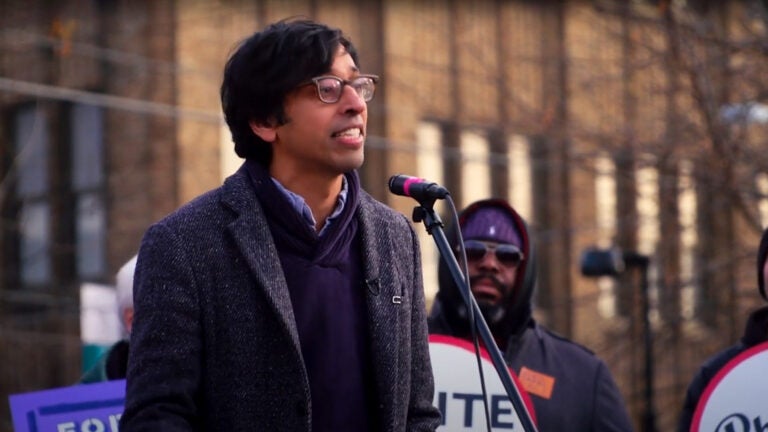
Pa. Sen. candidate Nikil Saval. (Screenshot/NikilSaval.com)
From Philly and the Pa. suburbs to South Jersey and Delaware, what would you like WHYY News to cover? Let us know!
Pennsylvania’s $50.8 billion state budget passed Sunday with overwhelming bipartisan support, but two local Democratic state senators broke with Gov. Josh Shapiro and most of their party, arguing the spending plan sidesteps the commonwealth’s biggest long-term challenges.
State Sens. Nikil Saval, D-Philadelphia, and Katie Muth, D-Chester County, praised the budget’s investments in public education and other priorities. But the self-identified progressives said lawmakers failed to confront rising energy costs, affordable housing and public transportation funding.
At Sunday’s signing ceremony, Shapiro described the budget as another example of bipartisan compromise in a politically divided Harrisburg, saying lawmakers had once again found common ground despite significant differences.
Saval said he saw it differently.
“It’s not that it’s the result of major compromises,” Saval told WHYY News. “It seems to be the result of avoiding major issues, major policy issues. So actually what I think characterizes this budget is an avoidance of serious issues and serious concerns.”
Muth agreed, saying that she believes the compromises made by Democrats were “convenient” for party members who capitulated to avoid a major fight during Shapiro’s reelection year.
“Democrats are going to do, for the most part, what the governor says,” Muth said. “They’re not going to be critical. That’s a thing.”
Deferred priorities
Saval said one of his biggest frustrations was the absence of new funding for public transit, despite repeated warnings from transit agencies across Pennsylvania that service cuts are already underway or imminent without additional state support. Shapiro effectively punted questions over public transportation funding until next year.
“This was once again a budget that did not invest at all in public transit, which is especially galling after last year thousands of constituents made their voices heard across the commonwealth,” he said. “This affects tons and tons of people. So it’s not an issue that we should be deferring action on.”
Saval also criticized lawmakers for failing to advance affordable housing initiatives, including proposals supported by Shapiro.
“The governor proposed recently a housing action plan that would issue a $1 billion bond to fund critical infrastructure, including housing,” Saval said. He noted that the Republican-controlled U.S. Congress passed a bipartisan bill addressing housing last week.
“I think we ought to be responding to our constituents in the same way,” he said.
Muth agreed with Saval but cited additional issues that still remained unaddressed, including underfunded rape crisis centers and impending issues with the Pennsylvania Emergency Management Agency, likely to arise from funding cuts to the Federal Emergency Management Agency.
“PEMA’s 90% funded by FEMA,” she said. “Where are we getting that money? That’s like our PEMA operating on bare bones. So we don’t have fully funded fire and [emergency medical services], because everything’s volunteer and being bought up by private equity on the EMS side.”
Related Content
Pa. Gov. Shapiro signs ‘compromise’ state budget shortly after passage on Sunday
Both sides called it a compromise with $2.4 billion less in spending than Shapiro’s proposal, no new revenues and leaving the rainy day fund alone.
1 month ago
Listen 1:16‘Rob Peter to pay Paul’
Saval and Muth said that the budget missed new funding opportunities, particularly from regulating skills games and legalizing cannabis, both of which were opposed by the Republican caucus.
“We cannot avoid a serious conversation around revenue,” Saval said. “So we cannot avoid a serious conversation around energy. We cannot avoid a serious conversation around transit. We cannot avoid serious conversations around housing.”
He said lawmakers again declined to consider proposals that would raise additional revenue, including taxes on digital advertising, higher taxes on wealthy residents and closing corporate tax loopholes.
Muth said those same concerns drove her vote against the budget, particularly what she saw as a regressive tax system.
“This budget is really a ‘rob Peter to pay Paul’ budget,” she said, arguing lawmakers relied on transfers between state funds rather than adding revenues, such as closing the Delaware corporate tax loophole, in which corporations shift revenue from states with high corporate taxes to a subsidiary or holding company in the state of Delaware.
“There is zero appetite on both sides of the aisle to change Pennsylvania’s rigged tax system,” Muth said. “We don’t have any money and there’s no appetite or political will to create revenue for the commonwealth.”
Muth argued those additional revenues could have strengthened programs she believes have gone underfunded for years, such as rape crisis centers and emergency management, but also environmental protection and other public services. She also criticized lawmakers for transferring money from environmental cleanup funds while leaving many abandoned wells and contaminated industrial sites unaddressed.
Like Saval, Muth also questioned whether Pennsylvania is doing enough to regulate the rapid growth of data centers, saying the state risks higher electricity prices and greater environmental impacts if stronger safeguards are not adopted.
Supporting parts of the budget
Both senators applauded some of the budget’s accomplishments. Saval praised continued investments in K-12 education, particularly efforts to reduce disparities in school funding. Muth highlighted long-awaited increases to fire and EMS loan programs and cost-of-living adjustments for some retirees, saying she was pleased those measures finally became law.
But they said those gains did not outweigh what they viewed as missed opportunities to tackle the state’s underlying fiscal and economic problems.
Saval said he was relieved lawmakers avoided last year’s delay in passing the budget, which could have disrupted schools, municipalities and nonprofit organizations that provide services for the homeless, seniors and the mentally ill. Still, he said future budgets will need to address difficult questions rather than postpone them.
“I do hope that in budgets going forward that we take seriously the concerns that we cannot avoid,” he said.

Get daily updates from WHYY News!
WHYY is your source for fact-based, in-depth journalism and information. As a nonprofit organization, we rely on financial support from readers like you. Please give today.
Pa. Gov. Shapiro signs ‘compromise’ state budget shortly after passage on Sunday
Both sides called it a compromise with $2.4 billion less in spending than Shapiro’s proposal, no new revenues and leaving the rainy day fund alone.
1 month ago
Listen 1:16
Pa. leaders and service providers brace for late budget as deadline passes for sixth year in a row
The state legislature went into recess Tuesday despite the budget deadline. Republican leaders said they will pick negotiations back up after the holiday.
1 month ago
Pennsylvania Democratic lawmakers push package of bills aiming to reduce energy costs
The legislation aims to reduce strains on the grid while protecting ratepayers from predatory billing.
4 months ago
Listen 1:21