

Pa. leaders and service providers brace for late budget as deadline passes for sixth year in a row
The state legislature went into recess Tuesday despite the budget deadline. Republican leaders said they will pick negotiations back up after the holiday.

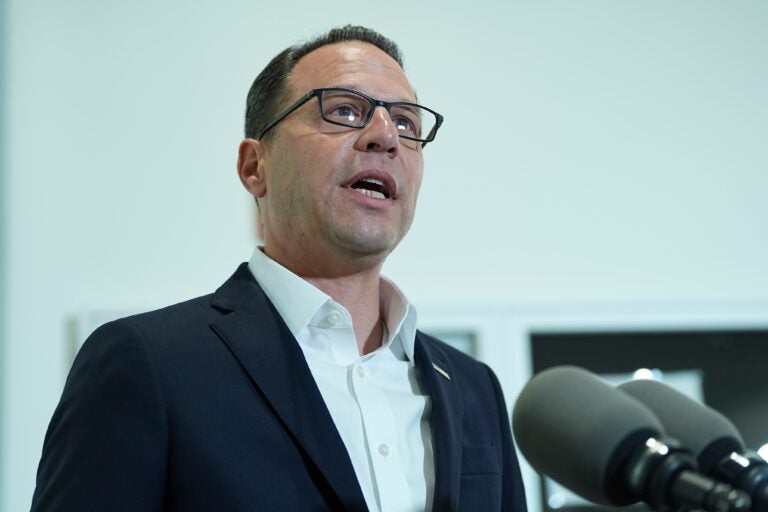
FILE - Pennsylvania Gov. Josh Shapiro visits the Hershey Company's new manufacturing plant in Hershey, Pa., Wednesday, April 16, 2025. (AP Photo/Matt Rourke)
From Philly and the Pa. suburbs to South Jersey and Delaware, what would you like WHYY News to cover? Let us know!
Pennsylvania’s budget is late for the sixth year in a row.
Lawmakers blew past the state’s June 30 constitutional deadline to approve a new spending plan Tuesday, marking the latest in a string of delayed budgets, as Gov. Josh Shapiro and legislative leaders continue negotiations over a package worth more than $53 billion.
Although the state constitution mandates that legislators in Harrisburg pass a budget by June 30, the practice of going well past that deadline has become an annual tradition. Last year’s budget was not finalized until November, after disputes over transit funding and other priorities. While the 2024-25 budget arrived only 11 days late, negotiations over the prior year’s spending plan stretched into December, during a monthslong stalemate over school vouchers and education funding.
Missing that deadline does not immediately shut down the state government as payroll for most state employees and many essential government functions will continue by law. But a significant delay in discretionary payments to school districts, counties, nonprofit organizations, vendors and grant recipients could wreak financial havoc on local school programs, city services and those providing services for the homeless, seniors and other vulnerable populations.
Shapiro addressed that in his February budget address, urging lawmakers to avoid stretching negotiations out to that point.
“We all recognize it took too long last year — and that had real impacts on Pennsylvanians,” he said.
Who is affected by the delayed budget?
Among those impacted are the homeless, disabled and elderly. Funding for services to help those populations are typically provided by nonprofit vendors who are paid by state grants distributed by local governments.
Last year, two homeless shelters in Delaware County were forced to shut down after payments ceased. Dr. Jeannine L. Lisitski, CEO of Mental Health Partnerships, said that even short-term disruptions can have long-term consequences.
“We don’t know because we can’t follow everybody, but they could have been killed on the street; they could have overheated and died; they could have then not been able to get to their medical appointments and had terrible outcomes,” Lisitski said. “We know that with serious mental health issues, without being able to get your medication and if you don’t have a home, where will you store your medication?”
Last year, as a result of the budget delay, payments to service providers were months late. Some organizations, such as Mental Health Partnerships, borrowed money to keep operations going. As a result, Lisitski said that they are now spending money on interest rather than building up capacity or strategic planning.
“Last year, we might have spent $100,000 on interest, so it’s no small amount of money,” she said, adding she would like to see the legislature reimburse those who pay that interest.
“If the state doesn’t have a budget and all the money is in their coffers, I would imagine they’re earning interest on it,” she said.
Related Content
Philadelphia leaders press state officials to step up education funding during visit to Harrisburg
Philly leaders hope to use the city’s recent education funding wins as an example to convince Harrisburg Republicans to supplement all state schools.
3 months ago
Increased spending for education, housing, development
At the center of this year’s negotiations is Shapiro’s proposed $53.3 billion budget, which calls for increased spending on public education, human services, housing and economic development, while relying on new revenue from legalized recreational marijuana, taxes on skill games and other proposals that have faced skepticism from Senate Republicans.
GOP leaders have argued the spending plan relies too heavily on one-time reserves and revenue sources that have not yet been approved.
Despite the missed deadline, some lawmakers expressed optimism that an agreement could still be reached in the coming days. Senate President Pro Tempore Kim Ward, R-Westmoreland County, Senate Majority Leader Joe Pittman, R-Indiana County, and Senate Appropriations Committee Chair Scott Martin, R-Lancaster, said in a statement Tuesday that, although they are going into recess, they will “reconvene once final budgetary language is ready to advance.”
“This week, we have received the necessary clarity on many outstanding issues which were delaying completion of this year’s budget,” the joint statement said. “Presently, we believe we are well on our way to effectuating a full budget agreement in the days following July 4th.”
That’s still too little too late for Lisitski, who said the risks are compounded by the changes in work requirements, which could push tens of thousands of Philadelphians off Medicaid next year, including many who will lose access to mental health treatment.
In addition, the Trump administration is seeking to change federal programs for housing for the homeless that will deprioritize the “housing first” model and reduce permanent housing support.
“All of that is going away and those people will be pushed out on the street,” she said. “So if you look at every single thing and the domino effect, and then put it all together, it is really the worst I’ve ever seen in my long career, which has been over three decades.”
Pennsylvania is one of 25 states suing the Trump administration over the changes to Medicaid work policy. Another lawsuit against the housing policy changes is also working its way through the courts.

Get daily updates from WHYY News!
WHYY is your source for fact-based, in-depth journalism and information. As a nonprofit organization, we rely on financial support from readers like you. Please give today.
Pennsylvania agencies warn of mounting damage as state enters its 4th month of a budget stalemate
The ongoing impasse has stalled billions of dollars from going to schools and social services, and it has no certain end in sight.
12 months ago
A big education fight stands in the way of a Pa. budget deal
With the budget deadline approaching, lawmakers have found common ground on taxes, permitting, and college. But crucially, they’re far from a deal on basic education funding.
2 years ago
Pa. lawmakers did not agree to spend more money on a popular home repair program or send additional money to poor schools despite a promise to do so earlier this year.
3 years ago