
Pennsylvania Democratic lawmakers push package of bills aiming to reduce energy costs
The legislation aims to reduce strains on the grid while protecting ratepayers from predatory billing.
Listen 1:21
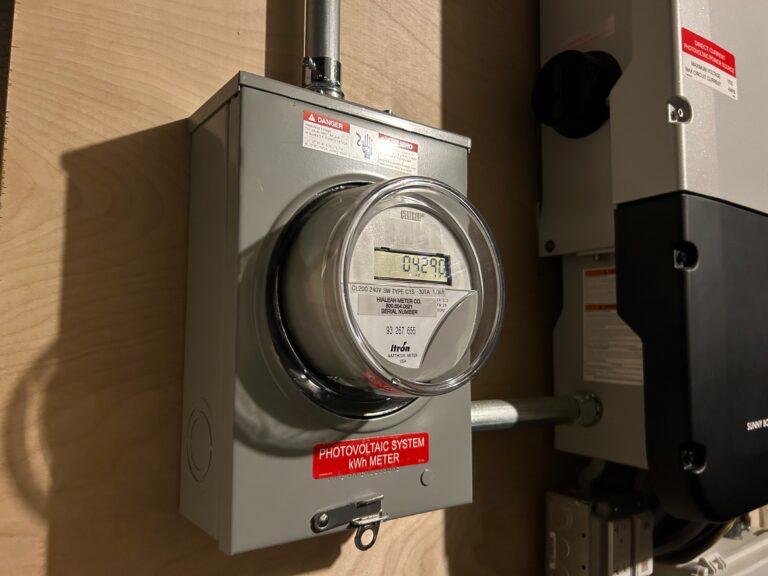
A meter shows energy produced by a photovoltaic system on the roof of a home in West Philadelphia. (Sophia Schmidt/WHYY)
From Philly and the Pa. suburbs to South Jersey and Delaware, what would you like WHYY News to cover? Let us know!
Pennsylvania Democratic lawmakers are pushing a package of bills that aim to reduce energy rates as people struggle to pay their bills.
The price of electricity has soared because of supply costs and increased demand from sources like data centers. The effects are evident in states like Pennsylvania, where utility shutoffs increased by 21% last year, leaving ratepayers in the dark.
Though freezing temperatures have contributed to high utility bills, rate hikes have also been driven by a supply-demand imbalance, increased power demand from data centers and slow construction of new energy generation.
Pennsylvania Democratic state representatives on Wednesday announced legislation that aims to alleviate the strain on the grid, while also trying to protect ratepayers from predatory billing.
“[People are] focused on the utility bills they can’t pay. They’re focused on how high their grocery bill is, even when they don’t buy extra things for their kids,” said state Rep. Elizabeth Fiedler, D-Philadelphia.
“We are here today to make very, very clear that we can change things. That we have good, strong ideas about ways to help consumers, help people back home and help Pennsylvania families.”
Among the legislative proposals includes a bill that aims to protect ratepayers from rising costs because of the boom of artificial intelligence-focused data centers.
AI requires more power at a faster rate than typical internet activities, straining the power grid and leading to increased electricity rates for consumers. PJM Interconnection, which manages the region’s electrical grid, has pointed to the increase in data centers as a reason for increased demand leading to higher electricity bills.
The legislation, sponsored by state Rep. Robert Matzie, D-Beaver, would require the Pennsylvania Utility Commission to create regulations that ensure costs associated with data center development are not passed on to ratepayers.
“Our bill basically says, ‘If you’re gonna build a data center, we don’t want grandma’s bill to go up.’ Bottom line, plain and simple,” Matzie said.
The bill would require security deposits to avoid “stranded costs” related to investments in energy generation and infrastructure that hit nearby residents if a project doesn’t come to fruition.
Data center operators would also be required to contribute to the Low Income Home Energy Assistance Program, or LIHEAP, which provides financial assistance to low-income households struggling to pay their energy bills.
The legislation, which passed in the state House last month, awaits a vote on the Senate floor.
In a statement, a spokesman for energy company PECO said it agrees data centers should pay their fair share of building and maintaining the grid, and that those costs should not be shifted onto customers.
“HB 1834 provides statutory support for consumer protections that PECO has put in place to protect our customers against stranded costs related to data centers,” spokesperson Greg Smore said in an email.
However, PECO would not support a separate rate class for data centers, because it would have “unintended negative cost impacts for our customers.”
Related Content
Your PECO bill could increase by $20 each month starting in 2027
The utility wants to raise its rates for electricity customers and suburban natural gas users. The CEO of PECO's parent company, Exelon, made more than $15.6 million in 2025.
7 months ago
Listen 1:15Protecting ratepayers
Other legislation aims to protect ratepayers from predatory billing and other practices that impact residents.
Pennsylvania law allows utilities to recover costs and earn returns on their system upgrades. However, an American Economic Liberties Project report found that utilities have earned returns above their financing costs, and that practice has driven rate increases.
Fiedler announced legislation yet to be introduced that she says would ensure rates of return that investor-owned utilities earn from infrastructure expansion are equal to the demonstrated cost of capital.
“This bill does not tell utility companies that they can’t make profits. It’s simply saying, ‘Please, let’s recognize how hard it is for regular working people in Pennsylvania, and make sure the profit that you are making is in line with returns you could expect elsewhere,’” she said.
The Democratic lawmakers have proposed several other measures that aim to prevent independent electricity suppliers from taking advantage of ratepayers who opt to purchase their power on the retail market through PAPowerswitch.com. State Rep. Heather Boyd, D-Delaware, has introduced legislation that aims to protect these customers from hidden fees, unclear contract renewals that have variable rates and electricity plans they didn’t sign up for.
The legislation, which awaits committee consideration, would strengthen notice requirements before contracts expire, require customer choice when contracts end and eliminate “junk fees.”
“Too many people sign up for electric contracts, expecting one price, a term, and one set of rules, only to get hit later with confusing notices, surprise fees or automatic rollovers that cost more,” Boyd said.
“Your electric bill shouldn’t read like a trap. Pennsylvanians are already juggling higher costs at the grocery store, at the pharmacy, at the pump. So the last thing they need is a utility bill full of fine print, or gotchas.”
PECO’s spokesperson said the utility “strongly supports” Boyd’s legislation.
The lawmakers are also calling for banning so-called “weather normalization adjustments.” The legislation was introduced almost one year ago, but has yet to be considered in the House.
Weather normalization adjustments allow utilities in Pennsylvania to charge or credit bills based on extreme temperatures. Energy companies may include additional charges when the winter is warmer than normal, or apply credits if the summer is unusually cool. Ratepayers have spoken out against the practice, arguing they shouldn’t have to pay for the cost of climate change.
“Basically, our utility and energy companies are telling us that we really don’t care what you’re using. It’s what we feel like charging you,” said state Rep. Tarah Probst, D-Monroe, who is sponsoring the bill. “Although weather normalization adjustments are supposed to even out, they often result in higher than expected winter utility bills for Pennsylvanians.”
POWER Interfaith, a nonprofit which advocates for reduced energy costs, has argued for years that weather normalization adjustments unreasonably penalize residents for reduced energy usage.
The organization said they applaud efforts to protect ratepayers, and urge lawmakers to further address the impacts of climate change on residents.
“Across our congregations, we’re hearing a consistent story: energy bills are rising, and families are being pushed to the edge while they’re already struggling to afford groceries, rent and other basic needs. In too many cases, utility companies are seeing significant profit increases at the same time,” said Randy Libros, an organizer for POWER Interfaith’s climate justice team, in a statement.
“Any serious affordability effort has to both ease immediate financial strain and hold utility providers accountable, so families aren’t left carrying costs they didn’t create.”
While PECO does not currently have a weather normalization adjustment, the spokesperson said the utility believes the mechanism limits high customer bills during extreme cold and heat seasons and is concerned about its potential elimination.
Related Content
What you can do about your rising electric bills in Pennsylvania
The National Consumer Law center said that about a quarter of all U.S. households sacrificed food and medicine to pay for their energy bills in 2024.
7 months ago
Listen 6:08Reducing strain on the grid
The Democrats are also calling for infrastructure upgrades to the grid. State Rep. Nathan Davidson, D-Dauphin, has introduced legislation proposing the build out of virtual power plants.
Virtual power plants aggregate technology such as home batteries, electric vehicle chargers and smart thermostats, that are then managed by software and operate in the same manner as a single power plant.
During the hottest and coldest days of the year, the grid relies on so-called “peaker plants,” which are power stations that can start up quickly to support the grid during peak demand and prevent blackouts.
Davidson argues virtual power plants could be an alternative to peaker plants, while lowering energy demand and reducing ratepayer costs. In Vermont, one virtual power plant is expected to save ratepayers $3 million.
It’s also a proposal PECO said it could stand behind.
“We cannot afford to wait years, or decades, for new generation to come online,” Davidson said. “Our constituents, and all Pennsylvanians, need action today.”
Meanwhile, state Rep. Fiedler is calling for software and hardware upgrades to the state’s existing transmission systems. Rather than building new transmission lines, Feidler’s legislation aims to ensure transmission systems are operating as efficiently as possible.
The legislation, which awaits a vote in the House, would not prevent utilities from building new transmission lines, but require them to first consider alternatives such as advanced conductors, grid-enhancing technologies or power-flow controls.
“These are things that we absolutely should be doing to increase capacity, efficiency and, of course, reliability of our existing grid,” Fiedler said. “A lot of people are really worried about prices going up, and also about the potential of blackouts and brownouts. We all want the lights to turn on when we flip the switch, and so do our constituents.”
In a statement, the Energy Association of Pennsylvania, which represents the state’s energy utilities, said it supports legislation that addresses energy affordability, especially for low-income households and small businesses.
However, the organization emphasized the need to address the driver of high customer bills, such as the cost of electricity and natural gas from generation companies, which are set in competitive markets. The organization said how the state implements legislation that assists low-income households and encourages alternative energy is crucial.
President and CEO Andy Tubbs pointed to efforts like net metering and retail electric competition as examples that could have unintentional consequences for customers.
“EAP strongly supports programs that protect low-income customers, but expanding these programs without addressing cost impacts can actually increase bills for working families who don’t qualify for assistance,” he said in a statement. “Getting affordability right requires policies that reduce costs rather than shifting them.”

Get daily updates from WHYY News!
WHYY is your source for fact-based, in-depth journalism and information. As a nonprofit organization, we rely on financial support from readers like you. Please give today.
2 Philly-area Democrats voted against the bipartisan ‘compromise’ state budget. Here’s why
The two state senators criticized the budget for failing to address “critical” issues such as public transit, affordable energy and rising energy costs.
3 months ago
Listen 1:11
Pennsylvania lawmakers push federal bill to boost clean energy
The Energy Bills Relief Act would reinstate tax incentives and speed the development of new clean energy projects.
5 months ago
Listen 1:12
Pennsylvania residents have an extra month to apply for heating assistance
Households faced higher heating bills this winter, as natural gas prices rose faster than inflation over the past year.
6 months ago
Listen 0:50