

Several deaths at New Jersey county jail led authorities to change the health care provider. Some question whether it will help
While some are blaming a medical provider that was illegally contracted, their replacement was the subject of similar criticisms and accusations in the past.
Listen 1:15
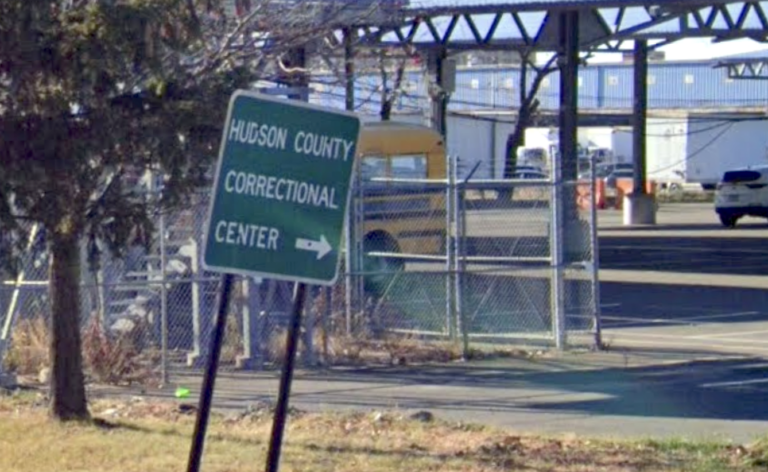
Several incarcerated people have died inside the walls of Hudson County Correctional Center in Kearny, N.J. (Google maps)
From Camden and Cherry Hill to Trenton and the Jersey Shore, what about life in New Jersey do you want WHYY News to cover? Let us know.
John Patrick Finucane was troubled. Diagnosed with schizophrenia and bipolar disorder as a teenager, he was prone to bouts of erratic behavior, sometimes threatening his family.
But Liz Oliveras loved her brother the same and wanted the best for him.
“He was smart, he was loved and he had people who cared about him,” she said.
One day in June, Finucane was having an episode and Oliveras, worried that he might hurt her, his father or someone else, called 911 hoping that Finucane would get the help he needed.
“Who else are you supposed to call?” she said. “I was protecting my loved ones and I didn’t know what to do. We always just called the police and he was put in the hospital.”
However, Finucane was not in a hospital when the 32-year-old died a few months later; rather he was in the Hudson County Correctional Facility in North Jersey when he was found dead.
Oliveras now expresses guilt that she made the call but also wants to know why her brother wasn’t somewhere he would get treatment rather than incarcerated.
“I feel so selfish but, it’s like, was it my fault?” she asks through tears during a phone interview. “He should have been in a hospital. Everyone knew that he was schizophrenic and bipolar; it wasn’t hidden. I don’t even know why a jail would want someone who is already known to be schizophrenic or bipolar unless there’s a doctor on hand. Why would you want anyone that’s diagnosed there?”
That’s a question longtime Hudson County Commissioner Bill O’Dea also wants answered.
“Does an individual with schizophrenia belong in a cell?” O’Dea said. “The system failed [Oliveras] and failed her brother because they should have been able to identify the fact that the worst place in the world for that individual was jail, where they did not have the adequate resources on site to provide treatment.”
Seven deaths in 12 months
Finucane was only one of many such cases within the confines of the Hudson County jail. WHYY News has determined that there have been at least seven known deaths over the course of 12 months, including Finucane, who died in November.
Andrew Smith, a Summit, New Jersey-based attorney who is representing two families who are suing the county after their relatives died behind bars last year, believes the problems are not concentrated within the Hudson County facility, but reflect a chronic statewide issue.
“New Jersey has a serious issue with the medical care it provides its correctional facilities,” he said. “It certainly seems that it could be a systemic problem.”
Sources familiar with the cases say that they suspect a variety of causes of death including heart failure, overdoses and suicide. However, those causes have not been confirmed as results of investigations into the deaths have not yet been made public, including that of Jonathan Colon, of Cumberland County, New Jersey, who was reported dead more than a year ago, on Dec. 4, 2024.
“That is a concern because that information isn’t readily available to us until well after the fact and only if we press to try to get information,” O’Dea said. “Families have a right to know and a right to know in a timely manner. And honestly, they should be kept abreast throughout the investigation process by the prosecutor’s office.”
New Jersey state law requires autopsies in suspicious deaths of individuals in custody. The AG’s Directive 2019-4 established a 10-step process for investigating in-custody deaths in the state. For deaths in county facilities, the county prosecutor’s office is required to inform the attorney general’s Office of Public Integrity and Accountability, which then assigns an investigator to determine whether an official may have been culpable in the death. If the death does not appear to be linked to the actions of an officer, the county prosecutor is then charged with the investigation.
A county prosecutor’s office spokesperson confirmed the seven deaths to WHYY News but said they couldn’t provide any other information because “all of these matters are still open investigations” and, as a result, they “are not permitted to release additional information at this time.” A spokesperson for the AG also confirmed that they had been notified of the seven deaths and that “the Hudson County Prosecutor’s Office was designated as the Independent Investigator.” The spokesperson said that all of “those investigations are either open or under supervisory review.”
The Hudson County Executive’s office echoed O’Dea’s concerns about the lack of information from the office of the county prosecutor, who is appointed by the state, meaning that the county executive has little to no authority over it. Wayne Mello, the acting county prosecutor, was appointed in August.
Hudson County spokesman Mark Cygan said that they have been waiting for information long before Colon’s death a year ago.
“It’s understandable that these reports take time but we haven’t seen a report since 2022,” Cygan told WHYY News. “I’d argue three years is way too long to be waiting on reports like these.”
Related Content
The state’s consent decree with the Community Legal Aid Society will be monitored by an independent evaluator and U.S. District Court.
4 months ago
The role of medical providers
Regardless of the causes behind the deaths, critics have pointed at the lack of medical resources for those being held in jail as one of the reasons the deaths have been occurring at an alarming rate. They say that there has been inadequate medical staff on site to properly screen inmates for potential physical issues as well as behavioral health, and treat them when issues arise.
Smith said there are “a lot of issues within these correctional facilities with how that care is being given to inmates.”
“This is a civil rights case,” he told WHYY News. “Inmates are particularly vulnerable because they have no ability to seek medical care outside that provided by the facility.”
Cygan disputed the assertions that medical care played any role in the deaths.
“We haven’t heard of these [criticisms], especially when it comes to health care for inmates of any staffing deficiencies or shortages, so I wouldn’t necessarily point to that as the reason,” he said, adding people held in prison are “medically screened within four hours for both medical as well as any behavioral issues that they might have.”
Between 2018 and this year, the Hudson County jail was served by Wellpath, a Nashville, Tennessee-based provider that serves more than 350 correctional facilities around the country, according to their website. Previously known as Correct Care Solutions, the company has been criticized and sued for “medical neglect” in dozens of cases.
In 2024, the New Jersey Comptroller’s Office sued the county for violating public bidding requirements when it awarded Wellpath the $13 million jail contract in 2018 by limiting those who could bid. The contract was then renewed in 2023. The county appealed, but a state Superior Court panel ruled against them last month.
As a result, the county was forced to change medical providers and, according to Cygan, went with “the lowest responsible bidder,” Mount Laurel-based CFG Health.
Wellpath, which did not respond to repeated email and phone messages, filed for bankruptcy in 2024, but settled with creditors last year.
O’Dea said he’s “optimistic” that things will improve under CFG given their local resources, including having access to a dedicated “secure mental health facility.”
However, CFG is not only Wellpath’s successor at the Hudson County prison, but also its predecessor. CFG lost its contract to oversee the prison’s medical care in 2018 after a series of suicides at the facility, leading to Wellpath becoming its new provider.
Those incidents also prompted the county to convene a board to review ways to provide better medical care to incarcerated patients.
CFG also did not respond to multiple email and phone requests for comment.
At the time CFG was coming under scrutiny, New Jersey ranked among the highest in per capita deaths in local jails, according to data compiled by the U.S. Department of Justice. Over the course of the next few years, the DOJ data reflected a downward trend. However, last year, the New Jersey Office of the Corrections Ombudsperson released a report that shows that per capita rates have gone back up.
Regardless, Oliveras just wants information, which she is not getting.
“There was an investigator who, a sergeant who called me and gave me the briefest amount of information that anybody could have given me,” she said. “Even to this day, I haven’t heard anything back from them or anything. I even don’t know what happened between 7:40 [a.m.] and 8:37 [a.m.] when he was pronounced dead. What happened? I know nothing.”

Get daily updates from WHYY News!
WHYY is your source for fact-based, in-depth journalism and information. As a nonprofit organization, we rely on financial support from readers like you. Please give today.

New Jersey lawmakers move bills to address online safety for children
Legislation is being fast-tracked to better protect children’s online privacy and force black box social media warnings to be posted on platforms.
2 months ago
Listen 1:03
N.J. Gov. Sherrill wants to freeze rate hikes. Here’s what that means for your electricity bills
New Jersey customers’ electric bills increased by as much as 20% last summer. They could rise again this year.
3 months ago
Listen 1:04