

N.J. doctors say immigration enforcement is raising anxiety in young children. Here’s how parents can help
Experts recommend parents and caregivers read out loud to babies and young children.
Listen 1:21
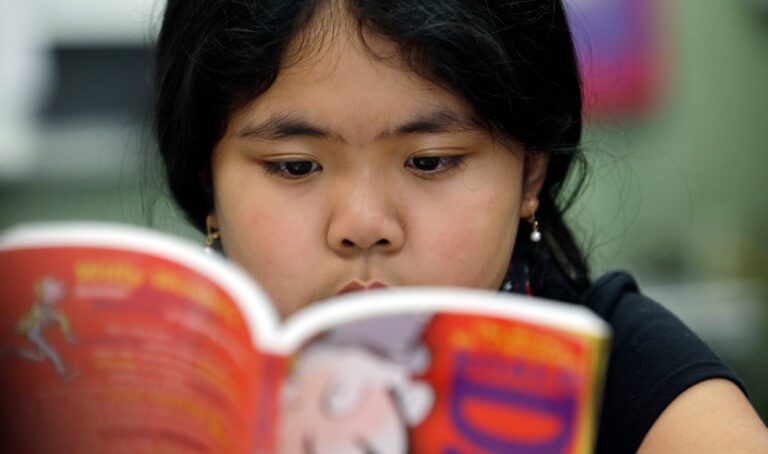
File - In this photo taken Thursday, Oct. 2, 2014, a fifth grader reads a book. (AP Photo/Elaine Thompson)
ICE latest: What to know
- Widespread protests: Philly is among many U.S. cities to see major protests after federal immigration officials shot and killed Renee Good and Alex Pretti in Minneapolis.
- ‘STOP ICE’: Philly Council members want to enshrine “sanctuary” status and ban ICE masking.
- ICE cooperation: WHYY News explores what immigration agreements are in place in Philly, the suburbs, New Jersey and Delaware.
- Legal protections: Here’s what to know if you’re an immigrant living in Philly. Plus, advocacy groups share what to know if you are stopped by federal immigration agents.
With increased activity by U.S. Immigration and Customs Enforcement agents continuing across the region, pediatric clinicians in New Jersey say they’re seeing more young children exhibiting signs of trauma, stress and anxiety.
To help allay those fears, the nonprofit organization Reach Out and Read is working with health clinics across the Garden State, encouraging parents to read aloud to their babies and young children every day.
Helping children feel safe
Shaniqa Williams started reading to her 1-year-old son, Sincere, after visiting the Henry J. Austin Health Center in Trenton. The nonprofit serves as the city’s Federally Qualified Health Center and aims to give families the tools they need for wellness.
“Sometimes during the day, he might be overstimulated, so we’ll take some quiet time out to read, and that helps him to be calm and get back to a good space,” she said.
Dr. Rachael Evans, chief medical officer at the Trenton health center, said that when a parent brings their baby or young child in for an appointment, they are immediately given a book from the Reach Out and Read program and encouraged to read it out loud every day.
“At a time when maybe families are feeling stressed, maybe children are feeling that stress, it’s wonderful to give a family a very concrete way to say you can make this child’s experience better, and that positive childhood experience leads to better health outcomes,” she said. “It becomes a wonderful tool to both conduct the visit, but then also to support the parent reading to the child.”
Maurice Elias, a professor of psychology at Rutgers University, said it’s not surprising that more children are showing signs of anxiety these days.
“Even if young children aren’t aware of what’s going on they can sense greater anxiety in their loved ones, they may not be able to pick up on the news or what’s really happening,” he said. “But they do know what’s going on, so I think this is a real phenomenon.”
Elias said reading aloud to young children is beneficial for them because it occupies them completely, and they are usually next to the parent, or on their lap.
“That physical contact is also very reassuring to young children, and it helps to alleviate other anxieties that they have without them even being aware of it,” he said.
He added that it’s important for adults to be as reassuring to children as possible, even if they don’t really feel that way, and reading aloud to them is a way to offer that reassurance.
“Especially before their bedtime, it will help them be more ready for sleep,” he said.
Elias said he frequently reads out loud to his own 4-year-old grandchild.
Related Content

New Jersey residents can upload videos of ICE activity to a new state portal
Gov. Mikie Sherrill has also signed an executive order that prohibits ICE agents from operating on state property.
8 months ago
Listen 0:57Multiple benefits
Kim Byam, executive director of Reach Out and Read in New Jersey and Delaware, said reading to young children is beneficial in multiple ways.
“It helps them relax and the more they hear the more their brain is building,” she said. “We know that children that have been exposed to Reach Out and Read for the first five years of life enter kindergarten with higher vocabulary scores.”
“Sometimes our parents don’t know how to read, they’re afraid of the idea of trying to read a book, so we encourage them to create stories,” said Kathryn Moffat, program manager of the early development programs at the Henry J. Austin Health Center. “Just point to pictures in the book and create an interaction between them and their child, it’s the same concept as actually reading the words in the story.”
“Your baby’s favorite sound in the whole world is your voice,” Byam said. “If you’re not comfortable reading you can talk about the pictures, tell stories and the more you do that, your baby’s brain will grow.”
Related Content
One of the suspects taken into custody by U.S. Marshals Service agents was wanted for assault by auto and other charges.
7 months ago
Listen 1:04Libraries have read out loud programs
Most libraries across New Jersey and the U.S. feature reading out loud programs for young children.
Erica Bess, the assistant director of the Princeton Public Library, said storytimes are offered twice a week for babies and toddlers, and three times weekly for children ages 2 and up.
She said every month library teams will visit public preschools in Princeton, offering reading aloud programs and visits are also coordinated with private area preschools.
She said exposure to language through hearing books read aloud is extremely helpful for building a child’s word bank.
“When our librarians sing and recite rhymes, they are slowing down language so that children can more easily hear the sounds that make up the words they will eventually read on the page,” she said. “And, with finger play and movement, children build coordination and dexterity, which are essential for holding and turning the pages of a book, and for understanding the concept of reading left to right.”
Bess said the library has two programs that promote parents and caregivers reading to children.
Williams said she has four other children, but Sincere is the first one she has read out loud to on a regular basis, and his favorite book is “Green Eggs and Ham” by Dr. Seuss.
“I feel like reading to him every day helps with his development,” she said. “I’ve noticed he’s started to pick up a lot of words earlier than the others did.”
Reach Out and Read provides more than 200,000 books a year for 80,000 New Jersey families in more than 100 clinics serving lower-income populations.

Get daily updates from WHYY News!
WHYY is your source for fact-based, in-depth journalism and information. As a nonprofit organization, we rely on financial support from readers like you. Please give today.

Protesters call on Philadelphia Parking Authority to end parking contract with DHS
Protesters urged the agency to end its contract with the Department of Homeland Security, which oversees ICE.
3 weeks ago
‘ICE Out’ in Philly: Advocates are filling in the gaps where they say the city has fallen short
Immigrant advocacy groups say many residents don’t fully understand what protections the legislation provides or how the city is enforcing the new laws.
2 months ago
Iemad Saifo, owner of Zena’s, an American-Mediterranean restaurant in Collingswood, is scheduled for a bail hearing Friday morning.
2 months ago
Listen 2:18