New Jersey American Water seeks $10 a month rate increase
The investor-owned utility said a rate increase would help fund major infrastructure projects.
Listen 1:00
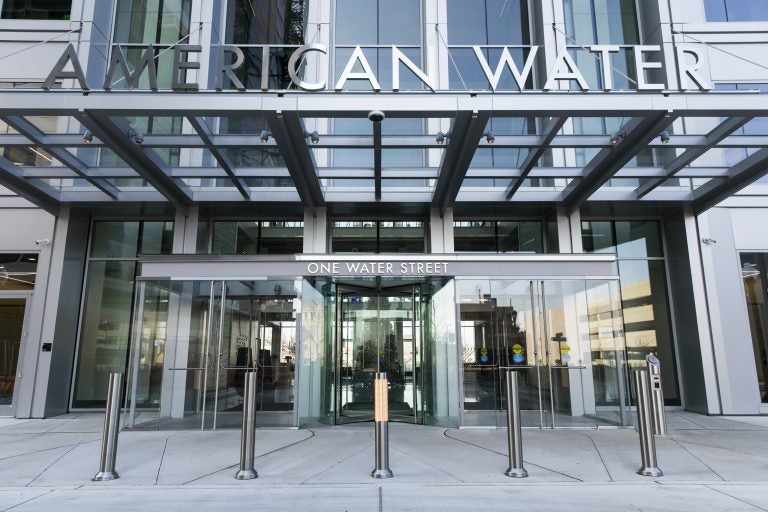
A logo sign outside of the headquarters of American Water in Camden, New Jersey, on December 23, 2018. (Kristoffer Tripplaar/Sipa USA)(Sipa via AP Images)
From Philly and the Pa. suburbs to South Jersey and Delaware, what would you like WHYY News to cover? Let us know!
New Jersey American Water wants to increase its customers’ water bills to help fund more than $1 billion in water and wastewater projects.
The investor-owned utility said the average customer could expect to pay an additional $10 per month if the request is approved by the New Jersey Board of Public Utilities. That could make the average monthly residential water bill rise to $93.89.
Customers served by sanitary wastewater systems would see an average increase of $8 per month. Households that receive both services could see a combined impact of about $18 per month, depending on their service area, meter size, and usage.
New Jersey American Water said the rate increase is essential to improve aging infrastructure, replace dangerous lead service lines and address toxic chemicals such as PFAS. President Mark McDonough said the revenue would ensure the company can deal with problems before they become acute.
“This rate case is really aimed at the investments we’re already making to stay ahead of problems,” he said. “If we do good planning and we’re proactive in prudent investment, we can really keep our customers receiving safe, reliable water and we maintain the affordability that we have.”
The request comes roughly 16 months after the company increased rates by more than $5 per month.
Water infrastructure across the U.S. is aging, and according to the U.S. Environmental Protection Agency, the nation needs at least $630 billion over the next 20 years for stormwater and wastewater projects alone. When combined with drinking water upgrades, water providers need a total of more than $1 trillion.
“Rate increases are definitely something that we see all around the country because of upward pressure on rates that’s driven by the need to invest in aging water systems,” said Larry Levine, a senior attorney with the Natural Resources Defense Council’s environmental health program.
Water providers are faced with new federal regulations requiring them to remove toxic chemicals such as PFAS from drinking water, replace lead pipes and to reduce wastewater discharges into waterways. Though the federal government under the Biden administration set aside billions of dollars to upgrade water and sewer infrastructure, providers say more funding is needed.
Pennsylvania American Water similarly filed a request with the Pennsylvania Utility Commission in November to fund $1.2 billion in water and wastewater system upgrades. If approved, the average water customer would pay an additional $14 per month on their bills.
While some rate increase is expected, it is unlikely that New Jersey American Water will be awarded the full request, said Brian Lipman, director of the New Jersey Division of the Rate Counsel, a state agency that advocates to keep costs affordable for ratepayers. He said the agency does its best to ensure rate increases are necessary to support infrastructure investments without unduly impacting consumers.
In an effort to alleviate the burden on rate payers, New Jersey American Water is seeking approval from the BPU to expand access to monthly bill discounts through its H2O Help to Others program. The company is asking to automatically enroll customers who partake in energy assistance programs like the Low Income Home Energy Assistance Program, or LIHEAP. If approved, New Jersey American Water would be the only utility in the state to offer automatic enrollment in water bill assistance.
“Water is so fundamental to sustaining life,” McDonough said. “We think it’s very important to have this kind of forward thinking program to be able to help those folks who may need some assistance.”
New Jersey Gov. Mikie Sherrill issued an executive order last week that aims to pause further rate increases for energy. However, no similar action has been taken for water bills and there’s currently no state-run program to help residents pay their water bills.
Related Content
N.J. Gov. Mikie Sherrill issues state of emergency on energy costs: Here’s what to know
Sherrill ordered state regulators to boost renewables and natural gas in light of rising electricity prices.
2 months ago
Listen 1:06The EPA in 2024 said that between 12.1 million and 19.2 million households across the nation struggled to pay their water bills. In New Jersey, one-fifth of households have challenges paying their water bill, putting them at risk of losing their water supply, according to a report by Rutgers University and New Jersey Future.
A NRDC report found that between 2019 and 2024, 57,000 households that are served by private water companies were shut off from their water. Between 2023 and 2024, New Jersey American Water saw an 18% increase in shutoffs, according to the report that used data from four large state water suppliers.
A company spokesperson said the data is skewed, however, because of regulations passed in 2023 that required redesigned field processes and for the company to retrain its teams, limiting their ability to complete shutoffs. They added that shutoffs remain lower than they were before the COVID-19 pandemic.
“Water is an essential utility, so when we really think about affordability challenges that people are facing across New Jersey, whether it be housing, healthcare or utility bills, water is a part of it,” the organization’s Levine said. “With increasing water rates and the expectation that those will continue into the future across the board, it’s really critical for the state to also be focusing on water affordability, not only electricity.”
New Jersey’s Winter Termination Program prevents water and other utility shutoffs between Nov. 15 and March 15 for low-income residents.
The Rate Counsel’s Lipman said the loss of funding for the Low Income Household Water Assistance Program, or LIHWAP, significantly impacted residents in New Jersey. The withdrawn federal program previously helped low-income households pay overdue water and wastewater bills.
“Our office does not track shut offs, but we are aware that people are already facing difficulties in paying their bills, and another increase will simply make a bad situation worse,” Lipman said in a statement. “We will do our best to ensure the increase is as low as possible, and work with [New Jersey American Water] to establish programs to assist those who are having trouble paying their bills.”
Lipman encourages anyone struggling to pay their water bills to talk to their water provider or BPU and see whether help is available.
Levine added that increased state and federal funding could also help take the burden off ratepayers. The vast majority of funding for water and sewer infrastructure comes from ratepayer fees and bonds.
“The way that rates are designed, low-income customers are disproportionately bearing a burden relative to their income,” Levine said, arguing for a rate structure that takes income into account.
The BPU, which regulates utilities in New Jersey, will make a ruling on the rate request following an extensive examination process and public hearings. If approved, the new rates would take effect during the second half of the year.

Get daily updates from WHYY News!
WHYY is your source for fact-based, in-depth journalism and information. As a nonprofit organization, we rely on financial support from readers like you. Please give today.
Residents have formed a preservation project to stomp out gentrification and put Whitesboro back on the historic map.
2 weeks ago
Listen 4:04
Saving a home that witnessed revolution, Moorestown, N.J., looks ahead to America’s 250th
The home, built in 1742, was the residence of Thomas Cowperthwaite, a prominent Quaker, and his family — some of whom ended up on opposite sides of the Revolutionary War.
2 months ago
The 5 WHYY News stories you couldn’t stop reading in 2025
As 2025 comes to a close, WHYY News remembers five of the stories that mattered most to readers in Pennsylvania, New Jersey and Delaware.
3 months ago