

N.J. election 2026: New state law allows some 17-year-olds to vote in primaries
Voting is underway in the 11th Congressional District to replace Mikie Sherrill, who resigned after becoming governor.
Listen 1:08
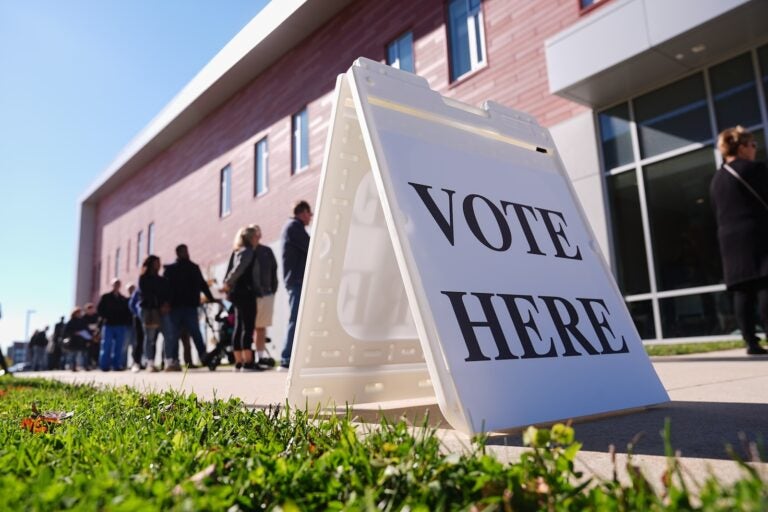
Voters wait in line to cast their ballots at a polling place at Rowan College in Mount Laurel, N.J., Monday, Oct. 27, 2025. (AP Photo/Matt Rourke)
What questions do you have about the 2026 elections? What major issues do you want candidates to address? Let us know.
Saanvi Kulkarni, 17, of Livingston, plans to take full advantage of a new voting law in New Jersey that allows some 17-year-olds to cast ballots in primary elections if they turn 18 before the general election.
The high school senior is set to cast her first vote in the 11th Congressional District special primary election on Feb. 4, and plans to vote again in the special general election on April 16, one day after she turns 18.
“In the United States a big advantage of our system is that we can complain, like when things don’t go the way that we want them to in our government we’re allowed to complain about it. But I don’t think complaining is enough, I think you also need to use your voice,” she told WHYY News.
Kulkarni is among the first group of 17-year-olds to benefit from the New Voter Empowerment Act that went into effect earlier this year.
Beth Thompson, the president of the New Jersey Association of Election Officials and the supervisor of the Hunterdon County Board of Elections, said the new law is designed to make teens aware of their civic duties and get them involved with the democratic process.
“I think that young people have a right to vote in the primary, to have their voice heard so that other people aren’t just making the choices,” she said.
Erik Cruz Morales, the director of democracy for the League of Women Voters of New Jersey, agreed that the New Voter Empowerment Act empowers young voters.
“It gives them an opportunity to become civically engaged and I think there’s a lot of appetite for young people to get involved right now, so we’re hoping that people come out to vote,” he said.
Heather Richner, the associate council in the democracy and justice program at the New Jersey Institute for Social Justice, said there is evidence that the earlier people vote, the more likely they will continue to vote. She said giving 17-year-olds a seat at the table makes sense.
“This strengthens democracy for our future,” she said.
“We’re hoping this is going to make New Jersey a leader for voting rights in this country, especially as we head down a path where voting rights are being attacked,” she said.
Related Content

A dozen Democrats are fighting for the chance to face Republican Randolph Mayor Joe Hathaway in April.
8 months ago
Affordability, democracy are key issues in the special primary
Kulkarni said affordability and democracy are the top issues in her district’s upcoming primary elections, where voters will replace Mikie Sherrill, who resigned from the House of Representatives in November after defeating Republican Jack Ciattarelli in the race for governor.
“I think voting is a way to show those in charge, like hey, this isn’t going to fly,” she said. “The only way to change this is to change those who have the power.”
She said she has always felt strongly about the importance of justice, and that led to an early interest in politics.
“I’ve been running voter registration drives, and I am forcing all my friends out to vote,” she said. “A lot of them don’t understand how crucial it is. A democracy only works if participation is broad and participation is expanded to everyone, and if everyone votes.”
Morales said, like Kulkarni, many young people feel strongly about issues like climate change, gun control and housing, and inviting them into the electoral process early is an important step forward.
“It increases confidence and builds better habits in the long term for them to be civically engaged,” he said.
New law could boost voter turnout
Jessica Ronan-Frisch, the associate director of the Center for Youth Political Participation at the Rutgers University Eagleton Institute of Politics, said the new law could increase enthusiasm for primary elections.
“It can only help improve and support young people in actually seeing the primaries as a place where they can really have a say in who’s going to be representing them,” she said. “Especially in New Jersey when you have elections every single year, I think it’s a nice opportunity for these younger people to make a difference and get involved.”
Ronan-Frisch said it’s important to remind younger voters that problems they face on the local level can be addressed by an elected office.
She said many young people may be dissuaded from voting initially.
“There’s a lot of deadlines, there’s a lot of guidelines and there’s not as much emphasis on the primary election,” she said. “Just reminding them that there is an election coming up and the importance of the primaries is important.”
Related Content

A dozen Democratic candidates and only one Republican will run in a special primary election in the 11th Congressional District.
8 months ago
Listen 1:04What process should 17-year-olds who are eligible to vote in New Jersey follow to vote in the primary?
Thompson said 17-year-olds who will turn 18 before the November general election must fill out a voter registration form by May 12. Thompson said when a 17-year-old gets their driver’s license they should be given the option to register to vote.
“If that didn’t happen there are paper forms available on every state government website, every state agency that we’re aware of,” she said.
The New Jersey state website offers an online voter registration.
Residents can go to the elections section of the state website, navigate to the Division of Elections page, select the Election Information dropdown, then open the Voter Information portal to complete voter registration.
To be eligible to vote in a primary election, voters need to be registered as a Democrat, Republican or as unaffiliated, but unaffiliated voters must declare as a Democrat or Republican the day of the primary if they wish to cast a ballot.
“If you’re registered with one of the alternative parties you are not eligible to vote in primaries in the state of New Jersey,” Thompson said.

Get daily updates from WHYY News!
WHYY is your source for fact-based, in-depth journalism and information. As a nonprofit organization, we rely on financial support from readers like you. Please give today.
Part of the series

New Jersey election 2026: What to know about the 12th Congressional District race
The 12th District covers parts of Mercer, Middlesex, Somerset and Union counties.
4 days ago

Data center opposition could become a key issue in New Jersey’s midterm elections
A growing number of towns are banning data centers because of quality-of-life and financial concerns.
1 week ago
New Jersey election 2026: Voter guides, key races and more
Election Day is Tuesday, Nov. 3. Here’s what’s at stake in the midterms, along with voting logistics, candidate breakdowns and more.
2 weeks ago