

Trump administration green card changes: Here’s what you need to know
The policy could be “devastating” for tens of thousands of people in Philadelphia who have applied for a green card via the adjustment of status process.
Listen 1:23
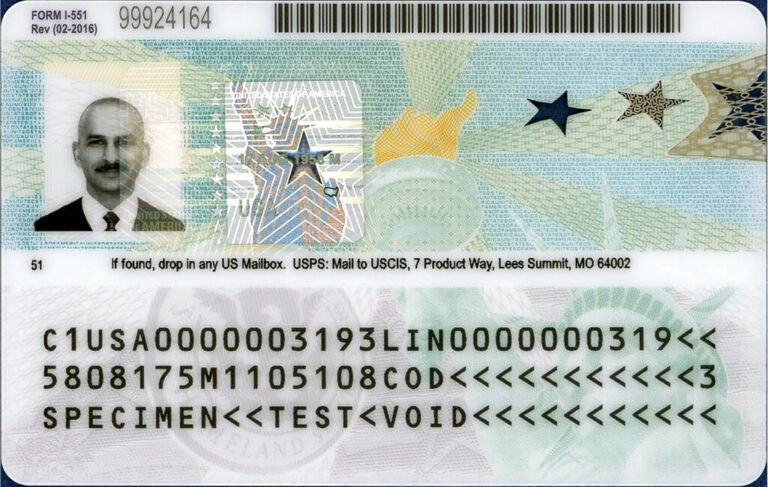
This undated image from the U.S. Citizenship and Immigration Service shows the back of a sample "green card," formally known as a Permanent Resident Card. (USCIS via AP)
ICE latest: What to know
- ‘ICE Out’ in Philly: Here’s what to know about ICE-related legislation in the city.
- ICE cooperation: WHYY News explores what immigration agreements are in place in Philly, the suburbs, New Jersey and Delaware.
- Legal protections: Here’s what to know if you’re an immigrant living in Philly. Plus, advocacy groups share what to know if you are stopped by federal immigration agents.
President Donald Trump’s administration announced sweeping changes to the green card application process in a policy memo released last week that requires most applicants to leave the country and apply at consulates abroad.
For more than seven decades, many immigrants applying to become lawful permanent residents have been able to do so from within the United States under a statute of the Immigration and Nationality Act passed by Congress in 1952. Under the new U.S. Citizenship and Immigration Services directive, absent “extraordinary discretionary relief,” people would have to leave the United States to apply for and receive their green card.
That process can take anywhere from months to years, depending on factors including the applicants’ country of origin, their pathway to lawful permanent residency, relevant yearly quotas and more.
A spokesperson for USCIS said in a statement to Time Magazine that the policy “allows our immigration system to function as the law intended instead of incentivizing loopholes,” and helps reduce the “need to find and remove” people who are denied residency and then remain in the U.S. without legal status.
Immigration advocates and attorneys say the abrupt reversal of this precedent could have a “devastating” impact on individuals, families and workplaces throughout the Philadelphia region.
“It’s not going to be a quick, two-week trip and back,” said Nicole Simon, managing partner of the Philadelphia-based law firm Simon, Choi & Tuohy. “Who knows when this appointment is even going to be scheduled, right? And they could be stuck for an untold amount of time. So it’s absolutely going to wreak havoc economically.”
Legal challenges to the new policy are expected, Simon said, but in the meantime, the announcement has “created so much anxiety, so much stress.”
Her office has already been flooded with calls and emails from concerned applicants or prospective applicants.
“Everyone’s really worried, and that’s really what the issue is,” she said. “I think more than anything, it’s the chaos and the concern and the anxiety that this is now there, the ripple effect.”
Related Content

The policy mirrors steps taken by state officials and other New Jersey counties.
4 months ago
Listen 1:05What does the policy say?
The directive requires people in the United States who are applying to become lawful permanent residents to leave the country and apply through the consular process rather than “adjustment of status.” An applicant would have to travel to their country of origin to apply at the U.S. consulate there, which, Simon noted, could pose issues for people from countries without a U.S. consulate.
“Basically they’re turning what was and is in the statute a discretionary ability to adjust into something much more narrow and into what they are now deeming it needs to be extraordinary circumstances,” Simon said. “So it will be the exception rather than the rule.”
Since 1980, a majority of legal immigrants have applied for and received lawful permanent residency while residing in the United States through the adjustment of status process.
That precedent “really is about minimizing disruption, so that the sponsored family member or employee would not have to leave the U.S. for an unforeseen amount of time,” Simon said.
“This could take months … if not years,” she said. “If the person has to leave, it’s pretty drastic.”
Are legal challenges expected?
“Absolutely,” Simon said.
“[The memo] is really turning 70-plus years of the rules and the case law upside down,” she said. “And it’s frankly creating a new policy, new law that does not exist, that has no legal basis.”
Litigation has already been filed challenging other immigration-related directives from the Trump administration, including the directive that raised the H-1B petition fee to $100,000.
Who is impacted now?
In 2024 alone, more than 16,800 people applied for a green card in Philadelphia through the adjustment of status process, according to USCIS data.
Nationwide, more than half a million people applied for a green card in that same time frame.
That number of people now being forced to apply abroad would “flood the consulates,” Simon said, and add to a preexisting backlog.
It would lead to families being separated, and workplaces losing valuable employees, she said.
“The impact again, if this actually is implemented, and … depending on how it is implemented, could be absolutely devastating,” Simon said. “The impact is far beyond those immigrants, it’s going to impact lots of U.S. citizens, lots of employers, everywhere.”
Related Content

The governor said protecting demonstrators and federal immigration enforcement officers is her administration's top priority.
4 months ago
Listen 0:52What are recommendations for people currently in the process of applying for a green card, or considering applying?
People with a pending green card application or anyone considering applying to adjust their immigration status to become lawful permanent U.S. residents should speak with their attorney, or find a reliable, licensed immigration lawyer if they don’t already have one, Simon said.
The American Immigration Lawyers Association, of which Simon is a member, provides a database of licensed attorneys online.
If possible, she said people should search for immigration lawyers specialized in the area relevant to their application, whether that’s family-based or employment-based pathways, for example.
Simon said she has informed her clients that there will be “more scrutiny” from USCIS officers about why they are applying from within the United States, and they will “need to be prepared to really state the obvious, basically, which is they didn’t want to leave their job for who knows how long, one to two years, they didn’t want to leave their family members without any guarantee as to when they’ll be back.”
How the policy will be implemented still remains to be seen, Simon said.
“We’re trying not to panic here,” she said. “We don’t think this is lawful, we don’t think this will stand up, so we’re hopeful the court will strike it down … Until then there’s a lot of uncertainty, so really just working with a trusted advocate, I think, is the best that someone can do.”
What kind of long-term impacts could this policy have on immigration to the U.S.?
The policy is another “nail in the coffin” in order to limit “any immigration,” Simon said, as the Trump administration has issued a series of directives aimed at reducing legal pathways amid its ongoing mass deportation campaign.
She said she would expect the number of people applying for a green card to drop in the wake of the directive.
“If the goal is really sort of to improve the immigration system, right, and to ensure that immigrants are following the right way … this policy is really doing the opposite,” Simon said. “It’s really about penalizing those who are absolutely trying to follow the law, and they are trying to complete the processing the right way.”

Never miss a moment with the WHYY Listen App!


WHYY is your source for fact-based, in-depth journalism and information. As a nonprofit organization, we rely on financial support from readers like you. Please give today.
Part of the series
A government report says as of last October, the Trump administration no longer builds new detention facilities on military bases.
1 week ago
ICE abandons plans to convert 2 rural Pennsylvania warehouses into detention centers
The Pennsylvania Department of Environmental Protection said doubling the population of the rural communities would tax the sewage system and drain drinking water supplies.
3 months ago
Listen 1:00
The city and activists have vowed to continue the legal fight to restore the original panels that focused on the nine enslaved people held by George Washington at the site.
3 months ago
Listen 1:08