

South Jersey woman contesting eminent domain seizure of her property: ‘They could build around me’
The law firm representing Middle Township claims a planned housing development will help community members.
Listen 1:00
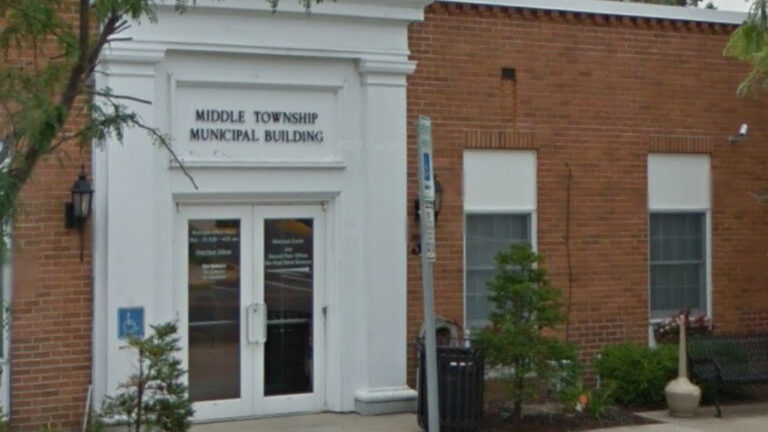
The Middle Township Municipal Building in South Jersey (Google Maps)
From Camden and Cherry Hill to Trenton and the Jersey Shore, what about life in New Jersey do you want WHYY News to cover? Let us know.
In South Jersey, Middle Township has filed an eminent domain condemnation complaint that seeks to acquire 2.4 acres of land in Whitesboro for a large-scale housing development project.
Dawn Robinson, who owns the property, does not want to give it up.
“The land is already paid for,” Robinson said. “If I wanted to sell, I would have had a ‘for sale’ sign on it. I’m not being rude, I don’t want to sell. I want to keep it for my kids.”
What is eminent domain?
Eminent domain gives the government the power to take away someone’s private property. However, the Fifth Amendment states a property may only be taken away if it is for public use and the owner is paid just compensation.
Township records indicate the project will be built by a private, for-profit developer, NVR, Inc, also known as Ryan Homes.
A show-cause hearing on the matter that was scheduled for May 6 was postponed until July 1.
Robinson hopes to convince a judge the housing development plan on the table doesn’t need to include her property.
“I would love to keep my land and develop it myself,” she said. “I bought this land from the township, they didn’t tell me there was an expiration on it.”
Robinson said that nine years ago, an attempt was made to force the acquisition of dozens of parcels of land using eminent domain, but a judge rejected the proposal and redevelopment of the area stalled.
“They could build around me, no problem,” she said.
Kerrin Wolf, an associate law professor at Stockton University, said that if a town uses eminent domain, there needs to be a specific plan in place to redevelop the area in question.
“They use [eminent domain] sometimes to build schools, sometimes to expand roadways, sometimes for public-private partnerships,” Wolf said.
Eminent domain can be used for commercial developments, as long as officials can prove the project is for legitimate public use.
“They have to show that the development will be good for the community in some significant way, you have to have a very specific plan that shows clear public good,” he said.
Related Content

Seaside Park votes to annex South Seaside Park from Berkeley Township
South Seaside Park, home to about 400 residents, had submitted a petition to join Seaside Park last year.
7 months ago
Affordable housing in return
James Maley, a partner at the law firm Maley Givens in Collingswood, said his firm will represent Middle Township in the condemnation proceeding. He said the lots being taken are extremely small and were given to people in the 1930s as part of a newspaper promotion.
“The township has been working for 10 years on assembling lots so that [the property] can be developed,” Maley said. “A development of this nature is critical for the community to provide more opportunities for decent housing. It will also increase the [township’s] ratable base and make the township more affordable for everyone.”
Maley said affordable housing units will be offered as part of the project, and that dozens of lots have already been acquired in preparation for the development to move forward.
Robinson said even if she wanted to sell, part of the legal agreement she has been offered stipulates that if the land ever needs to be remediated, she would be financially responsible for whatever needed to be done, even after the sale was complete.
“If they find anything on it, tomorrow or 20 years from now, I’m responsible for that,” Robinson said. “How can they take something from me and hold me responsible?”
Robinson said she has been offered $47,000 for her 2.4-acre property, which is right next to her current home. However, that is only $7,000 more than what she initially paid for the property 23 years ago.
She said she originally owned two lots, but that the township split one of them in half, so technically, she is now the owner of three parcels of land.
The Whitesboro community has a history of flawed and inconsistent property records and boundary line disputes.

Never miss a moment with the WHYY Listen App!


WHYY is your source for fact-based, in-depth journalism and information. As a nonprofit organization, we rely on financial support from readers like you. Please give today.

A South Jersey woman is not giving up her eminent domain fight with Middle Twp.
Efforts to settle in mediation failed, but Dawn Robinson is garnering new online support to make her case in court.
2 months ago
Listen 0:56
N.J. Gov. Phil Murphy announces expanded transportation options for South Jersey
The initiatives include adding more electric buses in Camden, establishing a shuttle service between Vineland and Atlantic City and more micro-transit in rural areas.
1 year ago
Listen 0:53
NJ Transit buses will return to Philly in June
After being pulled from the Greyhound terminal in April, agency officials said five NJ Transit buses will once again cross the Delaware River.
4 years ago