Some Delmarva Power customers say high utility bills are making them choose between prescriptions and keeping the lights on
Delmarva Power is downplaying its recent request to raise electricity rates, arguing supply price hikes are responsible for customers' higher costs.
Listen 0:56
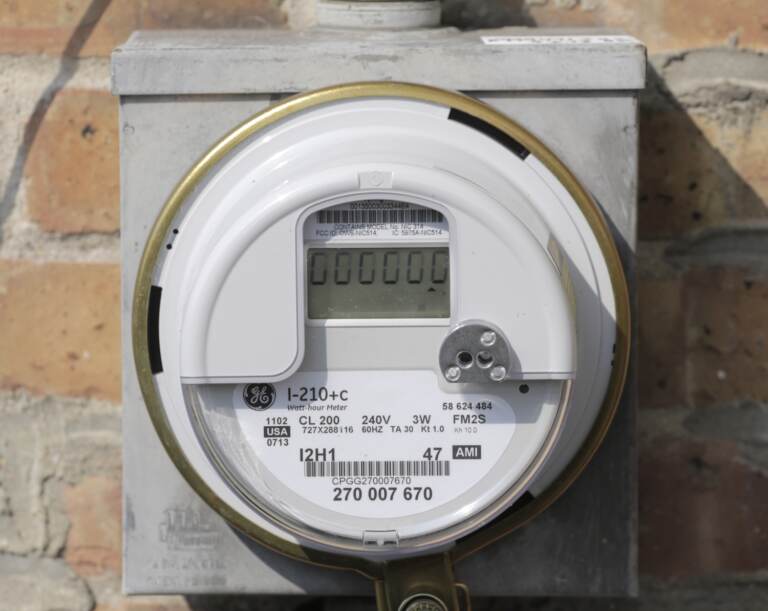
A utility meter is seen in a file photo. (AP Photo/M. Spencer Green)
From Philly and the Pa. suburbs to South Jersey and Delaware, what would you like WHYY News to cover? Let us know!
Delmarva Power customers are expressing their anger on social media over skyrocketing bills, just as they did this time last year.
Some Delaware ratepayers told WHYY News that their most recent bills have doubled or tripled.
Brandon Aufiero said he and his fiance and stepson have taken several measures to reduce their energy usage, but their charges keep rising.
“I’m doing everything that I can to keep my bill as low as I can. We’re turning everything off,” he said. “We’ve stopped using the dishwasher. We don’t do laundry as often. We turn one light on at a time. We have really, really, really cut back.”
Below-freezing weather lasting several days throughout January and February caused an increase in energy usage for many Delmarva customers. So, despite his cost-saving measures, Aufiero and others were frustrated by a spike in their energy bill. Many also expressed anger about sky-high bills early last year during another cold snap.
Delmarva, an investor-owned utility, serves 344,000 residential and nonresidential customers in the state.
While the utility has blamed the increases on the cold weather, the Delaware Public Service Commission has also approved rate increases, which have added to customer bills. Delmarva has another rate request pending.
The company said it has several assistance programs to help people struggling to pay their bills and has recently expanded its customer relief fund.
Here’s what to know.
What are the supply and delivery charges on your utility bill?
Delmarva Power breaks out charges on its gas and electric bills for supply and distribution. The supply charge is for the actual cost of the energy to the customer, and the delivery charge is for the distribution of the energy to one’s home or business.
The supply of energy to Delaware comes from PJM Interconnection, a regional grid serving more than 67 million ratepayers in Pennsylvania, Delaware, New Jersey, Maryland and part or all of 10 other states, as well as Washington, D.C. Supply is a pass-through cost on Delmarva Power bills.
The utility makes its profits through the distribution charges. The Public Service Commission regulates investor-owned utilities and the distribution of natural gas.
Related Content
Philadelphia utility bills surged in 2025, and more increases are coming in 2026. Here’s why
Philadelphians’ electric, gas and water bills all increased in 2025. Together, the typical household is paying around $30 more per month.
2 months ago
Supply and distribution rate hikes increasing energy bills
Supply and distribution increases have added approximately $31 to the average ratepayer’s bill over the past year.
Electricity costs increased by about $10 in 2025 because of what’s called a capacity auction, the process that PJM Interconnection uses to guarantee future electricity supply during the hottest and coldest days of the year.
The Public Service Commission allowed the recovery of natural gas supply costs in November, adding another $11.33 per month, or 13%, to utility bills. It is subject to a final determination by the commission.
On the delivery side, an interim Delmarva gas rate increase took effect last April, raising the average monthly bill by about $8. A recent settlement with the commission added another $2 a month to bills that started in January for a total of $10.
More recently, Delmarva asked the commission in December to approve an overall revenue hike in electric base delivery rates of $67.8 million, a 21% increase, with an actual impact of $44.6 million on bills. The company said it would amount to a 4.13% increase, or about $6.42, on an average residential customer’s bill, taking effect in July, if the commission signs off. The request proposes a new low- to moderate-income rate and to reduce weather-related bill impacts.
Delmarva Region President Marcus Beal said the company asks for rate increases so it can maintain its infrastructure, including poles and wires, substations and transformers. A spokesperson said the December request was recouping dollars spent by the company for infrastructure improvement work that have already been completed.
“We replace older transformers. We have to put up stronger, more resilient poles,” Beal said. “You know, really tangible projects and things that help maintain reliability. Our customers expect reliability.”
A spokesperson for Pepco Holdings, a subsidiary of Delmarva’s parent company Exelon, said supply costs make up 60% of bills on average, with delivery representing the other 40%. However, some ratepayers told WHYY News that the supply and delivery costs were comparable amounts or the delivery cost was sometimes higher.
Related Content
PECO’s profits skyrocket almost 50% after 2025 rate hikes
Critics say investor-owned utilities, which enjoy a monopoly, earn too much at the expense of ratepayers. PECO says the increased rates fund needed infrastructure upgrades.
2 weeks ago
Listen 1:15Delaware elected officials push back on rising prices
Gov. Matt Meyer called out Delmarva for “overcharging Delaware families” in his January State of the State speech. He has also urged the Public Service Commission to reject the utility’s rate requests.
“Rate increases far beyond inflation are unacceptable,” he said. “Delmarva’s out-of-state shareholders should not take advantage of Delaware’s families working to make ends meet. We must hold monopolies accountable.”
Democratic members of the Delaware General Assembly also sent a letter in February to the commission, calling for Delmarva to resubmit its December rate increase request so it falls under a law that took effect in January that gives the commission greater scrutiny over rate increase requests.
The state lawmakers also noted that Delmarva has sought three electric base rate adjustments over the past five years and asked the commission to reject the current rate case so the company would have to resubmit the request.
“We cannot reward Delmarva investors with such high returns on the backs of our constituents,” the letter stated.
Beal said they appreciate the governors in the states that use the PJM grid focusing on the supply costs and the need for more generation, which he said was the true driver of these significant increases for customers. He argued that they work on the delivery side to keep costs down.
“Our company’s been around since 1909,” he said. “Not all of our equipment is that old, but we certainly have some aging equipment. Over 50-year-old transformers that are really at the end of their life, and you want to make sure that you’re replacing this equipment in a planned manner, versus a catastrophic failure of equipment.”
Assistance programs to help low- and moderate-income households
Wilmington resident Alan Shores said he has tried to apply for help as his average monthly bill has gone from around $200 a month to about $500. Shores depends on monthly disability payments and said he’s struggling to afford his prescription medication because of the rising cost.
“I’m tap dancing as fast as I can, trying to pay this stuff, and I just can’t,” he said. “It’s because of this electric bill. Once that electric bill went through the roof, I’m like, ‘What do I do?’”
Beal said they are adding $500,000 to the $6.5 million customer relief fund created last year. Past-due gas and electric customers who have a household income between 60% of the state median income and 350% of the federal poverty level could be eligible for a $500 credit.
The utility also offers payment arrangements and budget billing, and it directs customers to financial assistance offered by charitable organizations.

Get daily updates from WHYY News!
WHYY is your source for fact-based, in-depth journalism and information. As a nonprofit organization, we rely on financial support from readers like you. Please give today.
Part of the series

El programa comenzó en noviembre de 2023. La mayoría de los casos fueron para clientes que estaban por debajo del nivel federal de pobreza.
6 days ago
Delaware legal aid groups request $3.2M to fund low-income eviction prevention program
The program started in November 2023. The majority of the cases were for clients who were below the federal poverty level.
2 weeks ago
Listen 0:53
The Friendship House is a Wilmington community organization that helps homeless residents find stability and resources.
2 months ago
Listen 0:54