

Pa. data centers: How lawmakers are responding, from electricity and water use to tax breaks
Dozens of data centers are planned for the Philly region. Some lawmakers want to put up guardrails, while others want to speed their development.
Listen 1:02
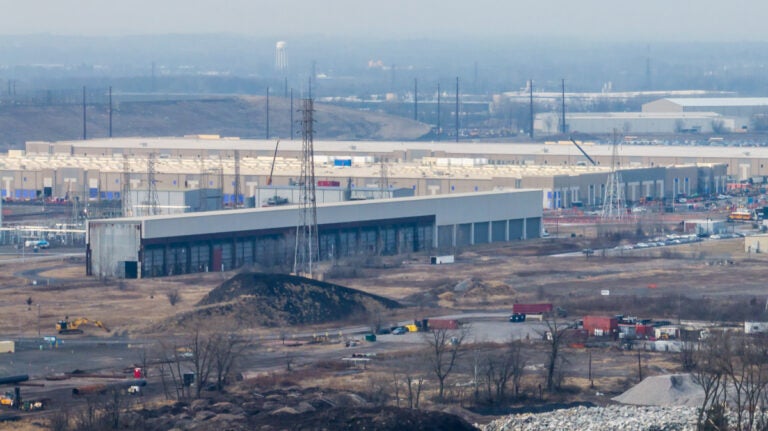
Keystone Trade Center Building 6 (center; purple detail), seen in January 2026, is set to become an Amazon data center at the Keystone Trade Center industrial development in Falls Township, Pa. (Kimberly Paynter/WHYY)
This story is part of the WHYY News Climate Desk, bringing you news and solutions for our changing region.
From the Poconos to the Jersey Shore to the mouth of the Delaware Bay, what do you want to know about climate change? What would you like us to cover? Get in touch.
Thousands of new data centers are under construction or planned across the U.S., with dozens slated for the Philadelphia region.
The rapid growth of these mega computing facilities has left state legislatures scrambling to respond to their development. Electricity consumption from data centers in the U.S is expected to nearly double over the next five years, according to research firm Wood Mackenzie. State lawmakers across the country have introduced a flurry of bills addressing data centers this year, said Nicholas Miller, a policy associate with the National Conference of State Legislatures.
“Data centers are incredibly fast moving and they are definitely high in the minds of many legislators and high in the minds of many people as well,” Miller said. “It does not show any sign of slowing down.”
In Pennsylvania, lawmakers are looking to limit impacts to household electricity bills, track data centers’ water usage and ensure they benefit local economies. Some state lawmakers want to speed up permitting for data centers, while others want to pause the development of hyperscale data centers entirely.
Protecting customers from electricity bill hikes
The growth of data centers, alongside electric vehicles and manufacturing, is driving the largest surge in electricity demand in the U.S. in decades, said Tim Profeta, executive in residence at the Nicholas Institute for Energy, Environment & Sustainability at Duke University.
This could present an opportunity to improve the grid. Or, it could raise costs for households and undermine grid reliability, Profeta said.
State utility regulators, like Pennsylvania’s Public Utility Commission, can create special rate structures that ensure data centers and other large energy users pay their own way. The commission is expected to announce its proposed rules for large load users like data centers this spring. A precedent-setting utility rate case settlement proposed in Pennsylvania last month included provisions to protect residential customers from costs associated with data centers.
“On top of that, a number of state legislatures are creating rules of the road for large loads,” Profeta said.
The Pennsylvania House of Representatives recently passed a bill that would require the state’s Public Utility Commission to develop rules that force data centers to pay for any grid upgrades needed to plug them in, while protecting other ratepayers from those costs. Data centers would need to pay deposits to prevent other ratepayers from being stuck with stranded costs if the data centers aren’t built or shut down early.
The bill would also require data centers to get at least 10% of their electricity from new, clean power sources, starting in 2027, or pay into a fund that would support clean energy and energy efficiency projects. Data centers would need to agree to cut their power use during emergencies or rely on their own backup power.
The House bill, sponsored by Democrat Rep. Robert Matzie, would need to pass the Republican-controlled Senate. A spokesperson for the Senate Republican Caucus said in an email that discussions regarding data centers “continue to progress.”
Senate Majority Leader Joe Pittman said in a statement that data centers offer economic opportunity, but any community impacts must be addressed.
“Energy grid accessibility, reliability, and reining in electricity prices for hardworking families must be at the forefront of Pennsylvania policy discussions,” he said.
Related Content
What you can do about your rising electric bills in Pennsylvania
The National Consumer Law center said that about a quarter of all U.S. households sacrificed food and medicine to pay for their energy bills in 2024.
5 months ago
Listen 6:08What data centers think of Matzie’s bill
The Data Center Coalition is watching bills like Matzie’s closely. The coalition represents companies including Amazon Web Services, Google, Microsoft, Anthropic, CoreWeave and OpenAI.
Dan Diorio, vice president of state policy with the group, said the coalition is open to special utility rates for large electricity users that force these customers to pay for any grid upgrades their operations require while insulating other ratepayers from these costs. But the group opposes bills like Matzie’s that apply specifically to data centers, rather than to all electricity users over a certain size.
“If it’s a transmission line or if it’s a substation, if it’s a generating asset, of course, data centers should pay for that and will pay for that,” Diorio said.
But “no specific end user should be singled out for disparate treatment,” he said.
The coalition also opposes mandating data centers to curtail energy use during times of peak demand or bring their own new, clean power, preferring instead incentives that reward data centers for voluntarily doing so, Diorio said.
“Things like having to take interruptible service … you could see projects move across to a different state line where they didn’t have that requirement, while doing nothing to solve the ultimate shortfall within [the regional grid],” he said.
Pennsylvania lobbying records show the Data Center Coalition spent $19,632 on lobbying at the state level on the topic of “energy, information technology and utilities” during the last three months of 2025.
“Pennsylvania is a very strong, growing and important market for the data center industry,” Diorio said. “We understand concerns, and we want to be an engaged stakeholder to address those concerns, but also keep the state strong for development. And I think we can do that — I think we can find a good middle ground.”
Related Content
It’s the first time a Pennsylvania utility agreed to shield average ratepayers from data center costs. Data centers will pay $11 million for low-income rate relief.
5 months ago
Listen 1:24Tracking and limiting data centers’ water use
Data centers can use massive amounts of water to cool their facilities, which in some places has threatened drinking water supplies.
A bill introduced by Pennsylvania House Democrats would require data centers that use more than 100,000 gallons per day to report their expected water use and wastewater discharge to state environmental regulators. Under the bill, regulators would need to deny permit requests under the state’s Clean Streams Law for projects that would negatively impact nearby water users.
Another bill would require data centers to report their energy and water use to the state, which would publish an annual report with the results, with proprietary information hidden from public disclosure.
Diorio said the Data Center Coalition opposes these reporting mandates, as he said they unfairly target data centers without holding other large water users to the same standards. He said that data centers are making strides in using energy and water more efficiently, and worries that reporting requirements could expose sensitive business information to competitors.
“There’s a lot of backwards math that can be done through energy and water use,” Diorio said.
Related Content

How much water do data centers use? One in Delaware City could use up to 20 million gallons a year
A proposed data center in New Castle County would use tens of millions of gallons of water every year.
6 months ago
Listen 1:03Walking back tax incentives and providing homeowner tax relief
This year, lawmakers across the country are attempting to rein in tax incentives for data centers, Miller said.
“States are both looking at conditions that they can attach to their tax incentives to make sure that local communities are getting a good deal, and they’re considering walking back the tax incentives,” he said. “It’s not a complete repeal, but states are looking for off-ramps from their incentives.”
In Pennsylvania, a tax break enacted in 2022 exempts computer data center equipment from the state sales and use tax for companies that hit certain financial benchmarks. Gov. Josh Shapiro’s administration has estimated the incentive could cost the state around $2 billion in revenue by mid-2031.
A bill introduced by House Democrats would repeal this tax exemption. But the bill’s prime sponsor, Rep. Greg Vitali, has expressed doubts that the bill would make it through the Legislature or that the governor would sign it.
Diorio said the Data Center Coalition is against any rollback of tax credits for the industry.
“Those send a dramatic signal that Pennsylvania is closed for business,” he said. “Those would have a devastating impact, I think, on the economy of the state.”
Another bill introduced by House Republicans would direct any increase in tax revenue to school districts from the construction of new data centers toward reducing homeowner and farm property taxes, rather than increasing revenue for the school district.
Related Content

Politicians, energy providers, Big Tech and climate activists are talking about data centers. Here’s what to know.
6 months ago
Encouraging local noise limits and setback requirements
States often have limited jurisdiction over the basics of where and how data centers are built, Miller said.
“Oftentimes, permitting and land use and zoning is in the domain of local governments,” he said.
So some state legislatures have been turning to model ordinances, Miller said.
A bill introduced by Democrats in the Pennsylvania House would direct the state’s Center for Local Government Services to publish a model ordinance that local governments could adopt that would set height and size limits, minimum setbacks from homes, noise limits and requirements around fencing and screening for data centers. The model ordinance would also require data centers to conduct a water feasibility study and show that their proposed water use and discharges would not negatively affect local water supplies.
Democratic state Sen. Katie Muth indicated in February she planned to propose a three-year moratorium on hyperscale data center development in Pennsylvania, but has not yet introduced that bill.
Related Content

Pa. Gov. Josh Shapiro wants more data centers but they need to bring their own power
Gov. Shapiro said his data center proposal includes greater transparency, community outreach and water conservation.
7 months ago
Listen 1:11Speeding up data center permitting
While Miller said state lawmakers across the country are increasingly looking to pump the brakes on data center development, some lawmakers want to fast-track data center permitting.
Republican senators in Pennsylvania have introduced a proposal to speed up environmental approvals for data centers, requiring the state Department of Environmental Protection to publish a list of preapproved sites for data centers, some located near decommissioned or retiring power plants, and to establish a process that would accelerate permit approvals.
Another Republican bill would create a new office meant to streamline state approvals for certain data center projects and require state environmental regulators to approve permits within 120 days for large data centers that bring their own power.
The Data Center Coalition supports this bill, Diorio said.
“We can address these concerns, but we can also facilitate development in a way that streamlines it, that makes it efficient,” he said. “I think that’s the key approach here.”
Shapiro is in favor of fast-tracking permits, as long as the data centers generate their own electricity and are subject to increased environmental scrutiny.

Get daily updates from WHYY News!
WHYY is your source for fact-based, in-depth journalism and information. As a nonprofit organization, we rely on financial support from readers like you. Please give today.
Part of the series
Pennsylvania Gov. Shapiro signs wide-ranging executive order reining in data center development
While stopping short of issuing a moratorium on new data centers, Shapiro’s executive order accuses developers of “predatory” behavior against local communities.
1 day ago
Listen 1:20
Vineland planning board approves 2nd phase of 300-megawatt data center plan
The plan would make way for the construction of a liquefied natural gas tank and fuel cell units.
2 days ago
Listen 1:13
Upper Merion board denies hyperscale data center campus near King of Prussia
Residents have pushed back against the data center campus, voicing concern about noise, pollution and impacts on property values.
6 days ago