

Avelo ends ICE flights as Delaware lawmakers seek transparency on companies profiting from deportations
Avelo denies it ever had a contract to help deport immigrants. But flight tracker data shows it operated deportation flights.

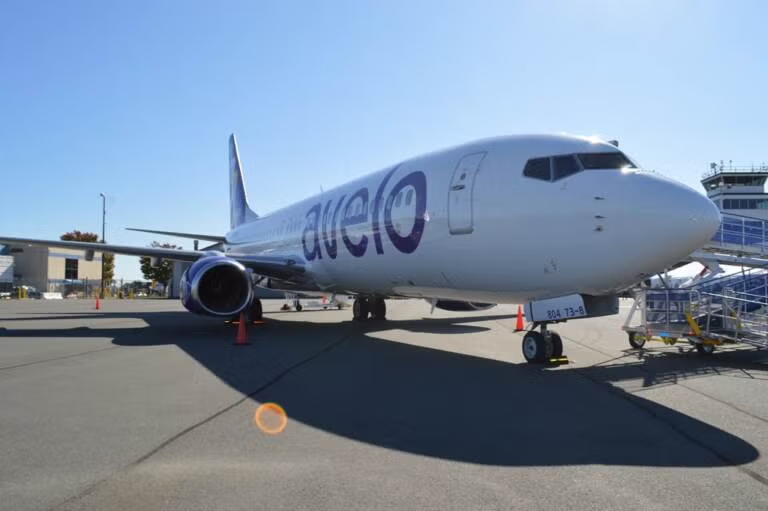
An Avelo Airlines plan at an airport. (Avelo photo)
Avelo Airlines is ending its deportation flights on Jan. 27 after months of harsh criticism and protests. The news comes after Delaware lawmakers recently introduced legislation that would strip state incentives from companies that support the massive nationwide immigration deportation efforts under President Donald Trump’s administration.
Delaware Stop Avelo Coalition has gathered at the Wilmington Airport since May to pressure the budget airline to drop the deportation flights. Activists in other states have also staged protests against the airline’s cooperation with U.S. Immigration and Customs Enforcement efforts across the country.
Avelo Communications Manager Courtney Goff said in a statement the company will end its participation in the nationwide Department of Homeland Security program and close its Arizona hub.
“The program provided short-term benefits, but ultimately did not deliver enough consistent and predictable revenue to overcome its operational complexity and costs,” she said.
Caritas Kerby, co-organizer of the Delaware Stop Avelo Coalition, said she believes the activism across the country led to Avelo’s decision to end its role in the controversial flights.
“I firmly believe that Avelo is folding due to the pressure campaigns all over the country,” she said. “It’s been months and months and months of hard work, late nights, meetings, coordination of a bunch of different organizations, and it’s feeling like a really big win.”
Goff denies that Avelo had a contract with the federal government to provide deportation flights, in spite of the company confirming to several media outlets in April that it agreed to provide ICE with flights to support “deportation efforts.”
“We realize this is a sensitive and complicated topic,” Andrew Levy, Avelo Airlines founder and CEO, said in a statement published by Houston Public Media in April. “After significant deliberations, we determined this charter flying will provide us with the stability to continue expanding our core scheduled passenger service and keep our more than 1,100 crewmembers employed for years to come.”
Goff told WHYY News that Avelo was a subcontractor of CSI Aviation, which is currently the prime contractor for ICE deportation flights. According to the official tracker of federal government spending, CSI Aviation to date has been paid more than $560 million for ICE deportation flights.
Data from Human Rights First, a nonprofit group that tracks ICE flights, shows Avelo did fly deportation flights. The group’s report said the Trump administration conducted at least 11,192 ICE air charter flights from January through the end of November 2025, with Avelo serving about 17% of all November flights.
“We did do government flying, we are not disputing that,” Goff said in an emailed statement.
Related Content
Delaware proposes plan to eliminate carbon emissions by 2050
Delaware environmental regulators are calling for increased access to electric vehicles, and the protection of natural resources.
10 months ago
Listen 1:12Proposed bills target Avelo Airlines’ economic incentives
A pair of Delaware lawmakers filed measures last month to address Avelo’s connection to ICE. The resolution and bill are sponsored by state Sen. Ray Seigfried, D-Talleyville, and Rep. Mara Gorman, D-Newark. Gorman said her constituents have been unhappy that Avelo has been profiting from these deportation flights. While Avelo did not run those flights out of Delaware, it did in other states, with a hub in Mesa, Arizona.
Senate Concurrent Resolution 123 would urge the Delaware River and Bay Authority, which operates the Wilmington Airport, to prohibit agreements or incentives to businesses with ICE contracts that help deport individuals who have not been afforded sufficient due process protections.
Senate Bill 207 would remove a financial incentive for commercial airlines that operate ICE flights that include detainees who lack a valid judicial warrant or have not received required due process rights.
While the Senate bill’s language is broad, it would have potentially impacted Avelo’s jet fuel tax exemption and DRBA marketing incentives.
“We have every right to say how we’re going to provide financial incentives to an organization that’s violating a person’s due process,” Siegfried said.
In a statement, DRBA spokesperson James Salmon said that “while the DRBA understands and acknowledges community concerns regarding Avelo’s activities at other airports, those activities are outside the scope of the DRBA’s authority.”
Related Content

ICE officer kills a Minneapolis driver in a deadly start to Trump’s latest immigration operation
An Immigration and Customs Enforcement officer shot and killed a Minneapolis motorist on Wednesday during the Trump administration's latest immigration crackdown.
10 months ago
DRBA could make deal with second ICE contractor
The proposed legislation could prevent or eliminate incentives on a possible lease agreement between DRBA and Daedalus Aviation Group at the Wilmington Airport.
Last month, DHS paid Virginia-based Daedalus nearly $140 million to buy six Boeing 737s to use in deportation flights. Top company officials also head a separate company that has a nearly $1 billion contract to support “self deportations.” Daedalus did not respond to a request for comment.
Gorman said the bills are needed because Delawareans should know about companies operating inside the state that may be profiting off of the deportation of people without legal documentation who have been denied due process.
“[The resolution] asks DRBA to review the existing contracts, apply greater scrutiny to future agreements involving companies that conduct ICE deportation flights,” Gorman said. “And basically says that if public money is being used, the public deserves transparency and accountability about where those dollars are going.”
Members of the Delaware Stop Avelo Coalition said they’re concerned the DRBA is trying to hide a possible deal with Daedalus Aviation because of its work helping ICE deport people who don’t have the proper documents to be in the country.
The DRBA is a bi-state government agency that owns and operates several transportation hubs across New Jersey and Delaware. It is run by a board of commissioners appointed by each state’s governor and is funded by tolls, user fees, ticket sales and retail transactions.
Rebekah Rodriguez, a member of the coalition, said she supports the lawmakers’ efforts.
“We think the legislation is important to increase transparency, to try to make sure that there’s no private profit off of the illegal deportations of our neighbors, and make sure that our institutions and representatives are being accountable,” she said.
Related Content
Advocates say federal immigration officials have detained many people in Norristown and have ramped up activity in Abington, Perkiomenville and Ambler, among other areas.
11 months ago
Listen 1:05DRBA pulls Daedalus agenda item after public scrutiny, revises agenda
The Delaware River and Bay Authority was expected to consider the Daedalus Aviation lease agreement at its Dec. 16 meeting.
Rodriguez said some activists showed up to the meeting to voice their concerns after seeing the lease agreement item on the agenda. She said the board quickly pulled it once the meeting started.
“Our community members showed up at that meeting and it was local clergy, parents and wage workers in our community,” she said. “When the DRBA saw us there, even though they are a public entity and they are answerable to the people of Delaware, they abruptly just took that resolution off and went into an executive session.”
WHYY News obtained the agenda that lists the lease agreement item from members of the Delaware Stop Avelo Coalition. That agenda is no longer on the economic development agency’s website.
DRBA posted a revised agenda where the resolution number of the lease agreement now discusses employee retirement plans. Salmon did not respond to follow up questions from WHYY News.
Kerby said that while she considers the Avelo decision a win, her group will continue to pressure companies in the state not to do business with ICE.
“We are still going to be fighting in Delaware,” she said. “We have more work to do, but we’re celebrating how powerful we can be together.”
Delaware DOJ says DRBA not subject to state public records laws
It’s unclear if taking down the original agenda and replacing it with one that removes the mention of the lease agreement would violate Delaware open records laws.
That’s because the bi-state agency is not subject to either states’ Freedom of Information laws, according to a 2020 Delaware FOIA legal opinion. DOJ lawyers said the agency adopted its own FOIA policy in 1990. Questions to Salmon about the legality of altering the December agenda went unanswered.
“DRBA contends that it is not subject to unilateral legislation, as relevant caselaw and the language of the compact itself do not permit any additional duties or obligations be undertaken by DRBA without the express authorization of both states,” the DOJ opinion reads.
That legal decision said DRBA could be subject to either of the states’ FOIA laws by passing legislation. If the states chose to do so, the bill must contain a direct statement that they intend to amend the compact under which DRBA was created to make those laws apply.
The next Delaware River and Bay Authority meeting is scheduled for Jan. 21. Delaware lawmakers go back into session next week.

Get daily updates from WHYY News!
WHYY is your source for fact-based, in-depth journalism and information. As a nonprofit organization, we rely on financial support from readers like you. Please give today.
Part of the series

The effort includes multilingual resources outlining what to do if approached by federal agents, including the right to remain silent, refuse searches and ask for a lawyer.
7 months ago
Listen 0:59
“What we wanted to highlight at the State of the Union was that, a year later, things are not better,” said Democratic Sen. Lisa Blunt Rochester.
8 months ago
Delaware launches Office of New Americans to strengthen support for immigrants
Delaware’s newly created Office of New Americans will coordinate resources for immigrants and strengthen statewide support networks.
12 months ago
Listen 1:23