

Mayor Parker vows to help preserve hundreds of subsidized rentals in the West Philly area
The announcement comes more than a year after the owner of Neighborhood Restorations told the city he planned to sell his portfolio of affordable units.
Listen 1:34
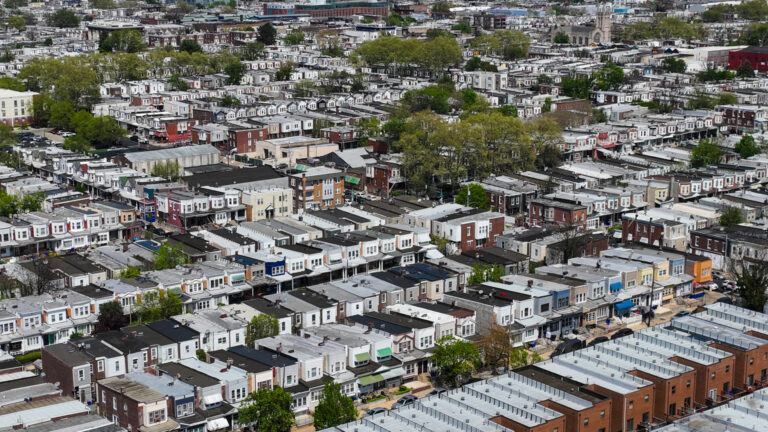
Homes in West Philadelphia. (Kimberly Paynter/WHYY)
Have a question about Philly’s neighborhoods or the systems that shape them? PlanPhilly reporters want to hear from you! Ask us a question or send us a story idea you think we should cover.
Mayor Cherelle Parker says her administration is working on a plan to potentially save nearly 1,000 affordable rentals scattered across West and Southwest Philadelphia.
The announcement, relayed in a formal statement released this week, marks the administration’s first public commitment to playing a role in preserving these units after more than a year of relative silence.
“The city remains committed to doing our part and continuing the work. But preserving these homes will require all of us, including strong intergovernmental support that includes resources from the local, state, and federal government,” Parker said.
The properties belong to Neighborhood Restorations and were built with federal tax credits that have kept them affordable for decades. Those credits are expiring on a rolling basis as the company’s owner, Jim Levin, seeks to sell the portfolio and retire.
Levin has said he would like the city to invest in these properties so they can remain affordable into the future. That sparked a grassroots campaign aimed at getting the Parker administration to commit funding for the proposal.
Roughly 3,000 residents rent from Neighborhood Restorations. Many of those tenants fear they will be displaced if the properties are sold to a market-rate developer and not a buyer, or group of buyers, backed by city dollars.
Until this week, the mayor had said little publicly to reassure tenants. That changed Tuesday with the formal statement, released not long after the start of a related rally with tenants and elected officials in front of City Hall.
“We are glad to hear that the administration is paying attention to the sale of our homes but we urge them to act now before it’s too late,” said the OnePA Neighborhood Restorations Tenant Committee in a statement. “We know that the funds exist and affordable financing plans have been developed. The city has $800 million for affordable housing. If it’s not for this, what? If not now, when?”
City Councilmember Jamie Gauthier, who has spent the last year advocating for Neighborhood Restorations tenants, also applauded the mayor for promising to put city dollars towards saving these units.
“We need everyone to stay at the table until we finish the job. The city has made an initial commitment, and now it’s time for our state government, PHA, and institutional and philanthropic partners to do the same,” Gauthier said in a statement.
Related Content
Why Philly’s public housing costs an average of $315,000 per unit
PHA’s $6.3 billion plan would remake its aging housing portfolio. Its per-unit estimate, which rivals the value of many Philadelphia homes, doesn’t tell the full story.
3 months ago
Listen 1:59Next steps for the administration
Angela Brooks, Philadelphia’s chief housing and urban development officer, said Wednesday that the administration plans to meet with Levin this month as a steering committee finalizes its recommendations regarding a potential sale.
Brooks said the committee, which included members of the administration, has suggested the city spend roughly $36 million over the next five years to help facilitate what will likely be a series of transactions with developers interested in maintaining the affordability of these properties.
The committee has estimated that preserving the entire portfolio may take $280 million, a figure that will require public and private partners working together.
“Hopefully in the next couple of weeks we can work with the owner to come up with something that gives people some level of comfort that the imminent threat of this being sold isn’t there,” Brooks said.
Levin has said he is in “no hurry” to reach a deal, and that if the city doesn’t invest, he would either sit on the properties for some years or sell them on the open market at some point.
For now, the administration is focused on preserving 225 rentals with expired affordability restrictions. The remaining 700 units will lose their restrictions over the next decade, potentially giving the administration more time to arrange deals involving those properties.
In the meantime, the administration is “working through” how to fund a capital needs assessment to definitely determine what it would cost to preserve each of these properties, Brooks said.
The properties date back to the early 1990s and 2000s. Most of the portfolio consists of single-family homes, but it also includes duplexes and triplexes, as well as some small apartment complexes.
“So we can finally have a figure. Everybody’s guessing right now. So nobody knows what that needs to be,” Brooks said.
Subscribe to PlanPhilly
WHYY is your source for fact-based, in-depth journalism and information. As a nonprofit organization, we rely on financial support from readers like you. Please give today.
Brought to you by PlanPhilly
PlanPhilly
In-depth, original reporting on housing, transportation, and development.
Philly’s new crime lab takes shape as City Council approves borrowing $40 million more
The Police Department's $95 million facility in University City will replace what is widely considered an undersized, outdated lab in North Philadelphia.
6 days ago
Listen 0:47
While there’s widespread support for saving the pop art mural, its future remains uncertain due to its condition.
2 weeks ago
Listen 1:09
Philadelphia real estate developers argue a 20-year tax abatement would boost city revenues
Critics contend tax breaks deprive the city and schools of badly needed funds, while proponents say that’s a misconception.
2 weeks ago
Listen 1:23