


Philly preservation history: Rare Keith Haring mural in Point Breeze added to city’s historic register
While there’s widespread support for saving the pop art mural, its future remains uncertain due to its condition.
Listen 1:09
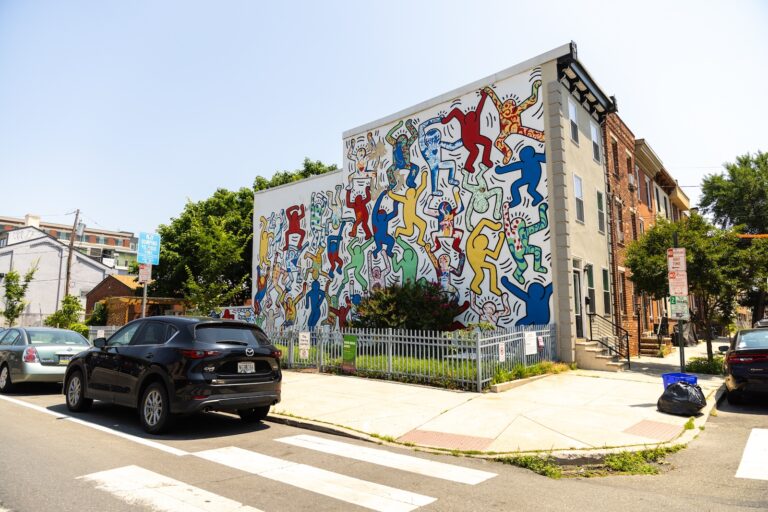
The "We the Youth" mural by artist Keith Haring, installed in 1987, as seen from 22nd and Ellsworth streets in South Philadelphia's Point Breeze neighborhood. (Kimberly Paynter/WHYY)
Have a question about Philly’s neighborhoods or the systems that shape them? PlanPhilly reporters want to hear from you! Ask us a question or send us a story idea you think we should cover.
A rare Keith Haring mural is now part of the Philadelphia Register of Historic Places, marking the first time the city has historically designated an outdoor mural.
The Philadelphia Historical Commission unanimously approved the underlying nomination during its meeting Friday. The vote came after a string of neighbors and experts expressed passionate support for preserving the deteriorating mural in Point Breeze.
“Moving it would not simply mean moving a painting from one location to another, but it would be severing the physical connection between the artwork and the history that gives it meaning. And this is precisely why designating it a historic object matters,” said Jane Golden, founder of Mural Arts Philadelphia, which stewards the artwork.
“We the Youth” was created in 1987 with the help of students from New York and Philadelphia to commemorate the bicentennial of the U.S. Constitution. It covers an exposed party wall at 2147 Ellsworth St. and overlooks a permanent community garden dedicated to the late artist, who was born and raised in Pennsylvania and achieved international acclaim.
The vibrant design, which features a colorful array of Haring’s signature dancing figures, is one of 70 murals Haring completed during his lifetime. Only four of them were outdoor murals and “We the Youth” is the only one that remains in its original location.
Even before Friday’s vote, the mural was something of a neighborhood landmark. Over the years, residents have held baby showers, birthday parties and weddings in the sitting garden below because of their love for the mural. And it routinely draws visitors from across the globe who come to admire Haring’s pop art imagery.
“I have never seen a sense of community from any other object or artwork or entity as I have seen from this mural,” said Tanya Covington, a block captain in Point Breeze.
For that reason, among others, the commission approved the nomination, adding the mural to the register as an “object,” a designation that so far also applies to a select group of fountains, statues and horse troughs.
The list also includes a handful of murals, including the Maxfield Parrish mosaic “Dream Garden” at The Curtis Center near Independence Hall.
Commissioners said Friday that strong public support for the mural was an important part of its decision to designate the artwork.
“What commenters have really brought to the fore … was that, if we do not designate, we have no role in how this property, this mural, is treated. And given the paramount and eminent historical significance that we’ve had ample evidence to, both in the nomination and those who’ve spoken today, it seems to me it would not be fulfilling our role acting in the public interest to not designate this mural,” Commissioner Emily Cooperman said.
Related Content
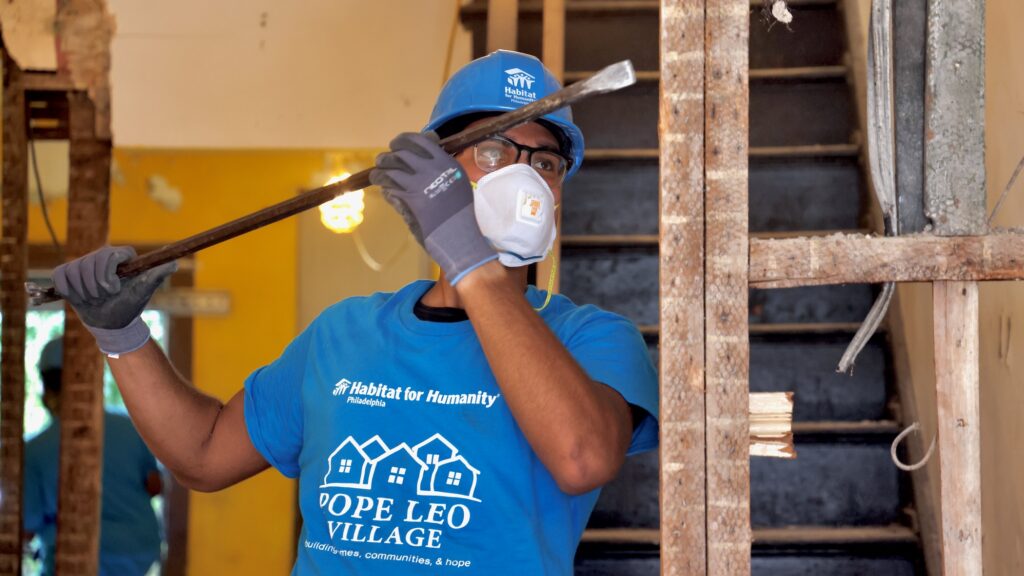
A day spent doing demolition work offers volunteers a firsthand look at Philadelphia’s housing challenges — and how communities respond to them.
2 months ago
Listen 3:08An uncertain future
The mural underwent a major preservation and restoration effort in 2013. Today, experts disagree about whether it can be preserved in place.
While there is widespread support for saving the mural, the owners of 2147 Ellsworth St. say the artwork needs to be stabilized, then removed from the wall so it can be preserved in a climate-controlled environment and ultimately displayed in a museum or another location.
“We are not talking about a wall that is failing. We are talking about a failed wall,” said attorney Sean Whalen.
While the underlying brick wall is in stable condition, the stucco on which the mural was painted is in bad shape, particularly around the bottom of the mural where the artwork has completely separated from the wall, which the city estimates to be more than a century old.
To help drive the point home, developer Ori Feibush, one of the building’s owners, shared a video he recently shot with a scope camera that shows a long gap between the stucco and the brick wall beneath.
“Despite any testimony, it is physically impossible to attach this mural to this wall,” Feibush said.
A site assessment performed with an engineering firm last October found that the stucco was generally in poor condition, with widespread areas of bulging and delamination, and hairline cracks throughout.
The report, carried out by Mural Arts, concluded that the mural would “not survive” if it were to be removed in sections, then reassembled and restored off-site. Engineers determined that preserving the mural in place was a better, if imperfect, solution.
“It would remain an old, irregular, brick wall with a stucco finish that may last longer than the 2013 restoration project but will still require regular upkeep and likely more restoration projects in the future as other areas of older stucco start to fail,” according to the report.

Get daily updates from WHYY News!
WHYY is your source for fact-based, in-depth journalism and information. As a nonprofit organization, we rely on financial support from readers like you. Please give today.
Brought to you by PlanPhilly

PlanPhilly
In-depth, original reporting on housing, transportation, and development.
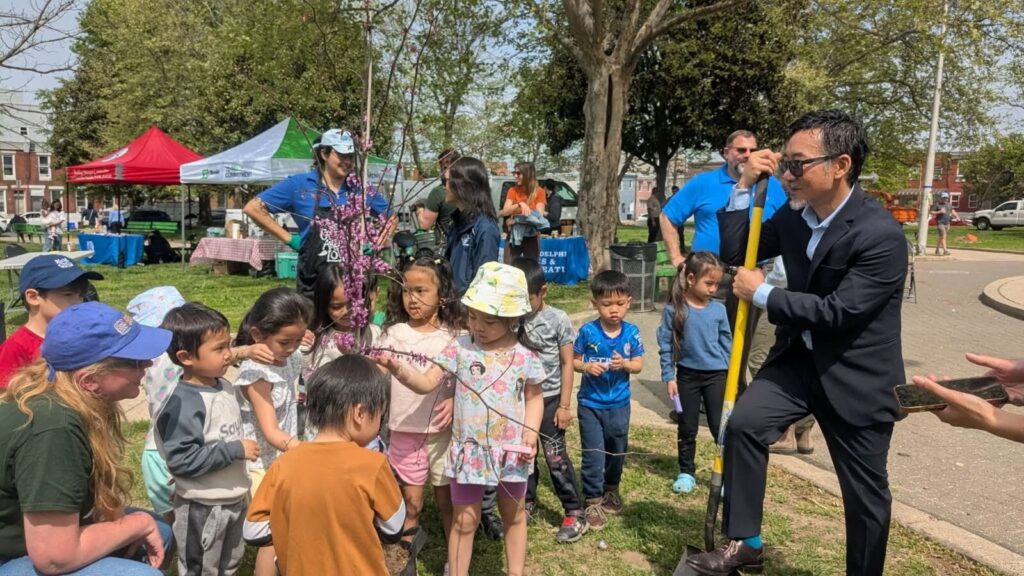
Philadelphia tree advocates report progress on planting, with over 18,000 added in 3 years
The city aims to expand its tree canopy from 20% to 30%. Partners implementing the plan have not yet measured progress toward that goal.
3 days ago
Listen 0:54
“Why is this such a difficult decision to make when the money is there?” asked one Cobbs Creek renter at risk of displacement.
5 days ago
Listen 1:07
Philly Habitat for Humanity project will overhaul blighted East Germantown rentals
The townhomes will become homeownership units after becoming vacant in 2006.
1 week ago
Listen 1:00