
Jovenel Moïse, Haiti’s embattled president, assassinated at his home
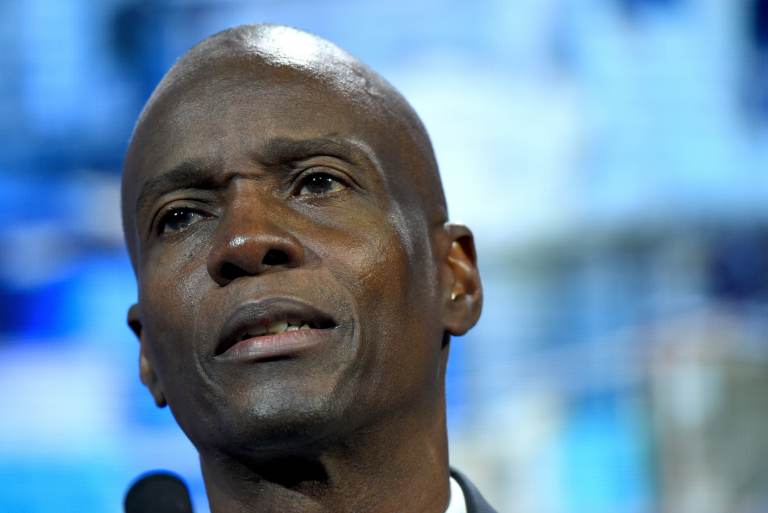
Haitian President Jovenel Moïse, shown here in 2018, was assassinated at his home, the country's acting prime minister said. (Riccardo Savi/Getty Images for Concordia Summit)
Jovenel Moïse, Haiti’s embattled president who thrust the country into deeper political turmoil during his tumultuous one term in office, was assassinated overnight at his private residence, according to the country’s acting prime minister.
Prime Minister Claude Joseph said a group of people attacked the president’s private residence and killed him, calling it an “odious, barbaric” act.
“Every measure is being taken to guarantee the continuity of the state to protect the nation,” Joseph said of the Caribbean country with a history of leaders being overthrown and occasionally killed.
The first lady was wounded by a bullet and is receiving care, he added.
Joseph said without explanation that some of the unknown attackers were speaking Spanish. The primary languages in Haiti are French and Haitian Creole.
Moïse went from ‘Banana Man’ to president
Moïse, 53, came into office in 2017 after a lengthy election process marred by delays and accusations of fraud.
Although he had never held political office before, Moïse was tapped for the post by the country’s previous president, Michel Martelly, who stepped down in 2016 without a successor in place.
Moïse was a wealthy businessman who made his fortune exporting fruit, earning him the moniker of “The Banana Man.”
More recently, Moïse had been under pressure to resign in February at the time his opponents considered the end of his five-year term. He insisted he still had another year as president because he took office late.
Haiti is facing ongoing political turmoil
Moïse, who had seven prime ministers during his brief stint in office, had been ruling by decree for more than a year since the Parliament was disbanded.
The political upheaval in the poorest country in the Western Hemisphere sparked ongoing political protests and an uncontrolled crime wave fueled by gangs. Rival gangs control some important areas of the country, and kidnappings are on the rise as well as food and fuel shortages.
Haiti has also struggled to control its COVID-19 outbreak, which has flooded hospitals with patients and led to an oxygen shortage. The first vaccines arrived in Haiti in mid-June.
On Monday, Moïse announced he was appointing a new prime minister, Dr. Ariel Henry, who was tasked with unifying the government and preparing for elections scheduled for later this year.
What comes next?
The streets of the capital, Port-au-Prince, were largely empty early Wednesday morning, though some people ransacked businesses in one area, The Associated Press reported.
The U.S. closed its embassy in Tabarre and urged people to avoid unnecessary travel “due to an ongoing security situation.”
The international airport was also shut down, according to the AP. Haiti-based Sunrise Airways says “all flights are cancelled and/or delayed” due to the current situation.
The Dominican Republic said it was closing its border with Haiti on the island of Hispaniola, Reuters reported.
President Biden denounced what he called the “horrific assassination” of Moïse. “We condemn this heinous act,” he said in a statement. “We stand ready to assist as we continue to work for a safe and secure Haiti.”
The Organization of American States’ General Secretariat issued a statement calling the assassination a “criminal act” that was an affront to other democratic nations.
“Disagreement and dissent are part of a strong and vigorous system of government. Political assassinations have no place in a democracy,” the statement said.
9(MDAzMzI1ODY3MDEyMzkzOTE3NjIxNDg3MQ001))
Gaza ceasefire deal: roadmap for lasting peace?
What does the ceasefire deal mean for Israelis and Palestinians? What are some of the pitfalls that lie ahead? How are local Jewish and Palestinian community members feeling?
Air Date: October 13, 2025 12:00 pm
Listen 51:09
Shutdown stalemate, ICE protests, Gaza talks, regional budget battles
In today’s politics roundtable, we break down the week’s biggest stories with two columnists from opposite sides of the aisle. We touch on topics near and far.
Air Date: October 6, 2025 12:00 pm
Listen 51:12
Here’s a look at why it is so hard to end the war in Gaza
Israelis have joined mass protests calling for a ceasefire that would bring the hostages back. They say the war continues because Netanyahu is trying to stay in power.
4 months ago