WHYY Civic News Summit focuses on public trust, AI, misinformation and the future of local journalism
Panels explored youth media, community connection, AI risks, misinformation and the future of public media.
Listen 1:19
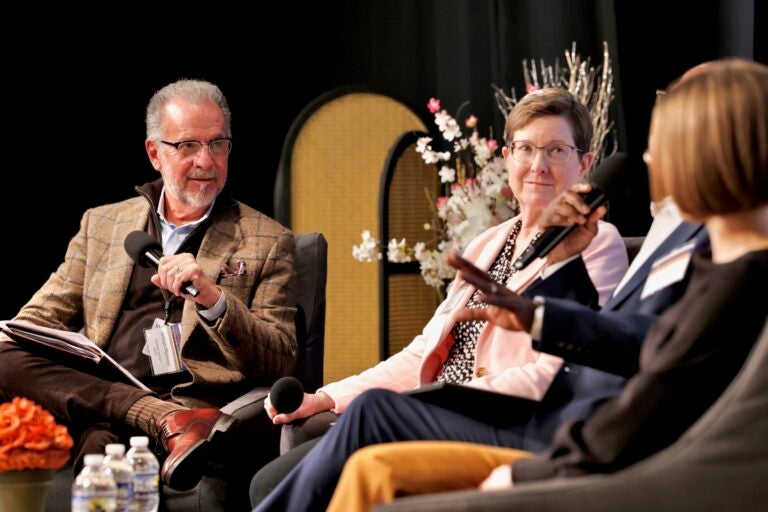
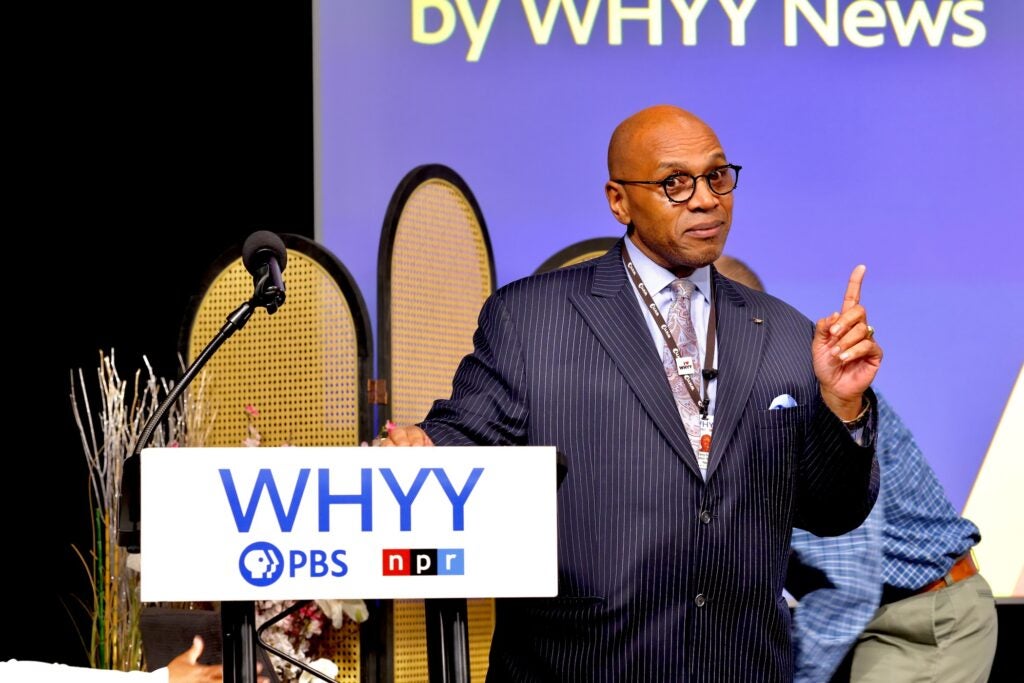
WHYY President and CEO William Marrazzo moderates a panel on the future of public media at WHYY's Civic News Summit. (Emma Lee/WHYY)
From Philly and the Pa. suburbs to South Jersey and Delaware, what would you like WHYY News to cover? Let us know!
WHYY’s Bridging Blocks held the first day of its third annual Civic News Summit Friday, bringing together journalists, students and community leaders. During the event, titled “Trust, Truth and the Future of Local News,” panel discussions examined how news outlets can better engage with the communities they cover and how journalists can face modern challenges presented by artificial intelligence and misinformation.
Empowering the next generation of journalists
WHYY’s director of educational programs, Craig Santoro, led a panel of Philadelphia youth leaders in a discussion about their media experiences.
Ethan Rodriguez helped produce “Run, Hide, Fight: Growing up under the gun,” a PBS documentary about the impact of gun violence on young people.
“So to have an opportunity to talk about the lived experience of Philadelphia and growing up around gun violence was a unique opportunity,” he said.
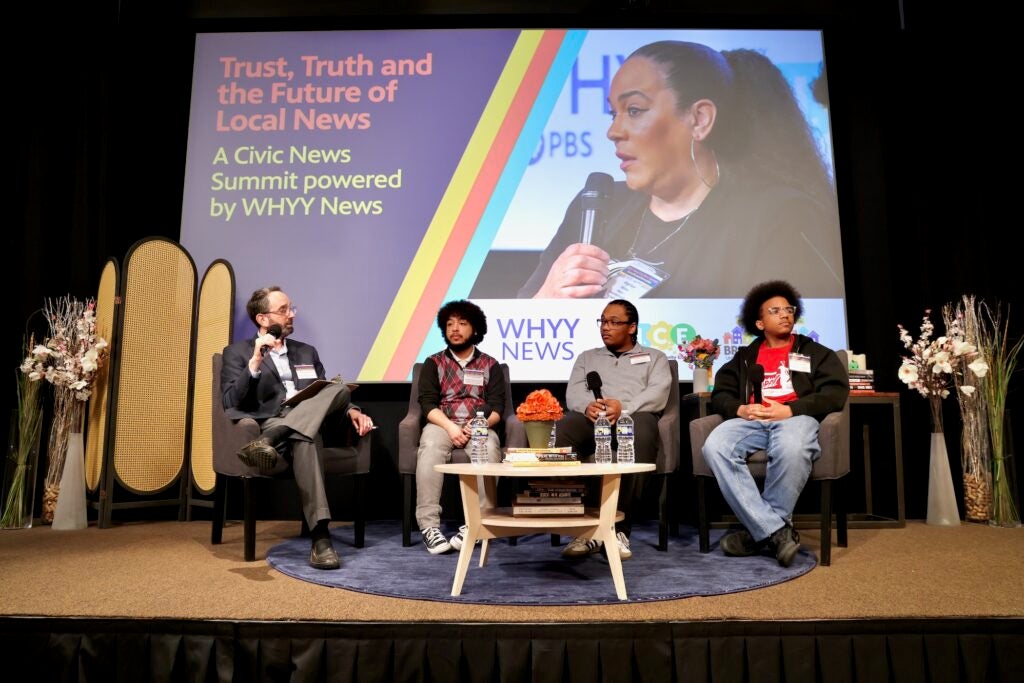
Rodriguez, who was one of 14 student journalists involved in the project, also emphasized the challenges of telling a story so personal.
“It was also vulnerable to talk about my hometown, especially my neighborhood, having to film my home, interview my mom,” he said. “And I love Philly, right? But to just say, Philly’s got some problems, it’s also true.”
Ewdi Rosario talked about his involvement in POPPYN, or Presenting on Perspective on Philly Youth News.
“This is a youth news media organization that strives to … present their perspective on Philadelphia news, which is a perspective that’s often lost in media, in my opinion,” he said.
POPPYN is produced by the University Community Collaborative.
Santoro said that the “Philly youth media scene is really strong” and pointed to the Philadelphia Youth Media Collaborative which includes 25 organizations, including WHYY, as well as WHYY’s own youth media labs and freelance opportunities with the station.
Getting diversity right in media
Another panel focused on how journalists can better represent and serve underrepresented communities, led by Shawn Mooring of the Lenfest Institute. The panelists represented media outlets with primary audiences among Philadelphia’s Latino, LGBTQ+ and Black communities.
Mooring said diversity is more than staffing.
“It isn’t just about who’s in the room, but who is heard, who is trusted and who is truly served,” he said.
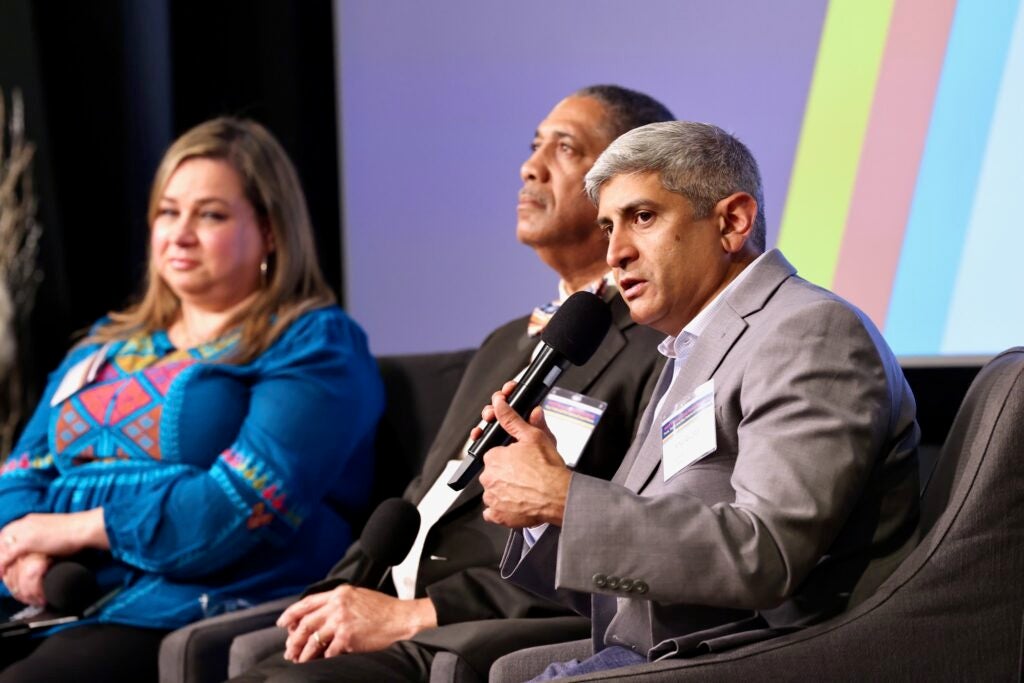
Panelists emphasized that trust starts with being present in communities. Nemesis Mora, of Dos Mundos Media, said reporters do more than “parachute in” for quick interviews.
“We really need to connect with the community, because they are the owners of the story,” she said. “So we usually try to understand better the needs and try to be with the community.”
Gabriela Watson-Burkett, a filmmaker and journalist who leads Inti Media, an independent producer that centers around the experience of people of color, agreed that trust is earned “on the ground” and that outlets have a responsibility to create strategies to get diverse journalists in the door.
“And then, when they’re in your organization, create pathways to success and to evolving their career,” she said. “Invest in your talent, really, truly, and listen to your talent.”
WURD Radio host Solomon Jones added that the real way to measure success is “in how the community is impacted” and not just “how the outlet is affected.”
“Can we bring about change in how people live?” he said. “Can we bring about change in how government serves? Can we bring change about in how people’s economics are lived out in their everyday lives?
Jeremy Rodriguez, editor of Philadelphia Gay News, added that newsrooms have to avoid just checking off boxes. He pointed out that, as a “white-passing, biracial” Hispanic, “I don’t feel comfortable representing the Latino community in that way.”
“I have entered spaces myself where… many people in charge would say, ‘Oh, thank God we have diversity here because we have a Latino on staff,’” he said. “It’s just a matter of just making sure that the person that you’re getting to represent that community fairly represents that community and can actually speak to them. “
Mora said that many mainstream newsrooms don’t have resources such as bilingual journalists to adequately cover the communities she covers. But that actually presents opportunities for partnerships and collaborations with journalists that do, she said.
Related Content
2026 WHYY News Civic News Summit highlights trust, truth and the future of local news
The conference will focus on media integrity and distinguishing truth from misinformation, with panels on public media and community engagement.
1 week ago
Listen 6:37AI: tool or weapon?
Jos Duncan-Asé, founder of Love Now Media, spoke about the potential and the risks of using AI in newsrooms. She encouraged journalists to learn about the technology rather than avoid it and also to be aware of its weaknesses.
“Become AI literate,” she said. “Take a prompting class.”
Duncan-Asé shared an early experience using ChatGPT to help pull quotations from interviews she uploaded for a story.
And ChatGPT gave them quotes.
“They were concise. The quotes painted perfect pictures,” she said. “And when we went to double check those against what the people on the streets had actually said, those quotes didn’t exist.”
Duncan-Asé stressed that AI can be a helpful tool but it can’t replace core elements of journalism and, therefore, human oversight is essential.
“Make sure a human is always leading, not just always in the loop, because the AI will run over you if you allow it,” she said. “Make sure humans are always leading.”
Fighting misinformation and valuing accuracy over speed
WHYY’s “Morning Edition” host, Jennifer Lynn, moderated a panel on how journalists verify the truth in the age of rampant misinformation.
Lynn asked panelists how they build trust with audiences.
Robert Farley, of FactCheck.org, said the outlet links to all of its sources and said transparency is central to credibility.
“Transparency about where we get our funding from. Transparency when we make mistakes and we run corrections,” he said.
FactCheck.org is a nonpartisan nonprofit organization housed at the Annenberg Public Policy Center of the University of Pennsylvania with the mission of debunking misinformation, a falsehood someone shares believing it to be true, and disinformation, a falsehood someone shares knowing it to be untrue, in American politics.
The panelists agreed that old-fashioned journalism methods are still relevant: reporting from “on the ground,” checking with original sources and verifying facts.
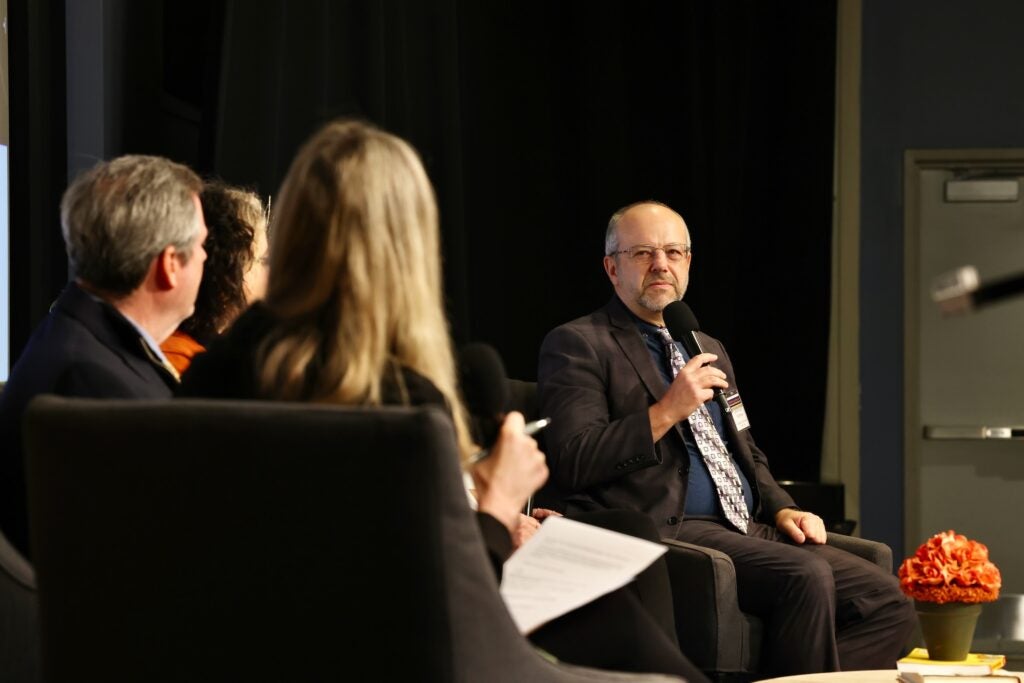
Tara Pixley, director of the master of journalism program at Temple University, added that she advises outlets to move beyond the “breaking news mentality.”
“We need to move thoughtfully, methodically and be accurate,” she said. “Certainly being fast and first has had its relevancy, but now in this plight of misinformation, we need to be really clear. We need to be very accurate. And so we need to focus on moving at that pace.”
Philadelphia Inquirer Deputy Managing Editor Molly Eichel said it’s OK not to be the first to report breaking news.
“I do like to win, but at the same time, winning is giving our audience the most complete, the most contextual and the most factual and accurate story possible,” she said. “So I have spent a lot of time saying, ‘Slow down. It’s okay.’”
Related Content
Federal judge finds Trump violated First Amendment by ordering NPR, PBS defunded
The decision leaves the future of federal funding for public media “unresolved,” WHYY’s CEO said Tuesday, but it’s a positive sign.
1 week ago
Listen 1:15Civic engagement: breaking break, oral history and empathy
Tony Cuffie, who runs WHYY’s Community and Engagement Team, led a panel that highlighted how community organizations and media can work together to strengthen participation and trust.
“Community engagement has never been more important,” he said. “It’s imperative, given the current political environment.”
Leaders from three Philadelphia-based civic organizations joined him to discuss specific initiatives focused on civic and community engagement.
Anuj Gupta, president and CEO of The Welcoming Center, told Cuffie about an “enormous” project called “Breaking Bread, Breaking Barriers.”
“We are bringing together nearly 700 Philadelphians, native and foreign born alike, in seven neighborhoods across Philadelphia,” he said. “They are engaging in conversations about food to understand what they still have in common with one another.”
Dr. Guy A. Sims, of the Free Library of Philadelphia, introduced an oral history project that’s part of the semiquincentennial celebration.
“We will be asking people to stop by branches to answer the question ‘What does it mean to be free?’” he said.
Vanessa Maria Graeber, of Free Press, discussed her roles in advocating for public funding for local news and practicing community-driven civic journalism at the Philadelphia Hall Monitor. She argued that authentic community engagement in journalism cannot be extractive and must be a core, fully resourced part of a newsroom’s strategy.
“You have to have more empathy,” she said. “You have to care about our communities in order to cover us better. And especially when people are vulnerable, you have to be more ethical. What you do with that information and how you’re promoting it and profiting off of it.”
The future of public media
WHYY’s president and CEO, Bill Marrazzo, led a discussion focusing on challenges and opportunities following the recent defunding of the Corporation for Public Broadcasting.
Kathy Merritt, a former executive with CPB, said the system is entering a new phase.
“That scaffolding for public media is now gone,” she said, referring to the loss of federal support.
However, she said, she is “bullish” on public media thriving.
“I don’t know that public media will look five years from now the way it looks today,” she said, “but I think it’ll still be central in many communities. And in fact, in some, even more of a hub of journalism and cultural reporting and connections within communities.”
Bill Johnson, general manager at WRTI, a public station in Philadelphia that airs classical and jazz music, noted that the recent cuts led to some programming changes, including dropping the hourly news and some of NPR’s music programs.
“I think it’s incumbent upon us as leaders of public media stations to ask what’s the best local service,” he said.
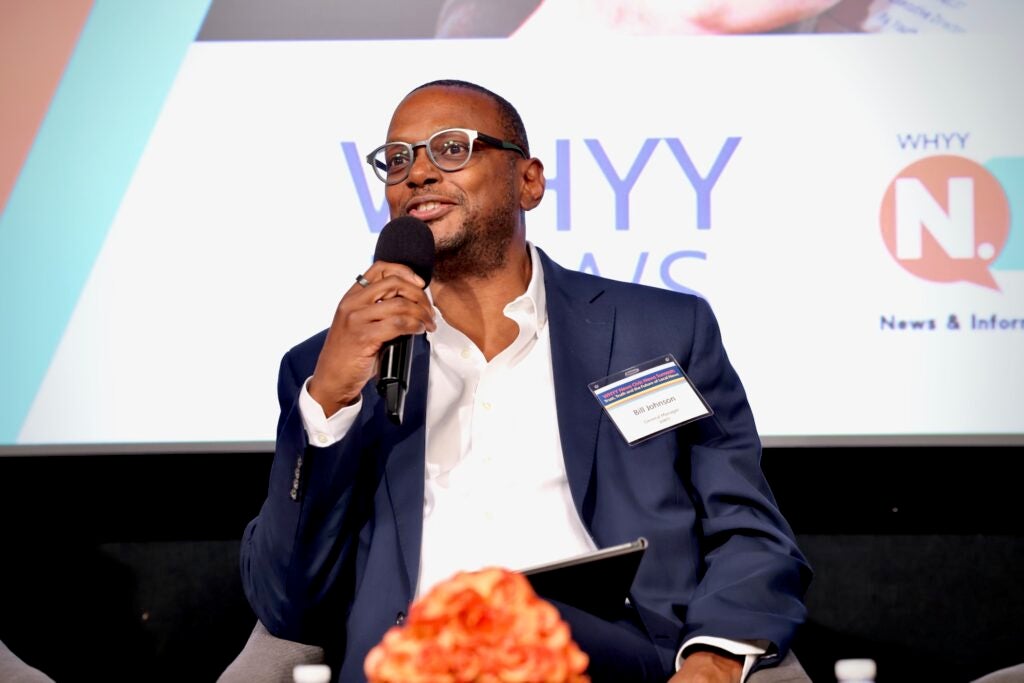
He agreed with Merritt that public media is “stronger than ever” but that the funding challenges will reshape interactions with the audience.
“The absence of federal money is forcing us to lean into our communities in ways that we arguably should have been doing a long time ago,” he said. “And now we’re really leaning into that space and we’re saying, ‘What is the [return on investment] for the money that is coming from our community and is it maximizing public service?’”
Allie Vanyur, of the Public Media Bridge Fund, described efforts to stabilize and reshape the system after funding cuts, which is the focus of her organization. Vanyur said she expects to see public media stations consolidate their resources in order to survive.
“The path to a sustainable future for public media [lies] in operational collaborations, diversifying revenue sources and strengthening business practices like donor retention,” she said.

Get daily updates from WHYY News!
WHYY is your source for fact-based, in-depth journalism and information. As a nonprofit organization, we rely on financial support from readers like you. Please give today.
4 key takeaways from the WHYY Civic News Summit
Journalism and community engagement have the power to bridge divides and generate meaningful conversations, panelists said.
5 days ago
Listen 1:06
During a legislative hearing, the head of the N.J. Chamber of Commerce said corporate support could help save public TV in the Garden State.
5 months ago
Listen 1:09
Penn State to wind down WPSU after board of trustees declines transfer to WHYY
In voting down a proposal to transfer the station to WHYY, trustees expressed concern over a $17 million subsidy and wanted a commitment to hire staff.
7 months ago
Listen 1:27