
FBI joins criminal probe into nonprofit led by ex-Delaware House speaker as report reveals duplicate invoices for $864K in grants
Federal agents descended on Legislative Hall and the state finance office with subpoenas for records about Police Athletic League grants.
Listen 2:23
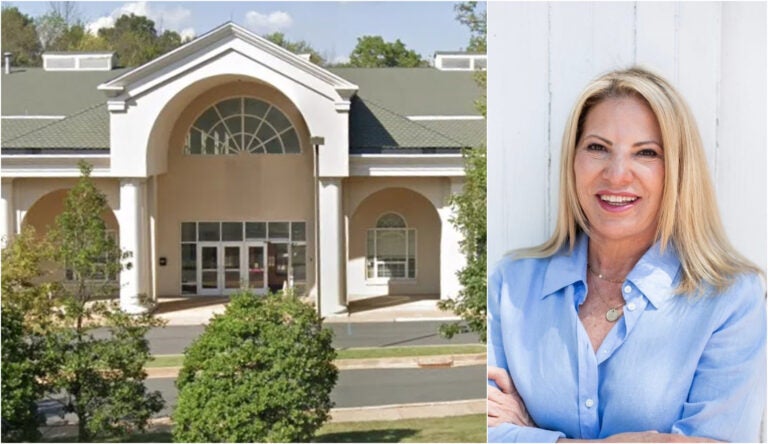
The FBI and state prosecutors are investigating how the Police Athletic League of Delaware spent millions of dollars in grants at its Hockessin facility while headed by former House speaker Valerie Longhurst. (Courtesy of PAL of Delaware/Valerie Longhurst)
What are journalists missing from the state of Delaware? What would you most like WHYY News to cover? Let us know.
A year ago, the Police Athletic League of Delaware appeared to be in great shape.
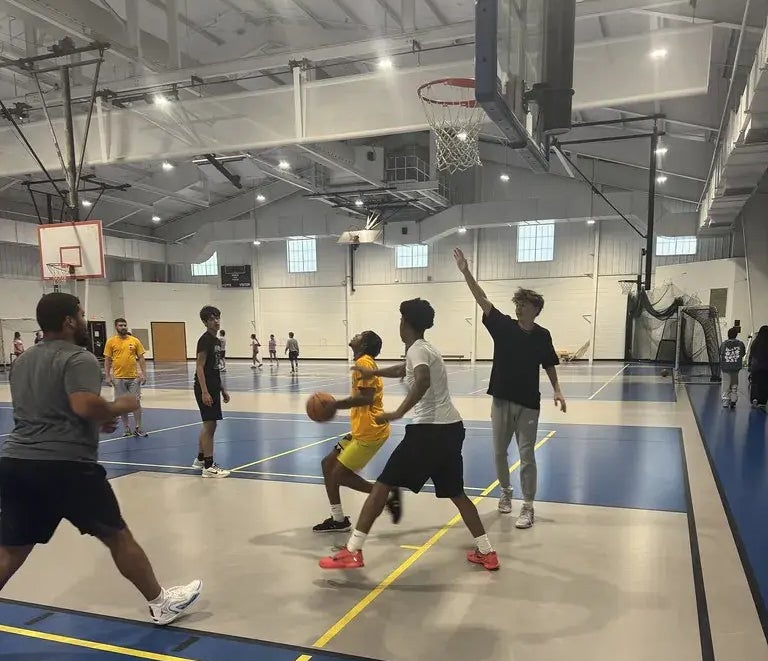
The gymnasiums with multiple basketball courts at its Hockessin and Garfield Park facilities finally had air conditioning. Other major renovations, including electrical and roofing work, had been completed.
The agency known as PAL, which is sponsored and supported by New Castle County police, paid for the upgrades with millions of dollars in state and federal grants that were awarded during Executive Director Valerie Longhurst’s tenure as majority leader and later speaker of the Delaware House of Representatives.
Serious financial and operations problems, however, had been brewing for months at the nonprofit that provides free educational, athletic and mentorship programs to help kids thrive and stay out of trouble.
Now state and federal law enforcement authorities are investigating how PAL obtained and spent state and federal grants, sources familiar with the criminal probe told WHYY News.
The fraud and public trust divisions within the Delaware Attorney General’s Office have been looking into PAL’s finances since last fall and have sought the assistance of federal law enforcement, sources said. The probe heated up in recent weeks when FBI agents descended on Legislative Hall and the state Department of Finance with subpoenas for documents relating to the federal and state grants to PAL, sources said.
The investigation was triggered by a cascade of troubling news that has poured out of PAL since last June, WHYY News has learned.
That’s when PAL board members, who had only met sporadically in recent years, first became concerned. Then-board chair Brian Moore said Longhurst had told them a cash crunch might force the cancellation of summer camp for about 100 kids at Garfield Park. Funding was reallocated so the camp could be held, but that facility was shuttered briefly and some PAL staff were laid off.
Then in July, state lawmakers froze $500,000 in new grants, awarded just days earlier, amid concerns about information PAL had provided, said state Rep. Kim Williams, co-chair of the legislative Joint Finance Committee.
The $500,000 was finally released later in 2025. But the financing freeze and revenue shortfall it caused alarmed PAL board members, and by August, several members forced Longhurst to step down, according to sources within PAL.
By October, the Attorney General’s Office had begun a criminal investigation into PAL’s finances, said New Castle County Police Chief Jamie Leonard, who has been interim board president since days after Longhurst departed. And now the FBI is involved.
Attorney General Kathy Jennings and Delaware U.S. Attorney Benjamin Wallace would not comment on the investigation.
The PAL of Delaware is not affiliated with the Police Athletic League of Wilmington or the Police Athletic League of Dover.
PAL ‘reported the same expenses on two different awards’
State documents obtained by WHYY News through state Freedom of Information Act requests and interviews with board members and others knowledgeable about problems at PAL shed light on why the organization’s finances now have the attention of law enforcement.
This is what the records revealed:
- State finance officials demanded in February that PAL repay $863,992 in “duplicated and unallowable costs” from installing air conditioning and upgrading electrical systems at the Hockessin facility. The “recoupment” demand cited a compliance audit of how PAL spent a $1.8 million federal American Rescue Plan Act grant.
- That review by accounting firm BDO found that “PAL reported the same expenses on two different awards” by providing “duplicate invoice submissions” for both the ARPA grant and separate state grants.
- Besides the federal ARPA grant, state records show that PAL also received $3.8 million in state Community Reinvestment Funds for air conditioning and other renovations while Longhurst, a Democrat from the Bear area near Newark, was House majority leader and then House speaker.
- The BDO report said the $863,992 “had been previously reimbursed” by the state grants. The report “identified six invoices” that were used twice: four, totaling $714,283, from Brandywine Contractors for electrical, roofing and security work; and two, totaling $149,709, from Summit Mechanical, which put in the air conditioning system.
- Leonard told County Council’s Public Safety Committee last month that, in reality, PAL had used the $863,992 of the ARPA grant for the construction projects for “daily expenses.”
- PAL never conducted a required “single audit” of how the ARPA money was spent, the BDO report said.
The issues discovered in the state’s review occurred while PAL was experiencing “a notable change in senior leadership,” according to BDO’s compliance report, issued in October.
Not only did Longhurst leave in August, the BDO report said that PAL’s deputy director also had “been released” from her post in January 2025. In addition, the agency’s longtime bookkeeper, Angela Weicht, severed ties with PAL that February.
Longhurst’s annual salary in 2025 was $98,280, according to records PAL submitted to the state last year, and she also drove a Jeep owned by the agency.
But WHYY News has also learned that after Longhurst submitted her resignation and while PAL was in financial distress, she awarded herself a $30,000 severance payout for vacation time she had not used during her 7 1⁄2 years running the agency.
Moore said he and other members should have been notified in advance about the $30,000 payment, but they didn’t learn about it until after Longhurst departed.
“I did object to it,” Moore said, adding that the board later instituted policy changes to prevent that from happening in the future.
Longhurst denies wrongdoing, says bookkeeper handled grants
Longhurst told WHYY News she did nothing wrong while leading PAL and said she had not been contacted by state or federal investigators. She did not respond to questions about the $30,000 severance payment.
Longhurst insisted she left accounting matters in the hands of Weicht, who she said left PAL “by mutual agreement.”
“I was not responsible for writing grants. I was not responsible for reporting grants,” Longhurst said. “That wasn’t what I was asked to do when I got hired, because I had a bookkeeper who did all that.”
After Weicht left, Longhurst said, she hired an accounting firm to oversee finances. “We started diving into some of the information, and we found some opportunities of improvement for this for the PAL,” she said. “There was a lot of procedural issues within the PAL that needed to be fixed.”
Though sources told WHYY News that board member Sam Waltz contacted Longhurst in August and said a group of fellow members wanted her resignation as soon as possible, Longhurst said she resigned of her own volition.
“I left for multiple reasons, losing the election and just wanting to do something different with my life,” Longhurst said, adding that she’s now “doing something different that I don’t share with anybody.”
Longhurst said she suspects the failure to do a “single audit” for the ARPA grant likely “triggered the whole thing,” as she described the investigation by state and federal prosecutors.
Longhurst said she also realizes that many politicos and bureaucrats now suspect she engaged in wrongdoing while running PAL, leading the state House of Representatives and receiving millions of dollars in state and federal grants.
“It’s easy to target somebody who’s already a public figure or was a public figure,” she said. “People need something to say. People need something to talk about. There’s a lot of holes in the story, and I think a lot of people are filling in blanks that shouldn’t be filled in.”
Nevertheless, Longhurst said, independent reviews are warranted and appropriate.
“It’s important,” she said. “When you get taxpayer dollars from the federal or state, it should be open to scrutiny. Definitely. Everybody should be.”
Ex-bookkeeper Weicht says she did everything properly
Weicht told WHYY News she was PAL’s contract bookkeeper for about 13 years, working remotely, and has lived in Florida for about a decade.
Weicht said she didn’t have autonomy over how to spend money but took Longhurst’s direction in applying for the grants and handling required paperwork.
Weicht said she was unaware of the BDO report before WHYY News told her about it this week but insisted she reported the grants properly and did everything by the book.
Asked about the $863,922 in invoices that BDO said was used for both grants, Weicht suggested that one way it could have occurred is if both grants paid a portion — not the full amount — of each invoice.
“If there could have been any overlap in receipts, it could have been that a partial payment that wasn’t covered by one grant was turned in for another grant,” Weicht said. “But it wouldn’t have been that we paid this contractor $500,000 on this grant and I used that same $500,000 receipt for another grant. Absolutely not.”
Weicht stressed that no one from the state, BDO or the FBI has contacted her, but said she would be willing to speak with them about how she accounted for the state and federal grants.
Weicht said no money from the grants was used for operational expenses while she worked for PAL.
Weicht said she ended her contract with PAL after 13 years because it was too time-consuming and “really was no longer a good professional fit for me.”
PAL was in decent financial shape when she left, Weicht said, adding that it’s “unfortunate” that the agency’s spending is now under scrutiny by law enforcement.
“I am not aware of why all of this is happening,” Weicht said. “I can’t speak to what happened after I left there, but clearly something has occurred that is causing an investigation.”
Grants provided air conditioning, other renovations
PAL, which was founded in 1984 by county police leaders, hired Longhurst as executive director in 2018. The longtime state lawmaker had served on the volunteer board for five years, and at the time was House majority leader.
Government transparency advocates criticized her hiring as a potential conflict of interest because PAL received about $200,000 a year in state taxpayer Grant-in-Aid money allocated by legislators, including herself, but Longhurst dismissed such concerns.
“I don’t know if it’s a conflict of interest compared to anybody else that gets money through Grant-in-Aid and votes on bills,” Longhurst told the Delaware State News at the time.
Longhurst also said then that she would not use her new position to advocate for PAL in the legislature.
Longhurst told WHYY News this month that raising money was a key reason she was hired. Regardless of whether she used her clout to get public grants, under her leadership PAL didn’t hesitate to seek taxpayer money from her fellow lawmakers and then-Gov. John Carney to install air conditioning in the gyms and make other renovations to the Hockessin and Garfield Park facilities.
“It kind of hurt my bottom line of doing rentals to help sustain the PAL because we would rent those facilities out, we also have programs there,” Longhurst said. “But in the summertime [rentals] would go down because it was like 102 degrees in the gym. It was brutal for those kids. It was just bad.”
So PAL sought money from not only from Grant-in-Aid, which has provided about $200,000 annually to the nonprofit, but from two other lucrative pots of taxpayer money.
One is the Delaware Community Reinvestment Fund, which allocates tens of millions of dollars annually to nonprofits and local governments for “community redevelopment, revitalization and investment capital projects,” according to the fund’s website.
Awardees are chosen by the co-chairs of the legislative Joint Committee on Capital Improvement after reviewing applications. The entire General Assembly votes for the total amount awarded, but not individual recipients.
The committee’s co-chairs, Rep. Deborah Heffernan and Sens. Nicole Poore and Jack Walsh, have awarded PAL of Delaware a total of $3.8 million since June 2022, state records showed.
Poore also runs the Jobs for Delaware Graduates nonprofit that has received $34.2 million in Delaware taxpayer dollars allocated by fellow lawmakers since 2017, a WHYY News review recently found.
Heffernan and Poore allocated $1.5 million in June 2022 for PAL’s “gym air conditioning project to support public health” at the two facilities, state records show.
“The problem we face with the lack of air conditioning in the gym is the health risk it causes 40 percent of the year,” PAL wrote in its grant request. “When the temperatures are high, the gym is unusable. Seniors run the risk of heat stroke and cannot use this space during the late spring, all summer, and the beginning of the fall.”
Heffernan and Walsh provided PAL with another $2 million in June 2023 for unspecified “renovations” after PAL’s request said gym lighting “is not in line with the energy efficient LED fixtures available today,” that “our roof is in need of major repairs to resolve leakages” and “flooring and bathrooms are in need of updating to resolve safety concerns.”
Related Content
“Anonymous tips” led ICE investigators to seek wage records for 15 businesses, the attorney general said. She suspects more subpoenas are coming.
3 months ago
Listen 0:55The Community Reinvestment Fund allocation passed that year on the same day House members promoted Longhurst from majority leader to speaker.
In June 2025, Heffernan and Walsh awarded PAL another $300,000 for “rooftop solar array and environmental controls,” records showed.
PAL’s request said the solar panels “will help us continue our efforts in reducing utility costs” and carbon dioxide reductions.
Heffernan, Poore and Walsh would not speak with WHYY News about the grants to PAL while then-powerful lawmaker Longhurst headed the agency.
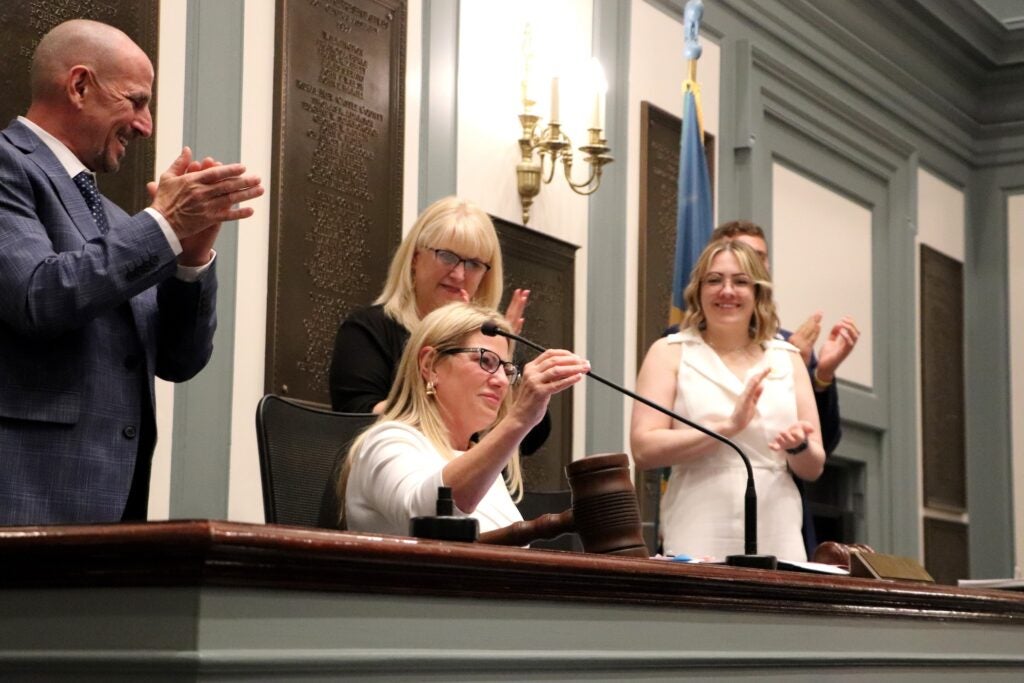
PAL wins $1.8 million in federal pandemic relief funds
PAL also sought money from the $1.75 billion in ARPA money that Delaware received during the COVID-19 pandemic. While most was used to shore up the state’s fiscal stability and help schools operate, $112.8 million was for capital projects like the ones at PAL.
The goal, the U.S. Treasury Department said in 2021, was to “change the course of the pandemic and deliver immediate and direct relief to families and workers impacted by the COVID-19 crisis through no fault of their own.”
Unlike the state grant request that sought money for air conditioning and other renovations to both facilities, PAL sought the ARPA money solely for upgrades to the Hockessin facility, records showed.
“The problem we face is that our building is 25 years old and is in a state of disrepair. We are in the process of installing air conditioning in the gym, which has raised concerns over the lack of energy efficiency,” PAL wrote in its application, using similar language to its successful requests for state Community Reinvestment Fund grants.
Upgrading the gym lighting, PAL claimed, would put “a strain on our organization’s financial resources … not to mention the strain this causes on the power grid.”
The application also said “our roof is in need of major repairs to resolve leakages.” Money was also sought to resolve “safety concerns” with flooring and bathrooms.
Longhurst said she had asked Carney to award pandemic relief dollars to PAL, and the then-Democratic governor t was supportive but non-committal. In September 2023, though, the Carney administration awarded PAL a $1.8 million ARPA grant for air conditioning, roofing and electrical work at the Hockessin facility.
Carney, now mayor of Wilmington, would not comment on the grant award and the controversy over how PAL spent the money.
Weicht signed the award agreement for PAL. The document contained a provision that said she and PAL certified “that the funds received for this agreement were not already paid for through other sources such as government contracts and grants, donations, or insurance proceeds.”
Even though Longhurst told WHYY News she didn’t handle reporting of grants, after the work was completed, in May 2025 she signed a “certification form” for the ARPA grant.
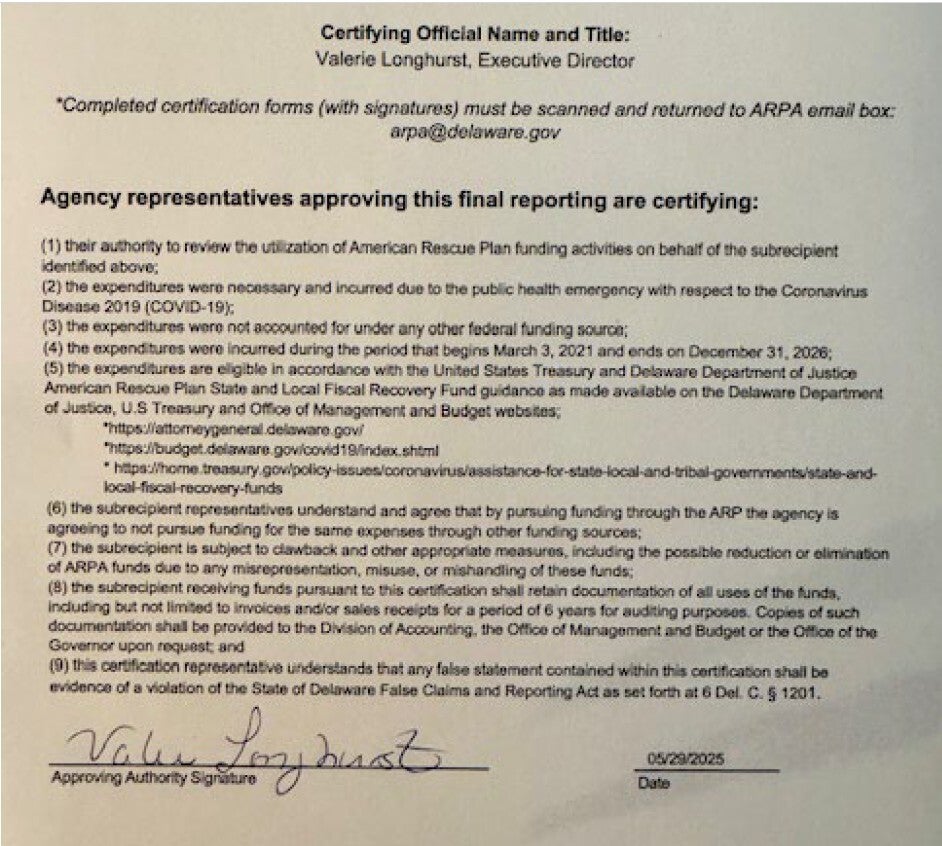
In that document, Longhurst agreed that PAL would “not pursue funding for the same expenses through any other funding source.”
The document Longhurst signed also said she “understands that any false statement contained within this certification shall be evidence of a violation” of the state’s False Claims Act.
Under the law, anyone convicted in Superior Court of violating the civil statute is subject to a penalty of three times the damages “the government sustains,” and a fine of at least $10,957.
Longhurst did not respond to questions from WHYY News about the “duplicate” invoices cited in the compliance report, or the certification form she signed.
‘Made the appropriate referrals to law enforcement’
The state’s independent compliance review found serious problems with how PAL handled the ARPA award, however.
PAL never audited the expenses and also didn’t seek approval for cost overruns of $281,000, BDO’s report concluded.
Perhaps most importantly, the report found that the “Hockessin PAL reported the same expenses on two different awards, resulting in a duplication of costs and noncompliance with federal grant requirements.”
That report was issued in October 2025, about the time Leonard told New Castle County Council members that Jenning’s office was investigating.
Leonard did not speak with WHYY News for this story, but in late May, the interim board chief told council members that PAL has “nowhere near that amount of money in cash assets” to repay the state for grant money used to pay operational costs.
He said PAL was pursuing several options, including getting a loan or having a lien put on its facilities.
Leonard said that federal and state officials “would look to the party responsible for the mismanagement at the time to recoup those funds” if those options were unsuccessful.
When one council member asked Leonard whether Longhurst “had any liability,” the chief said, “That remains to be seen. … We’ve made the appropriate referrals to law enforcement agencies.”
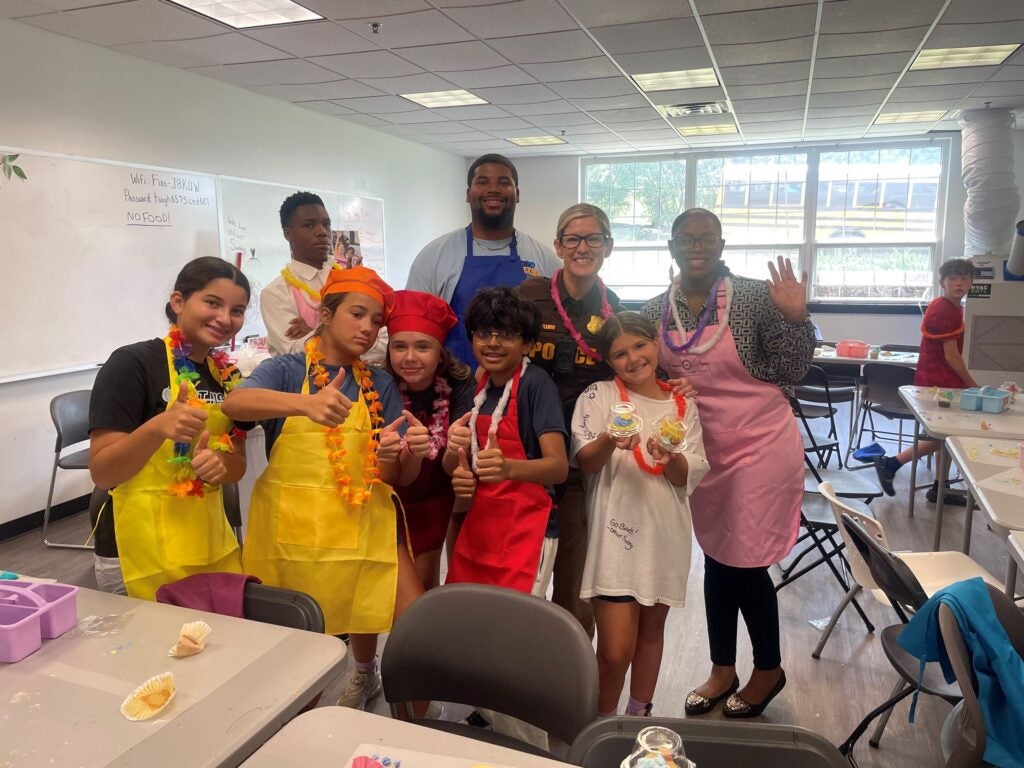
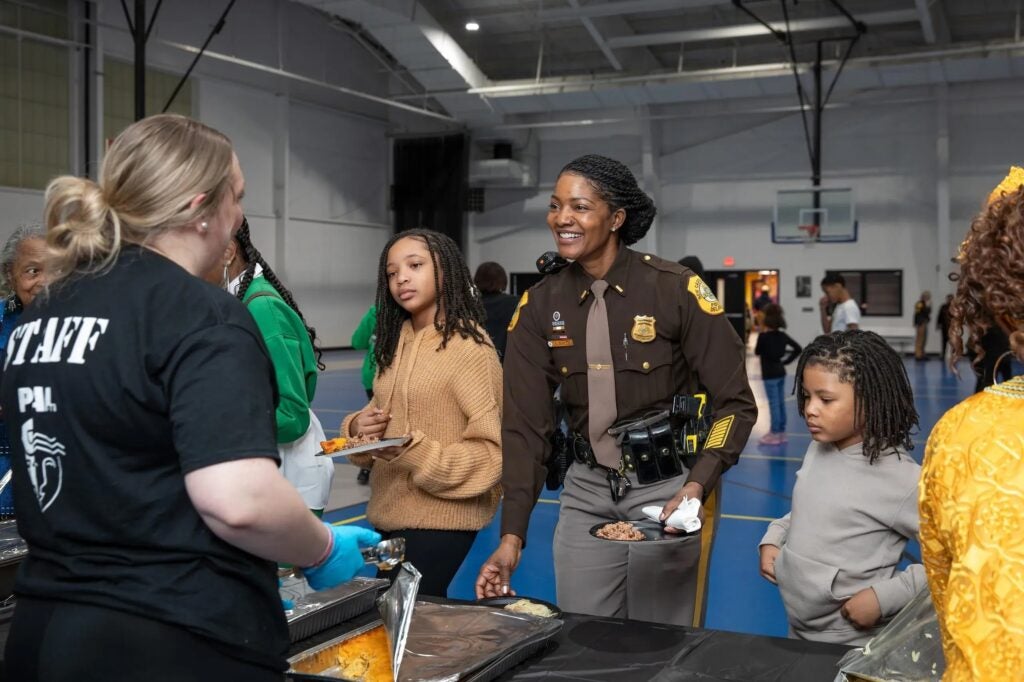
Despite the turmoil and the steep financial liability, Leonard said PAL is open and offers a wide array of programs.
“The kids are being serviced at record levels,” he added.
‘We were told everything was well in hand’
Former board chair Moore, who remains a member, said he and others were blindsided last June when the troubles surfaced. Until then, the picture looked rosy, he said.
“You rely on your staff to let you know what’s going on,” Moore said. “When I got financial reports from the staff, everything looked good. I never saw any signs or any indications that there was a problem.”
Moore said Weicht provided monthly balance sheets and other financial information and that Longhurst gave a report “that told us what the staffing levels were, what the program levels were, where everything was going.”
He said it came as a “huge shock” to learn that finances were in disarray, and said he accepts responsibility for not being more active in overseeing the agency.
“When you’re the chair and something happens on your watch, you’re going to try and second guess and try and figure out what you missed or what you should have seen,” Moore said. “It hurts, obviously.”
Waltz would not discuss his call to Longhurst to step down, but said he’s dismayed by what has transpired.
“It’s regrettable that PAL apparently got off track over the last two or three years, particularly with regard to staff leadership and the relationship between staff and board,” Waltz said.
State Insurance Commissioner Trinidad Navarro, a former New Castle County police officer, is a longtime board member who echoed Moore in saying he was stunned to learn PAL’s fiscal house was in disarray.
“I’m disappointed,” Navarro said. “We weren’t aware of any financial challenges until recently. We were told everything was well in hand, meaning that the finances were in order, we have more reserves than ever. There was no hint of any problems.”
Navarro said it appears Longhurst and Weicht “are pointing fingers at each other” now that authorities are seeking answers.
“We as a board will continue to cooperate,” Navarro said. “We have nothing to hide, and we’ll see how the investigations go.”

Get daily updates from WHYY News!
WHYY is your source for fact-based, in-depth journalism and information. As a nonprofit organization, we rely on financial support from readers like you. Please give today.
‘Deeply troubling’: Delaware lawmakers investigate colleague for abuse allegations
The woman accusing him said in court filings that Rep. Josué Ortega told her no one would believe her over a state representative.
2 months ago
Listen 0:45
High-profile Delaware murder case against Jill Biden’s ex-husband shrouded in secrecy
Bill Stevenson and the future first lady divorced a half-century ago. Now he’s held on $2 million cash bail, accused of killing his wife of nearly 40 years.
6 months ago
Delaware lawmaker removed from budget writing committee after DUI conviction
State Rep. Kevin Hensley accepted a plea deal last week for his DUI arrest last November. It’s his second alcohol-related offense.
1 year ago
Listen 1:02